Designation: PET1655
Name in English: Gold Conure/ Queen of Bavaria's Conure
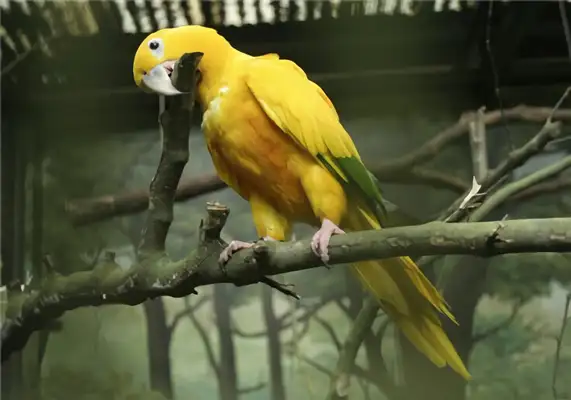
The feathers of the golden cones are very special, except for the green wings, which are all golden and very beautiful. It is not only one of the rarest of the conic parrots, but it is also the most beautiful and large.
Gold cone parrots are typical climbers, usually in pairs. Mainly in the South Asian Amazon Basin in north-eastern Brazil.
Chinese literary name: Golden Cone Parrot
Chinese aliases:
English name: Golden Conure/ Queen of Bavaria's Conure
Two words:
Area: Animal
Door: vertebrate door.
Platform: Birds
It's a parrot.
Section of parrots
Family: Conesian parrot
Distribution: morphological characteristics of a golden cocoon parrot in the South Asian Amazon Basin in north-eastern Brazil
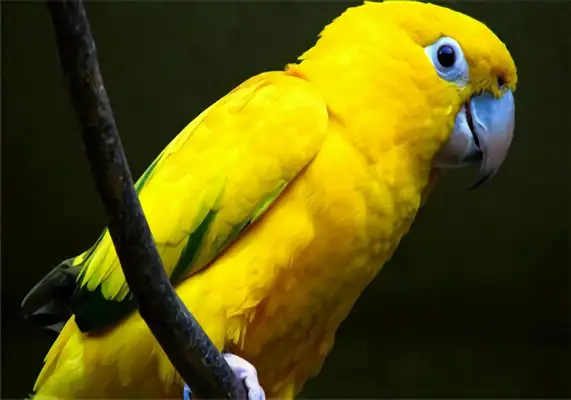
The difference between the golden cone parrot and the other parrots is that the parrot's feathers are very bright, the golden bird is particularly visible, and the wings are partly green. The size of the adult porcelain parrot should be around 34 cm and weight around 270 g.
There is a circle of white skin around the eyes of a golden cortex parrot, a beak of flesh, with a light blue tone at the front end; the iris is brown. The plume of the young bird is not as glamorous as a bird, with many olives and green in its body, especially when the head is very visible, but not as full as a bird, which will become full as a bird in about 20 months.
Gold-cream parrots are typical bird climbers, with strong beaks, beak hooks, active joints on the upper arctic, and laminum on the base. Muscles are thick. Short, strong, toe-toe-toe-toe-toe-toe-toe-toe-toe-toe-toe-toe-toe-toe-toe-toe-toe-toe-toe-toe-toe-toe-toe-toe-toe. The Golden Cinnamon Parrot Living Environment
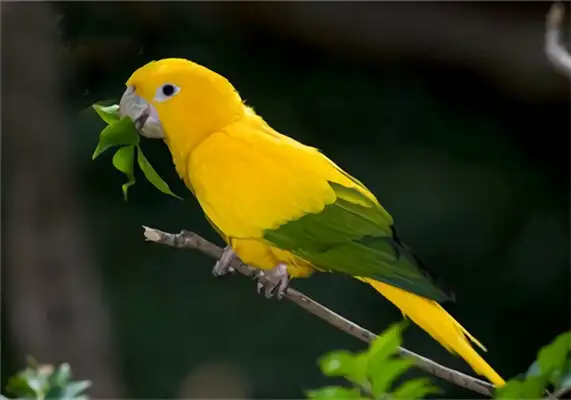
The main reason for the attraction of the golden conic parrot is that it has a very high profile. They've always been the dream bird species of many lovers. It is essential to provide a good living environment for the gold-creas parrots.
It is necessary to pay more thought and patience to raise the gold-crayons and to pay more attention to behavioural changes and problems. But for the new environment and for the masters, once adapted, they are strong, they love baths, they provide fresh branches for bites, they feed their loved ones and they are cute, and they provide toys for play.
The gold cone parrots are actually very hot, and the heat is much worse than the cold. When ambient temperatures exceed 35 °C, most golden cone parrots are restless; when they exceed 37 °C, individual parrots of poor quality may die from central nervous paralysis. The prevention of heat in parrots is simple: in the summer, take care of indoor ventilation, do not place cages and nests in strong light, provide fresh vegetables and vegetables in feed, cool indoors with qualified air conditioning or ice, and spray the parrot when heated. Gold and yellow cone parrots feed knowledge.
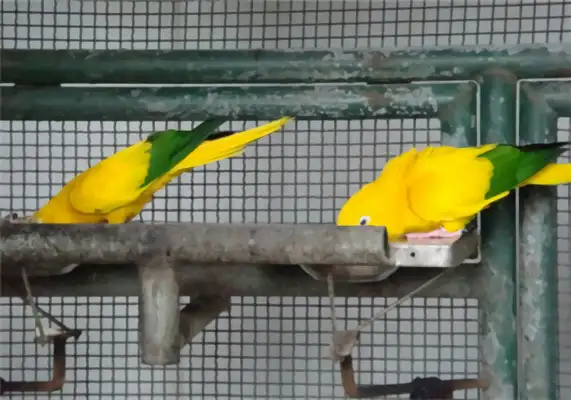
Many people choose to feed them because of their beautiful shape, but they have different colours at every stage. New-born chicks have dark green in yellow, and only after 20 months will their whole body turn yellow, except their wings. Absorption is common during reproduction, and good interaction with the owner during infancy reduces the probability of defavour and imitates.
The golden cone parrot may be offensive to the feeder during the breeding period. During the rainy season, usually from 12 to April, nesting occurs in caves 15 to 30 metres high, with studies documenting frequent collective reproduction, usually larger numbers of female birds, with the highest record of 14 young birds being found in one nest, supported by 6 adult wheels and approximately 2 to 4 eggs in one chamber.
The golden cocoon parrot is a rather sexual parrot, and there was a record of the wild coco parrot raising not his own offspring but other species of birds. The reproductive period of artificially produced golden cones parrots began in November, providing 30 x 40 x 40 centimetres of thick wood nesting boxes. If it is properly cared for, it is a rather productive and easily reproductive parrot, with male and female birds hatching eggs on a rotational basis, with three to five eggs on a date, for an incubation period of about 23 days, and young birds growing feathers of about seven weeks' duration, and when they grow up, they will soon eject them from their nest and begin to prepare for their next nest. In the wild, the golden cone parrot is different from the artificially produced situation, and in the wild, the male parrots stay on guard outside their nests while the females hatch, and when the feathers grow, the prodigal birds will still live with them and teach them survival techniques until they join the community. The reproductive record of artificially raised children is over 4 years of age.