Designation: PET4122
Character: Fragile
Origin: Alamo Ridge from sea level to 1,000 metres
Vulnerability: gastroenteritis, flu
Life: More than 20 years
Price: Summary of 50-200 Alamo turtle species
Alamo turtles live in more abundant habitats in the aquatic environment and in unique ponds (the community environment of Ramola turtles). During the drying period, it apparently hides in the dirt in order to sleep. Foods in nature include insects, shrimps, scorpions, crickets, red rhesus, red worms, bananas that can be fed, but also occasionally eat seeds of plants, a shy tortoise, which tends to fall into the shell when it comes to danger and does not normally attack or bite voluntarily. Alamo mud turtle morphological characteristics
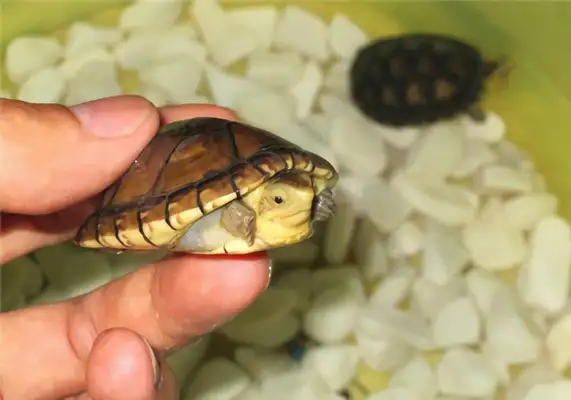
Alamo turtles are named by Berry and Legler in 1980, with a small, fine size of 13.5 cm, a narrow, egg-shaped back, and a condensed spine.
The perimeters of the Alamo femur shield are overlapping into watts, the 1st vertebrate shield is not the same as the 2nd guilder, and the 10th and 11th guilders are the same as the others. The edges behind the backs of the vest are straight, but do not open the side of the back or slip inside it. The colours are as wide as brown, brown and olive, and there is a glitter stitch in the armor. Through the semi-transparent shield, it is often visible where the cylindrical skeletons converge.
The vests have a wide and free-knot cover, with loose thongs bound to the shell, in which the head, limbs and tails can be completely decorated. If there was a loophole, it would be limited to a shallow concussion of anal shield terminals. And the back shield is a large piece of cloth, and it's a chest shield. The back is yellow, and there are brown stitches and death marks in the shield.
The bridge is less powerful, approximately 26-33 per cent less than the back armour, and the mantle under the armpit removes a wide range of backslids, and I take the 6th pair of shields, with a short nose and nose and hook profile on the broad head. The oscillator does not raise or flash V-shaped shapes. The chin has two yellow tentacles, the gray head is rounded with the dark side and the head is stained on both sides. A gruesome white stripe stretches from the eye to the corner of the mouth, as broad as butter or ash, where males are having more vague, brown stripes. The lower part of the back of the neck is less gray than yellow. An overview of the post-legged leg shows a graphic combination with a puncture in the tail terminal.
The male is slightly smaller than the female but slightly smaller. There is a bumped back armor and a small, thick tail, with a female vest that stretches or has a small bump, and a shorter tail. Alamo mud turtle care knowledge
The female reaches five to seven years of work with a lower back armour of 9 to 10 cm. In July, Iverson was inspecting them for sexual intercourse, and Berry and Legler and Iverson were examining some of the female dead cavities and making speculations, with the number of eggs per nest being as broad as 3-5, and some females being overloaded every hour. They assume that the time when the female is becoming active during the initial wet season is also the beginning of the ovulation development, and that the laying of the infarction is being completed in October or November. Alamo mud turtle living environment
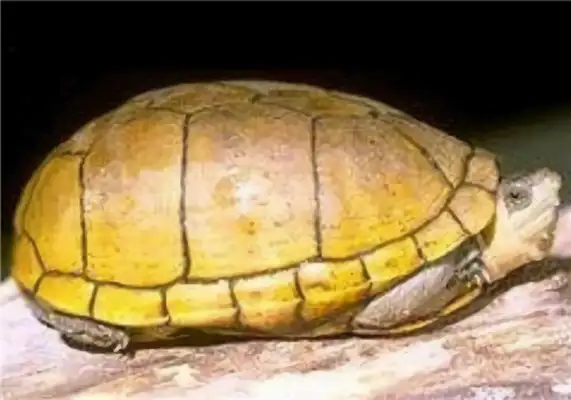
Alamo turtles can withstand high water temperatures and can be safe even at 42°C. In the wet months, its activities are most frequent, while the months of July to September of each year are the least active periods. At this point, it spends more time in the summer of inflammation, commonly referred to as “sleeping”.
It has been suggested that earthworms, or fruit and vegetables, should be given preference for sweeter species. Insects, shrimps, scorpions, but also occasionally eat seeds of plants that can be fed to crickets, red rhesus worms, red worms, bananas. But each turtle's habits vary, so it always takes time, slowly to observe and try to feed with different foods.
Maintained at 23-25 degrees Celsius in the daytime, around 18-22 degrees Celsius in the evening and between 70 and 85% humidity in the long term. When the temperature is too high, they can have a hibernation image, while when the temperature is below 20 degrees Celsius, both appetite and activity decline significantly. They are turtles that are more sensitive to the environment and to the quality of water, and are more time-consuming on land and need to change water.
It takes a long time (about three weeks) to adapt to the feeder. It also prefers to operate in a damp environment, so it is necessary to maintain the internal humidity of the tank; the active temperature is at 23-29°C and above 31°C in a “hypnotic” state, and below 18°C in a “hypnotic” state, at around 20°C, which would stop eating or attack only live mouths (crickets, rhesus worms) without eating. They're good at climbing, but they don't swim well in the daytime. Alamo moth turtle breeding points.
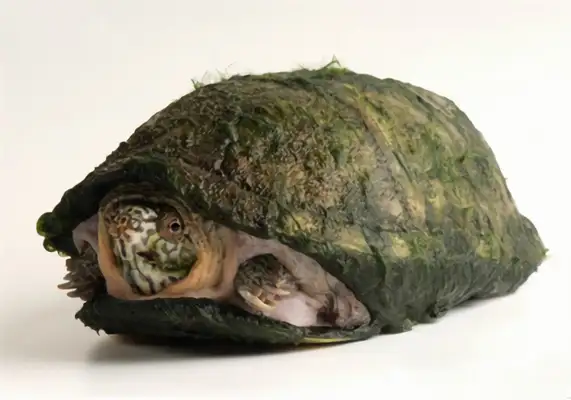
Alamo mud turtles suggest the feeding of earthworms, or fruit and vegetables (the preferred species with sweeter taste). Insects, shrimps, scorpions, but also occasionally eat seeds of plants that can be fed to crickets, red rhesus worms, red worms, bananas. But each turtle's habits vary, so it always takes time, slowly to observe and try to feed with different foods.
After hibernation, the most likely conditions are “post-hypnotic anorexia”, dehydration, inability to open eyes, weakness of limbs, oral inflammation, respiratory disorders, skin diseases, weakness due to vitamin deficiency, cold, etc.
After hibernation, the temperature and humidity are slowly increased daily, followed by fresh fruit and vegetables, such as tomatoes, bananas, tarts, etc., where the turtles are fed to smaller insects or fish, and even fresh livers. Normally, normal feeding should occur after one to two weeks; calcium powder and vitamin supplements on feed would allow turtles to recover faster. If more than three weeks have passed and food has not yet begun, the feeding is about to take place.
On the other hand, oral inflammation and skin diseases are treated in a daily manner with medicinal water, while they are administered in dry conditions. And feeding vitamin C to sick turtles. Respiratory disorders are treated by gradually increasing temperature and humidity, which can even be slightly increased and maintained for a week by the same day. The cure for cold, which increases temperatures to about 29-30 degrees Celsius, reduces humidity and maintains it for a week, while feeding vitamin A, C, E to the infested tortoise, is poorly treated and can turn into pneumonia.