Designation: PET1113
Origin: Amazon Basin
Vulnerability to diseases: albino disease, rotting tail disease
Life: Overview of tiger species 6-7 years
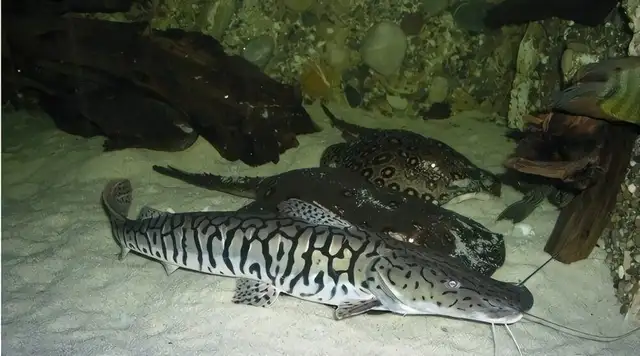
The tigers are also known as snout tigers, duck sharks, duck-stealing mice and duck-skin fish, mainly from the Amazon basin in South America. Tiger catfish are the most popular species of large catfish.
Chinese name: Tiger Pu
Maximum length: 70-100 cm
Food: commotion
Appropriate water temperature: 22-28°C
PH: around 6.5
Reproduction mode: Pygmy-prototype characteristics
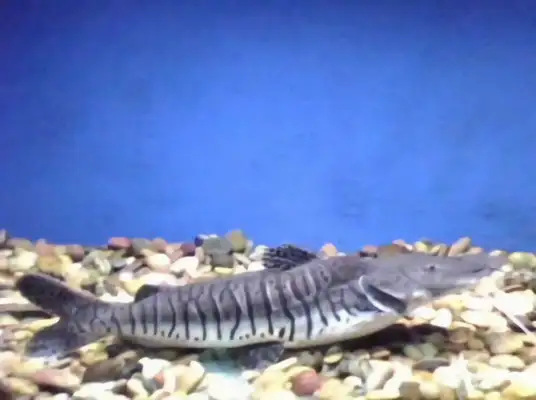
Tiger catfish can be one of the most popular species of large catfish, because they are very special in shape, they have dozens of stripes on their bodies, and they have a very large appetite, and they eat almost everything.
The size of the catfish is 70-100 cm. It's a thin, elegant line. The head is extremely long and wide, the forehead is flat and tilted, the front circle is flat and the back is flat. The kiss is long, wide and flat, like a round, and like a duck's mouth. There are three pairs of long-shaves in the mouth, with a very long kiss, which stretches back to the tail fin, and two pairs, which are approximately the same or shorter than the head. Small eyes, sharp eyes. All fins are well developed, and tail fins are wide and split.
The colour of the tiger's catapults is blue and has a light blue tone, spreading small black spots, especially thickened on the back and silver white on the abdomen. The edges of the fins are tangerine red, and there are dozens of black stripes entangled between the head and the tail handle, which are shaped like tiger skins and are therefore known. In addition, physical stripes change due to geographic differences or variations. Tiger-breeding environment
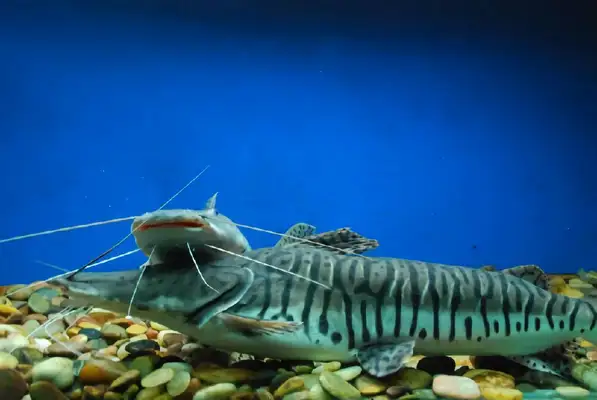
The size of the aquariums and the quality of water are important, since the fish friends who want to raise them must be careful to provide an adequate living environment for them.
Tigers are night-dwelling benthic fish that prefer micro-dark environments, where they live under shelters such as caves and running water, where they move around at night to feed, and often swim in water at speeds that are short of speed. Deep fork fins do not move when moving, but move at high speed by vibration. It is edible, and its bait requirements are mainly small fish, earthworms, meat, etc. It eats a lot, almost everything. It's a standard eater.
Tigers grow fast, and every time they grow, the skins that fall are often eaten by themselves for their unique habits. Its water temperature is 22-28°C and its water quality is weak (pH is 6). Soft water (hardness of around 5) Tigers are spawned and are not yet able to reproduce manually. Here's some food for the tiger.
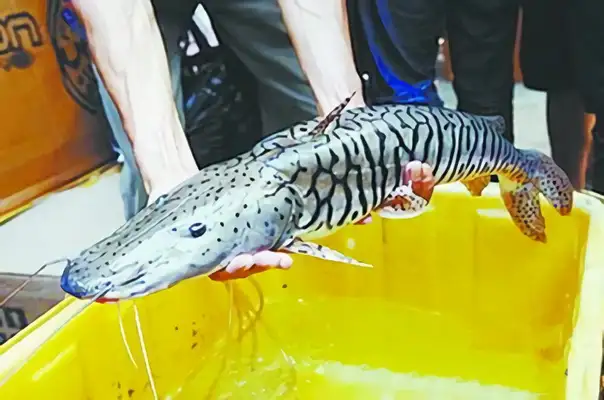
The size of the catfish is large, and their appetite is very large, so there is a need to be careful about feeding methods in order not to lead to an imbalance in their nutrition. The tiger cat is a night-dwelling bottom-dwelling fish, so it should be maintained as much as possible in feeding.
Tigers have a complex diet, and the baits required are small fish, earthworms, meat, etc. It eats a lot, almost everything. It's a standard eater. Sufficient bait can be fed in combination with large fish. It grows fast. Every time a tiger grows, the skin that falls down is often eaten by itself for its own unique habits.