Designation: PET1287
English name: guppy
Origin: River basins in Venezuela, Guyana, West Indies, etc.
Vulnerability to diseases: albino disease, rotting tail disease
Life: Overview of peacock fish species: 1-2 years
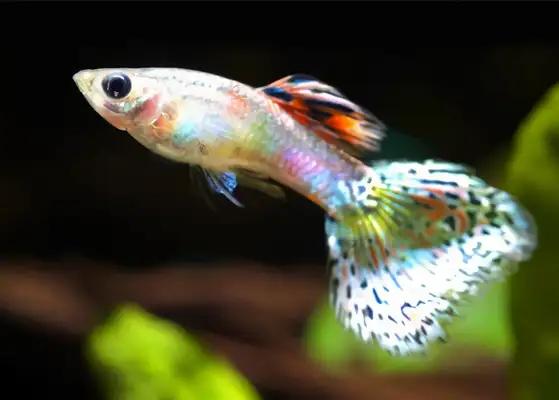
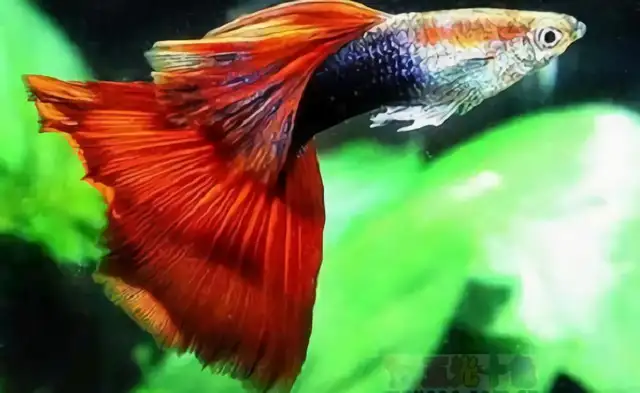
Peacockfish, with river basins in Venezuela, Guyana and the West Indies, also known as phoenix fish, is known as guppy (guppy) Latin.
Gate: Pipeline gate
I'm sorry.
From: from the flower
PH: 7.5~8.5
Context: Animals
Platform: irradiated fin fisheries
Section: Hanaya Section
Crop: Peacock flower
Water temperature: 22-24°C
Food: earthworms, daphnia and synthetic bait Peacock fish
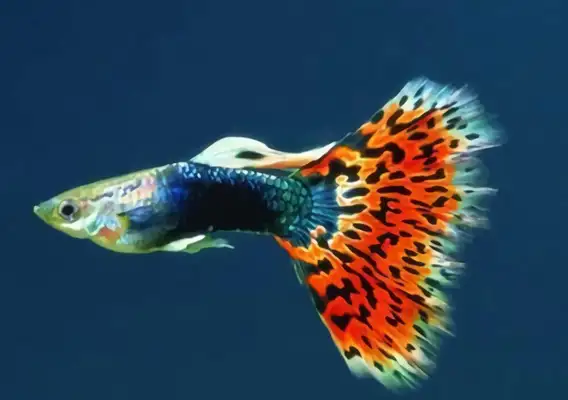
Peacock fish, like their name, have a tail like a peacock open, its unique shape and the difficulty of raising it are very popular with fish friends. Peacockfish, on the other hand, was an early species introduced from abroad to prevent dengue fever in Taiwan. Peacockfish now have hundreds of species, which, according to the rules of the competition, can be broadly divided into the following eight categories.
I. Grasstails have a little detail on the tail, there's no connection between each point.
Two: MOSAIC has a thick spot on the tail, and each point is connected.
iii. Tuxedo. There's a clearly coloured waist between the waist and the head. Body
iv. Single colour (SOLID) single colour for the whole peacock fish Colour
V. KING COBRA Fish have snakes or leopards on their skin
VI. Swordtails with a single sword, a double sword or a bottom sword
White with red eyes or red wine Eye.
VIII. Special tails, fins and tails, more specific species of peat fish
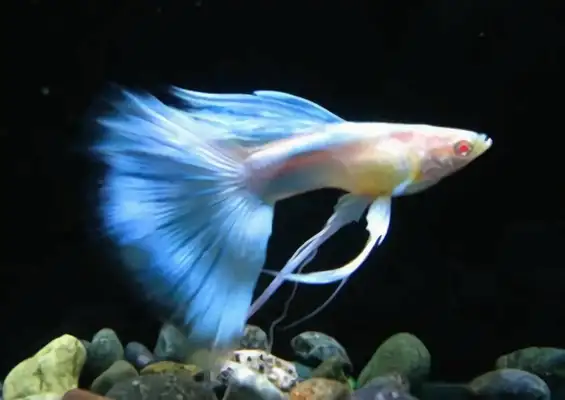
Peacock fish are a less difficult species to raise, but there is much to be done to feed them. First, of course, your peacockfish is healthy, and second, the most basic elements of feeding are the following:
I. Daily pyrefish breeding
1. Temperature water quality
The water temperature suitable for a peacock fish ranges from 22 degrees c to 24 degrees c. The water quality is 10-30 Dgh and the water acid ph is 7.0-8.5 peacocks When fish reach poor water quality or fall ill, the coloured blue becomes black.
2. Fitness for feeding
The food suitable for feeding peacock fish is either red wire worms and daphnia or dried feed.
3 Fish tank size advice
Peacock fish are best fed by aquariums above 45 CM. Because peacock fish can be considered as medium-sized toothfish. However, the size of the fish tank depends on the amount of stock raised.
4. Co-feeding
Peacock fish are mild and can be ploughed with moderate small and medium-sized tropical fish.
II. Feeding at the turn of spring and summer
Water temperature is stable.
The heater stick should not be removed, setting an insured temperature, such as 25 degrees, which is no longer working without electricity. It is also important to keep in mind the temperature when changing water, which is not suitable for new water.
Reduced density
Better water quality to reduce excretion. You don't have to say anything about filtering.
Three, watch out for food.
A red bug, for three days and five days. When temperatures are higher between June and September, it is recommended not to feed live red bugs, which can be fed to the freezer.
Four, watch out for disinfection.
Whether the fish in the tank is sick or sick, the gear for fishing nets, straws, sponges rinsing the tank, or even the hands of the operator, after having touched the water in one tank for use in another tank, it would be better to bubble potassium permanganate solution or soap wash. This is particularly important in the case of tattered child shoes, which have a headache in the form of tails and white dots. Peacockfish breeding environment
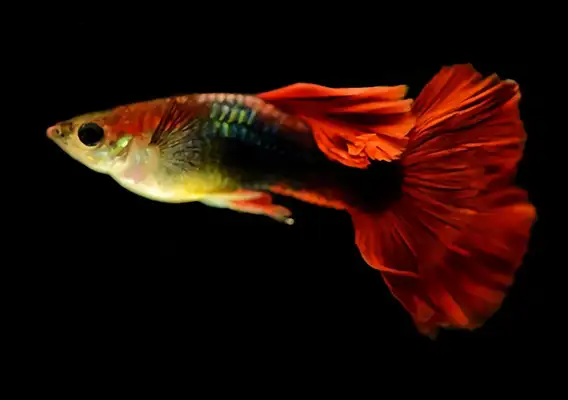
The water quality of peacock fish is crucial in the process of raising them, and all fish are raised in a way that adjusts the quality of water before the fish grows healthy. And if you need to breed, the pyrefish breeding environment needs to be adapted to its optimal state. The mini-codile tells you how to produce healthy peacockfish by temperature and animal density.
I. Temperature
Peacock is at a temperature of between 22 and 26 degrees, and in the case of adult fish, I am in control of between 22 and 24 degrees and in the case of juvenile fish, between 24 and 26 degrees. It is true that some fish mates raise the temperature of juvenile fish to 27 or 8 degrees, which is considered to be the only way for young fish to develop rapidly, with increased consumption and metabolism, but the negative effects of this high temperature are ignored. At this high temperature, juvenile fish metabolize too quickly, even with more food, and especially calcium, so that sudden malformations, such as those, can occur after some time.
Peacock fish are mostly grown in winter, mainly because of the warmness and suitability of water during winter.
II. Livestock density
For the density of the subfish, the recommended cask is 40*25*30 cm and the recommended density is around 50 to 60 ends. Overdensity, the lack of water for control of susceptibility to disease, the low density, the small number of fish in the tank, and the absence of predators can lead to a lack of excitement and motion, which affects the speed of growth, which many players do not notice and which requires attention.
Usually, in two weeks, we see that as the fish grows, the density of the cask increases, and if the space is not increased, it will affect the growth rate of the fish. And then I move them into my 50-40-30 tank, and I give them wide space and better conditions for their further rapid development. Peacock.
The five kinds of feed common to peacock fish include artificial feed, live bait, shrimp, fleas and silk earthworms, but there are also differences in what peacock fish feed in different growing states. Like other animals, the feeding of peacockfish requires avoiding the monolithic nature of food in order to balance its nutritional balance.
For bait, the main reference is the type of bait, the amount fed and the frequency of daily feeding, as well as the adaptation of the variety and feeding of bait as the age of the fish increases.
I didn't feed the newborn fish that day, because the first one was to adapt them to the environment, the second one was the yellow cyst that had not been absorbed, and the peacock fish was born of the eggs. Starting on day 2, it would be preferable to open the mouth with lively shrimp larvae, which is nutritious and easily absorbed, and which promotes defecation. During this period, the fish eat as much and as full as possible, to the extent that the stomach is hemispheric, and a small amount of live bait can be kept in the tank.
I. Artificial feed
There are now a considerable variety of artificial feed sold on the market, broadly divided into three categories: one, thin feed; two, particulate feed; and three, frozen feed. This feed is the most accessible and easily fed feed. In addition, there is a special diet developed for peacock fish, which should also be the choice of most peacock fish feeders as their staple food, with a fairly complete nutritional component.
II. Live bait
The use of live baits has always been mixed, because the nutritional value of live baits is, of course, far greater than that of manually processed feed. But there is a safety problem that comes with us as feeders. Or the aftereffects will make you feel better than just feeding.
III. FOOD Shrimp
The safest living bait at this time should be an old shrimp (unregulated larvae). The preparation time does not take too long, and it does not require too much formalities, but it should be fed as soon as it hatches. Because the most nutritious thing about the larvae is when it's just hatching and carrying an egg yolk. If it takes too long, the yolk has been absorbed by the indiscretionary larvae, so the nutritional value is reduced slightly. If Internet users have the habit of hatching crayfish to feed peacocks, if there are so many chrissakes, they can freeze him up and use it when feeding next time.
Daphnia
Daphnia, which can reproduce with green water, should be noted that it is best not to feed it directly to fish when it is recently collected from the field. Because daphnia is the host of a leech worm, and once it's parasited, it's not in three words!
V. Silk earthworms
Silk earthworms have a very high nutritional value, and they put some in the fish tank, and they can survive long enough to keep your peacock eating. As a result, peacockfish grow quite rapidly and are used as bait to turn the drug into a drug for silk earthworms and then for peacockfish, which is quite effective. In this way, silk earthworms should be the perfect feed, but since the source of silk earthworms is collected from the field, although some aquariums are first prepared for bacteria. But there is no way to ensure that the worms do not carry eggs in the body of silk earthworms, so the user has to notice.