Designation: PET4929
English name: Scythemarked butterfish
Origin: Eastern Pacific and Los Angeles to California
Vulnerability to disease: end-of-life disease
Life: 3-4-year overview of the sicklefish species
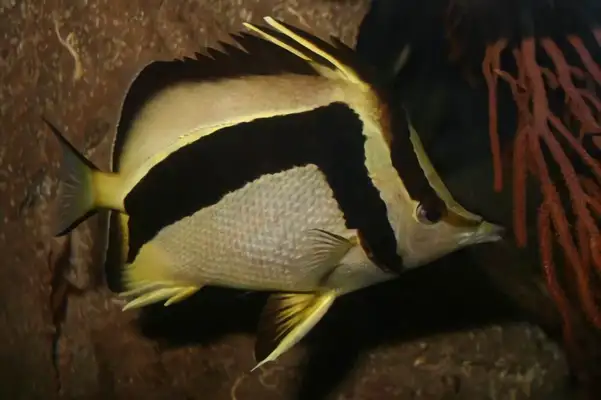
Butterfly.
A sicklefish has similar characteristics to a butterfly fish, but because it has a strip like a black sickle, it is known as a sickle, and some are called a sickle. A minimum aquarium size of 265 litres is recommended.
English name: Scythemarked butterfish
Type: butterfly fish, tropical seawater fish
Origin: East Pacific and Los Angeles to California
Reproduction: Eggs
Water quality: pH: 8.1-8.4; weight: 1.020-1.025
difficulty of raising: difficulty
Fits to water temperature: 16°C ~ 20°C sickle butterflies
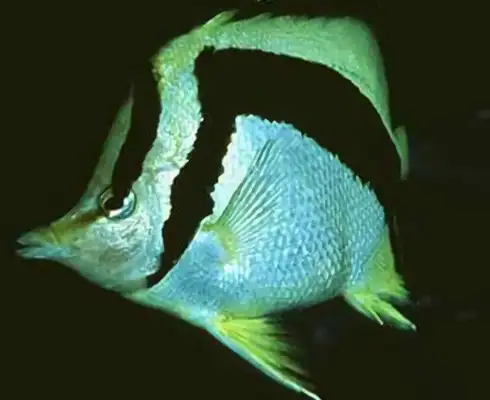
Butterfly.
The shape of a sicklefish is even more special than that of another butterfly fish, which is called a “ sickle butterflies” by fish friends because of the black sickle stripes on the sicklefish. The minimum aquarium size of the sickle butterflies is recommended at 265 litres.
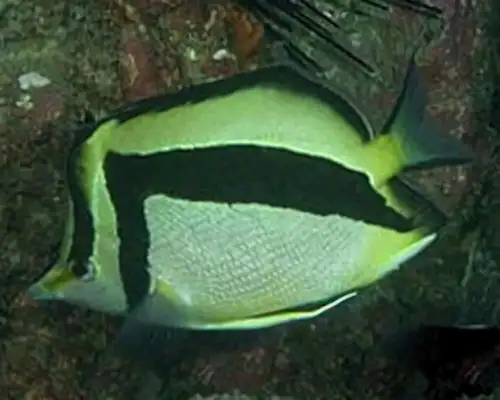
The sickle butterflies are tall and ovarian, with a flat contours above their heads and a dent in their nostrils. The kiss was prominent and a short piped mouth opened to the front of the tube. Short pliers up and down, two dents in a tight line. The body is covered by small scales and the sideline rises upwards to the bottom of the back fin 9-10 and falls to the tail fin base. Back fin single. The body is white, with a black sickle-like strip between the tail of the side fins and the base at the end of the back fin and the canyons of the throat, and is therefore known as “the sickle butter”. A black eye belt with a head from the back fin to the eye, narrow enough to extend to the kiss, where the eye reaches the yellow part of the kiss. Back fin black, with a yellow inner edge; hip fin yellow, with a black edge in the soft strip; abdominal fin yellow, with a white edge; chest fin base yellow, with a white back; tail handle yellow, with a white tail. The sickle butterfly breeding environment
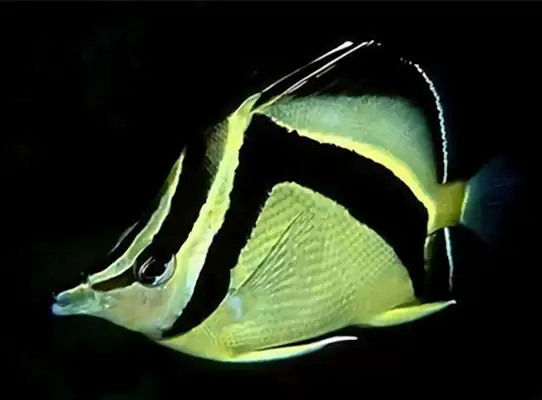
Butterfly.
The recommended ph of 8.1 to 8.4 for the quality of sickle butterflies, with a ratio of 1.020 to 1.025, and the suitable water temperature of sickle butterflies at 16 to 20°C, are intended to produce healthy and beautiful sickle butterflies, which must be taken into account.
It is recommended that parasites must be quarantined, and that parasites are often also a significant cause of death of sickle butterflies, which are less resistant to quarantine, and bacteria, which cannot be confused with bacteria, because drugs can easily kill parasites but have little impact on fish and nitrics, because bacterial infections cannot be fully quarantined and treated because they often have a full effect with nitrics, and the primary cause of bacterial infections in general is ammonia or urgency, and the treatment of antibacterials is generally improved, and the effects of antibacterials are poor and the effects of any type of antibacter in continuous experiments are difficult to achieve. Butterfly feeding points.
Butterfly.
The bait for raising sickle butterflies is also important, and many butterflies are in a situation where they don't eat when they change their environment, and they tell you how to bait sickle butterflies.
The commonly used baits are frozen shrimp meat, vincing clams, red insects, and manic shrimp, which are less recommended, because bacterial seafish from the freshwater environment are not exposed and have no antibodies. They must be cooked for use, and red insects who don't eat vinyl shrimp are usually not good enough to eat red insects, which are mostly water-depleted.