Designation: PET1643
English name: Redfoot Tortoise
Character: lively
Origin: South America and the Caribbean Islands
Vulnerability: pneumonia
Life: Around 80 years old
Price: A brief description of the species of red-legged turtles, $500-2000
Red-legged turtles are the preferred species of turtles, the prices of red-legged turtles are relatively fair, and they are less environmentally demanding, less susceptible to disease and better to breed, so many prefer red-legged turtles. Red-legged turtles are terrestrial turtles and turtles are animals. They're habitat, forests, caves, hot caves. Red-legged turtles were also found on several islands of the Caribbean Sea, but the species was thought to have been introduced as a convenient source of food in the seventeenth century. Red-legged turtle morphological characteristics
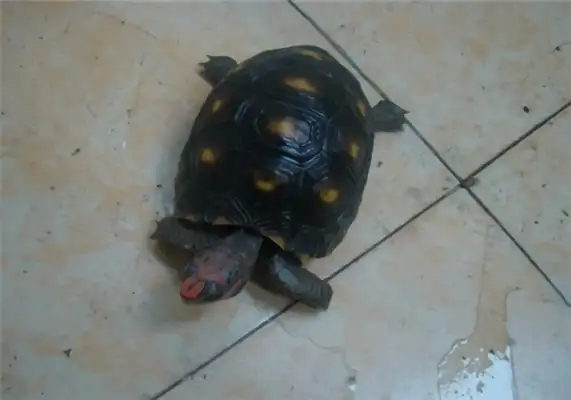
Red-legged turtles, by definition, are a species of turtles with red-legged legs, and if you get a chance to see a real red-legged turtle, you'll find that the greatest characteristic of red-legged turtles is that his nails are red, not red.
I. The physical features of red-legged turtles
The red legs have large yellow head and orange or red limbs and tails. The hull is slightly dark and the central part of the shield is slightly yellow. The front leg had sharp scales, which were red in depth.
They don't grow big, usually 40-50 centimeters. The species of the South are swollen around their nostrils and have ball root. Adult males grow up on average 50 centimetres slightly larger than females. Males have dimpled abdomen, like other land turtles, and have lower and more visible sandy crust.
II. Changes in red-legged turtles after adulthood
Red-legged turtles are a medium-sized species. Male red-legged land turtles have larger backs and weights than female turtles, but not wider or higher. Like other turtle species, male red-legged turtles have dented abdomen. When the red-legged turtle matures, the female and male form a unique mid-body constriction, with the red-legged turtle in a visible sandglass shape, looking down above. Male turtles are more visible. Adult females have longer and wider tails. Red-legged land turtles have experienced a change in color in redevelopment. Red Leg Turtle Care Knowledge
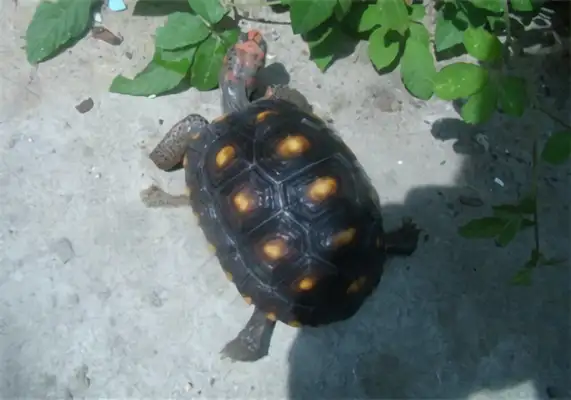
In the conservation of red-legged turtles, bathing is an important aspect, and the main purpose of bathing is not to bathe for red-legged turtles, but to promote the discharge of red-legged turtles during bathing and to ensure the health of their gastrointestinal tracts.
I. A bath on a red-legged turtle
Red-legged turtles under 10 centimetres can bubble for two days and above 10 centimetres, if the environment is wet for three to four days, it's no problem to prepare the basin for their own water. Land turtles are drinking water to promote excretion. The health of the turtle can be inferred from acid and faeces. If the faeces are striped with a certain amount of green or ink green, they are generally healthy and defecated to the point that the ingestion of food is excessive.
II. Reproduction of red-legged turtles
While seasonal activity of red-legged turtles can be noted, they may lay eggs at any time of the year, and it is recommended that female turtles be provided with a nesting room full of wet peat moth and sand at all times. The nesting rooms can be made from a large, top-open box, with a slope so that turtles can climb in and out at will. The size of the nesting room shall be 1.2 x 1.2 x 0.6 m and be filled with wet nesting materials of at least 50 cm thick. It is important that there must be more than one male tortoise in a breeding group, and that male rivalry is important to induce red-legged turtles to breed. Red Leg Turtle Living Environment
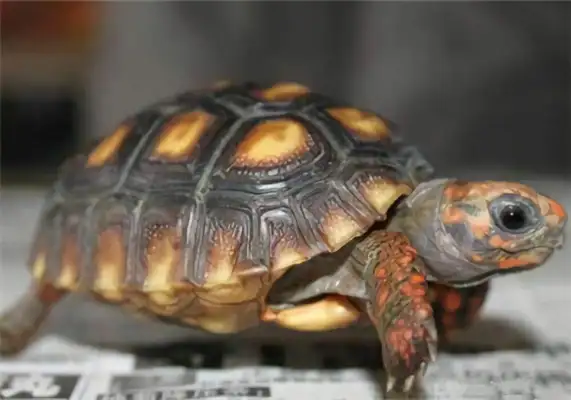
Red-legged land turtles have special environmental requirements, as this is a high-moisture requirement, but lower temperature requirements for turtles are often difficult to control in their environmental setting.
I. Humidity of red-legged turtles
Red-legged turtles are one of the most wet species in the turtles. Wet-resistence does not mean that as much as possible, red-legged humidity is appropriate at 50-60 per cent, and high-wetting can cause the turtles to become hungry or die. Because the red-legged turtle is a forest-based turtle, it needs a high humidity, and when raising it, it needs a basin that allows the whole turtle to immerse, and if it can't drink for long, don't be scared, because it does for every red leg, like always thirsty.
II. Temperature Requirements for Red Leg Land Turtles
The temperatures of red-legged land turtles and Indian star turtles are relatively low, ranging from 26-28°C in the daytime to 23-25°C in the evening. For turtles, a certain temperature difference is necessary. This better promote the metabolism of turtles.
III. Importance of red-legged turtle light
When it comes to temperature, it is important for the turtles to talk about sunlight, and long-wave UVAs and short-wave UVBs in natural sunlight are indispensable for biological growth. They can promote the synthesis of body vitamin D3, which promotes calcium absorption and better growth of turtle shells. Wild-breeding turtles are more sophisticated than hand-breeding, and this has a certain relationship with food and sunlight. The point of red-legged turtle breeding.
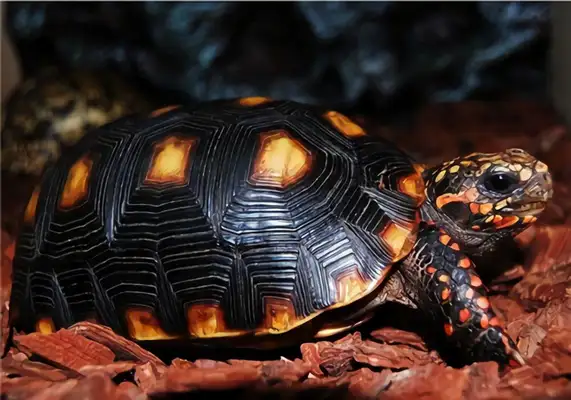
Among the red-legged turtles, the most important concern is control over the amount of food, not the more food the better, and the stomach and intestinal tracts of the turtles are fragile and the amount of food is easily disease-prone. Here are some of the highlights of the red-legged turtle feeding.
I. The choice of red-legged turtle food
Many turtles feed tortoises, cabbage, wrapping fruit, which is not good for turtles.
Wheat: The supermarket is easy to buy, the root water is more abundant, it is edible food for larvae turtles, it is inappropriate to overdose and it is appropriate to add to improve taste.
2. Pudu: Most of the turtles are suitable for food, have a high fibre content, are ideal for turtle food, and flowers can be eaten.
3. Grapes: grapes are more suitable for smaller land turtles to adapt to excessive foods with slightly higher fibres and are essential as part of the staple diet.
Twilight: King of the Grass. Ultraviolets are less common in cities and can buy their own seeds to feed turtles. It would be preferable for larger turtles to add dry grasshoppers to their food.
II. Control of consumption of red-legged land turtles
Vegetable turtles are weak in digestive capacity, and it generally takes about three days, or even longer, to digest the food they eat at a time, so the turtles are the most reluctant to feed, eat too much, and weigh too much to say nothing but to feed. Controlling the consumption of land turtles is crucial.
For turtles over the age of 3, it is appropriate to feed every three days and to feed once. After eating, the turtles wander for a while, or a little bit, and at that point take the rest of the food away.