Men transported their pet dogs from Shenzhen to Henan through pet shipping platforms, but by the time they arrived at their destination, their beloved “pure child” had died. Who is liable, the shipping platform or the actual carrier?
Recently, the People ' s Court of the Bong Hyun District of Shanghai (hereinafter referred to as the People ' s Court of the Bong Hyun District) concluded a dispute concerning the contract of carriage for pet dogs.
Mr. Liu shipped his beloved “sweet child” — a French bulldog that bought $10,500 — from Shenzhen to Henan through a micro-clinic programme run by Petty Shipment.
When Mr. Liu placed an order, he checked the platform to agree to the terms of the transport contract. The contract provides that the platform is a web-based information platform providing logistics resource services. Upon successful submission of orders from the Platform, pet operators registered with the Platform will provide them with follow-up pet shipping services. Patients implement the platform ' s unified service code and are responsible for the quality of service during service. In the event that the vehicle is chosen for the purpose of transportation, the vehicle environment and services during the journey result in the accidental death of the pet, the peter is liable to pay compensation to the peter, who is subject to a maximum of three times the freight charge (including freight).

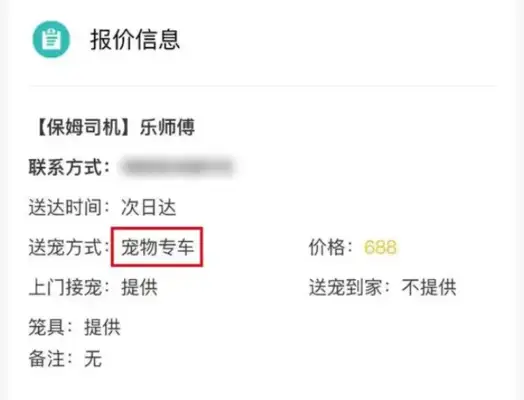
Following the receipt of an order and the offer by Ms. Lok, a registered pet dealer on the platform, Mr. Liu paid $688 in freight to the platform, and the parties agreed to treat the pets as a car.
However, while on the way to transport, Ms. Lok, on the other hand, changed the mode of transport from the original pet car to a bus shipment, resulting in Mr. Liu ' s pet dog dying of asphyxiation due to lack of circulation in the air upon arrival. Subsequently, Ms. Lok paid the Platform twice as much freight as $1376, and the Platform returned Mr. Liu ' s full freight fee of $688 and paid Mr. Liu ' s account of $1376.
Mr. Liu was dissatisfied with the outcome of the Platform ' s proceedings and, after no outcome of the consultations, sued the People ' s Court of Bong Hyen District for compensation of an additional $9,124 for the loss of Mr. Liu ' s pets. During the trial, the Platform Company disclosed Ms. Lok ' s main information and the People ' s Court, Mr. Yi Liu, applied for Ms. Lok ' s co-defendant in the case. Subsequently, Mr. Liu changed his claim to seek compensation for the loss of Mr. Liu ' s pets in the amount of $9,124 from the Platform Corporation and Ms. Lok, the actual carrier.
The platform company argued that the platform company was an intermediary of the information services platform and that Mr. Liu and the platform company had an intermediary contractual relationship, not a contract of carriage relationship. The death of Mr. Liu ' s pet was the result of Ms. Lok ' s unauthorized change of mode of transport, and the Platform Corporation ' s obligation has been fulfilled by refunding the freight charges at the first time and by paying Mr. Liu twice the freight rates as contracted.
Ms. Lok argued that Mr. Liu ' s pet was already asthmatic prior to transport and that Mr. Liu had not provided a medical certificate issued by the veterinary doctor. In the absence of a direct pet car, Ms. Lok, on the other hand, changed the pet mode to a bus without informing Mr. Liu at the time. Following the death of Mr. Liu ' s pet, Ms. Lok did not charge freight charges and paid twice as much freight charges to the platform, which already met the highest standard of compensation for the platform.
The People ' s Court of the Bayon Hyon District held that Ms. Lok, as the actual carrier of the contract of carriage, should bear the burden of proof of exemption, and that if there was no proof of exoneration under article 832 of the Civil Code, she would be liable for loss during the transport. Although Ms. Lok argued that Mr. Liu ' s pet dog was asthmatic prior to shipment, there was insufficient evidence, such as video, to show that Mr. Liu ' s pet dog was in bad health prior to shipment, and that it was wrong to change the mode of transport without proving that there was an exoneration from liability under article 832 of the Civil Code.
As a web-based information platform for the provision of logistics resources services, Petty Shipment has facilitated the contract of carriage between Mr. Liu and Ms. Lo, and it has disclosed Ms. Lok ' s main information to allow Mr. Liu to claim liability from Ms. Lo, so Mr. Liu claims liability for the Platform Corporation, lacking a factual and legal basis and without support.
With regard to the amount of compensation in the present case, the Contract Clause is a form clause, and the three-fold freight compensation clause (which includes freight) does not use fonts to add weight or other special instructions. Despite Mr. Liu ' s cross-checking of the article, it cannot be concluded that the Platform has complied with its obligation to provide adequate and reasonable advice in accordance with the law. Mr. Liu purchased pet dogs at a price of more than $10,000, and the three-fold freight compensation clause (which included freight) agreed in the terms of the contract clearly reduced the carrier's liability, limited the shipper's rights and was unfair. The three-fold freight compensation clause should therefore not apply. Ms. Lok should be compensated for the purchase price of $10,500. After deducting the amount of $1,376 already paid to Mr. Liu, the Court finally awarded Mr. Liu $9,124 in compensation to Ms. Lok in accordance with the decision of the People ' s Court of the Hyen District.
After the first instance judgement, Ms. Lok appealed the judgement, which was upheld by the Shanghai City First Intermediate People ' s Court, which dismissed the appeal after a hearing.