Designation: PET4552
Origin: Amazonian River in South America
Vulnerability to diseases: albino disease, rotting tail disease
Life: 4 to 5 years' profile of fairies
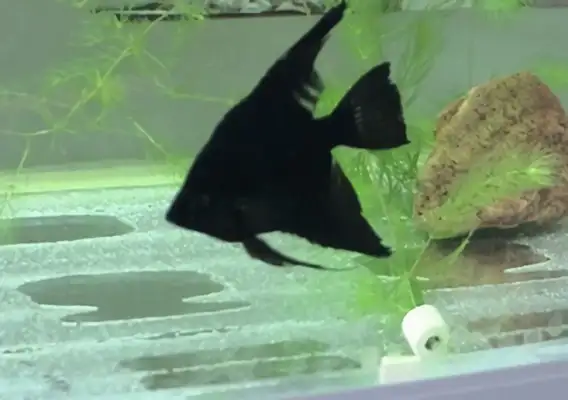
Blackfish has a very special look, so it's also called the Black Yan and the Ink Yan. The black fairies are mutated, very similar in shape to the fairies, but they are dark, very beautiful and popular with many fish friends.
Chinese literary name: The Black Fairy
Don't call it "black swallow."
Context: Animals
Gate: Pipeline gate
Amen: vertebrate Amen.
Region of distribution: the shape of the fairies of the Amazon in South America
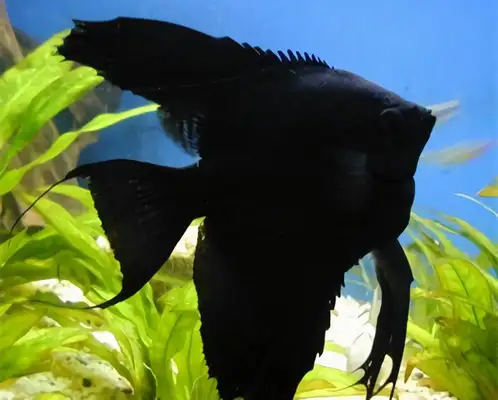
Blackfish and fairies have similar characteristics. They have a temperate personality. They like to move in the middle. They're quiet. The fairies of the black spirit, by their unique appearance, are loved by a great number of fish friends.
Blackfish fish have a sarcophagus shape, are flat on the polar side, have a flat tail, have a back fin, have a hip fin extended backwards, have a symmetrical upper and lower, and appear to have open sails. Abdominal fin specialty, silky. From the side, it looks like a swallow flying in the air, so it is called an oatfish, which has no color. The original fish has a base colour of silver white, a yellow back, four black horizontal stripes on the side, the first through the eyes, the second at the front of the back fin and hip-button, the third at the end of the back fin to the end of the hip, and the fourth at the end of the tail-hand.
The Black Fairyfish is 10-15CM long and flat on the side of the disc. It's dark and bright. The male is larger, has a thick, thick head, and the female has a flat head. It's a mutated species of fairyfish, and artificially selected to stabilize genetic properties. The size is similar to that of a fairyfish, and the fins are relatively broad, like butterflies, and black. Some black fairyfish, looking at a vertically transparent grid in the tailings base, are very beautiful. Blackfish breeding environment.
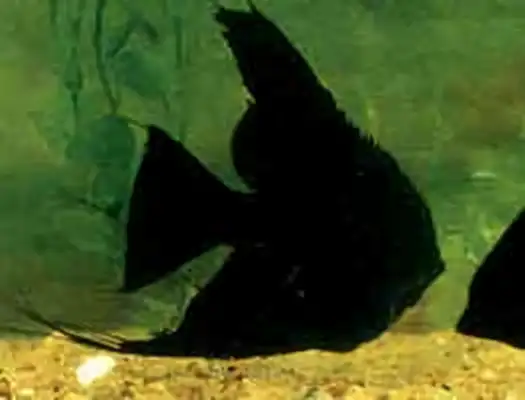
Like fairyfish, black fairyfish are less difficult to raise, but this does not mean that they can be raised at will, but also that they need to be provided with a stable environment to ensure their healthy growth.
The black fairies do not have strict requirements for water quality, prefer soft water with weak acids, and black fairies can live at 20°C water temperature, but the water is chronically low, poorly grown and susceptible to disease, and is most suitable around 26°C. The frequent exchange of fresh, dry water reduces the risk of disease and favours small animal baits. Water is required to be wide, clean, with hydrogen ion concentrations of 39.81-316.3 nmol/L (PH6.5-7.4), and an environment where water grass and light are exposed (but sunlight is not direct). Blackfish.
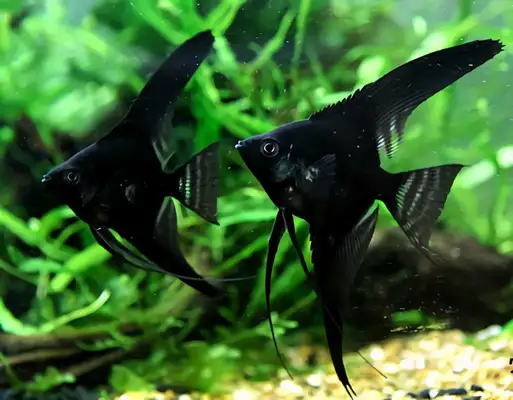
Although black fairies can accept water temperature at 20°C, they cannot stay in this water for long periods of time and can cause disease or even death. In addition to providing them with a suitable and stable environment, the artificial feeding of black god fairies also requires attention to provide them with accessible feed.
The black fairyfish are flat as a disc, with small heads and sharp heads, long as chubby fins, ass fins and astrided as sails, giving people a sense of goodness and dignity. It's rich and well-coordinated, some silver, some ink, some black and white, some rainbow red. The black fairyfish are particularly fond of eating live baits, which should be washed first to reduce unnecessary pathogens.