Designation: PET4604
English name: Matamata Turtle
Nature: timidity
Origin: Amazon, Peru, Brazil, Colombia, etc.
Vulnerability to disease: decomposition
Life: A brief description of the species of dead leaf turtles for about 50 years
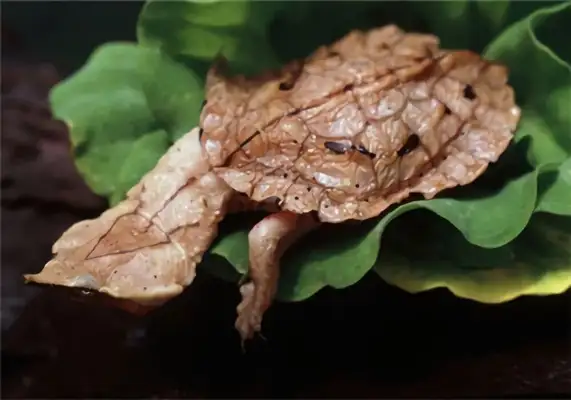
The look of a dead leaf turtle is very specific, as it is a yellow leaf. Many people like this strange shape, the market buys more people, and the price of a dead leaf turtle is not very expensive, so it's very popular.
The dead leaf turtle, which grows in the Martamatta marsh, also known as the Matamatta turtle and the Marta turtle, belongs to the large aquatic turtle and is the oldest reptile in existence. It is a long-suspensive tortoise, with a triangulated flat head, a pipe-shaped nose and an angular part with three tentacles and four twirling tentacles on its chin, in a form of a dead leaf, yellow and visible in the lake. It's called a tortoise because its shells are like dead leaves.
Chinese literary name: Dead leaf turtle
Latin name: Chelus fimbriata
English name: Matamata Turtle
Don't call it: Matamarta turtle, leaf-dead turtle, Mata snake neck turtle, snake neck turtle.
Two words: Chelus fimbriatus
Context: Animals
Gate: Pipeline gate
Programme: reptiles
Tortoises.
C: Snakes and turtles
It's a snake's neck.
Crop: Dead leaf turtle
Distribution: Amazon, Peru, Brazil, Bolivia, Ecuador, Colombia, etc.
Living environment: Small rivers, lakes and ponds with slow flow.
Level of protection: non-State protected animals. Flow turtle morphological characteristics
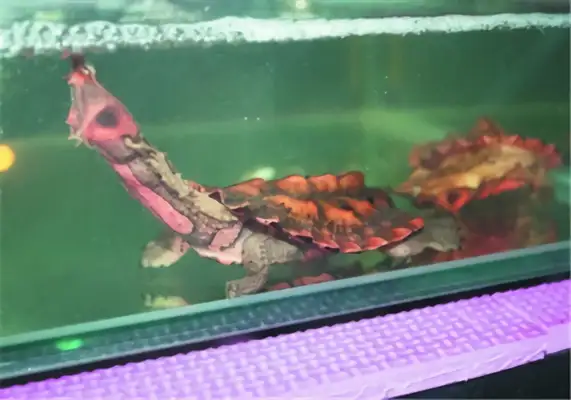
The backs of the dead leaf turtles are similar to those of the fungus, but the features of the head are more visible, integrated with the body ' s perfection, creating a self-protective colour with greater capacity to disguise, which not only avoids natural enemies but also captures food.
The dead leaf turtle has a maximum of 40 centimetres long, with a rectangular backnail and a rough, tumour-coated backnail. The maximum straight length of this turtle's backnail can be as long as 18 inches. Each shield is conical and has a visible concentric growth ring. Their heads and necks were flat and covered with countless small tumours, knots and wrinkles. The mouth is very wide and the nose is long. The eyes are small and very close to the nose.
The colours of the back and neck in childhood are tea brown to red brown, and the abdominal nails are usually bright orange red. When such turtles grow up, the orange red on the abdomen fades into yellow or brown. The neck is brown, but eventually brown or tea brown. The throat has two dark stripes and the abdomen are dark. The maximum line length of the back armor can be as long as 18 inches. Each shield is conical and has a visible concentric growth ring. Knowledge of dead leaf turtle care
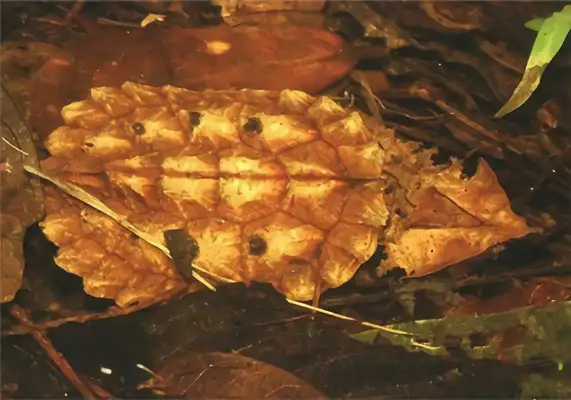
The life of a dead leaf turtle is usually static, because his unique appearance can be used to confuse food and eat it accidentally, and there is a feeling of “fishing”, and the dead leaf turtle prefers to live in water, and it is a very good to swim turtle.
The dead leaf turtles are probably the most unique turtles in the world, with one of the ones growing on the Amazon River in South America, particularly in Brazil, Guyana and Peru. What does its head do? This is also part of the greatest conspiracies of the dead leaf turtles, and one of the most powerful places, where people are not too aware of the role of its “Hai Liu” as a part of a turtle, which is not easy to discover when he hunts animals and fish. The “Hai Liu” has a lot of nerve endings, which can act as sensors even in dark places. They can feel where the animals are, and his “Hai Liu” can swing, just like waterweed, and attract fish.
The dead leaf turtles are found in the Amazon and Orinoco basins, in Brazil, Peru, Ecuador, Venezuela, Colombia, Bolivia, etc. It is a fully aquatic turtle that lives in very shallow waters, like stagnant ponds, lakes of the Amazon, where dead leaf turtles cannot live in deep water, mainly because it is not a good diver, so they simply use the length of their necks to extend their underwater vents to breathe air, and dead leaf turtles like to live in dark water, and when the light shines on their eyes, their eyes reflect light like dogs. The dead leaf turtle does not need light, and its little eyes are sensitive to light. Their wildlife bodies are generally dark and dirty tropical rainforests where sunlight is difficult to penetrate. Living environment of a dead leaf turtle
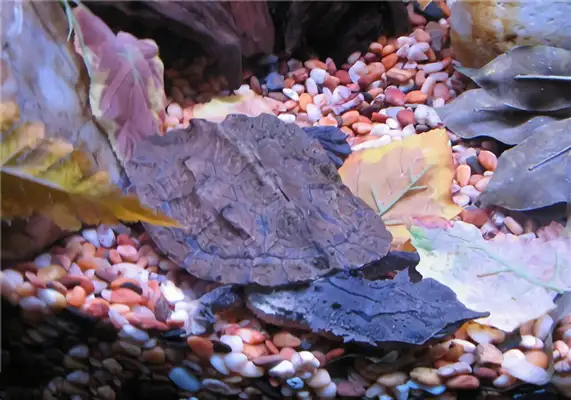
Tortoises, also known as Marta turtles, are a form of water turtles, where wildlife prefers to live in shallow water to feed, and where there are no excessive requirements for water depths in artificially raised environments, but are sensitive to changes in temperature and do not like sun.
I. Living conditions for the dead leaf turtles
The dead leaf turtle usually grows in the lake, crawling very slowly, and although it is a complete aquatic animal, it is not very watery and often waits for food under water. It is highly hydrophobic and rarely leaves the water. The dead leaf turtles do not have sun sun and land activities. A few sources suggest that they can tolerate long-term exposure to salt water or a mixture of sea water and fresh water by stretching their necks to the point of their nose just above the water surface. The dead leaf turtle prefers the still or slow flow of rivers.
II. THE TRADITIONAL OF LEAVEL TORTURE
Dead leaf turtles tend to lurch at the bottom of waters that are static or very slow in flow, with little movement. In a warm environment, water temperatures below 10°C enter hibernation, water temperatures around 18°C are consumed in small quantities and water temperatures around 22°C are eaten normally. In nature, small animals such as fish and shrimp eat. Fish are the staple food, but usually do not take the initiative to eat, but rather to stretch the neck and open the mouth, so that when the small fish approaches, they suddenly shut up and inhale. The Marta turtle, though fierce, was lazy, timid, unattractive and quickly agitated. I'm gonna need some of that.
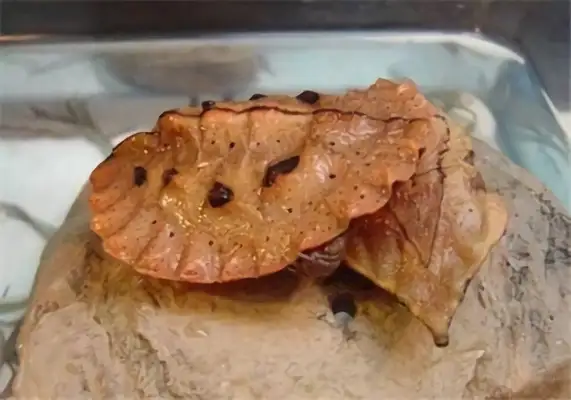
The strange shape of the dead leaf has had some effect on diet, and many wonder how the dead leaf turtle eats. In fact, a number of studies have been carried out on this issue and the following conclusions have been drawn.
Among turtles, the food of dead leaf turtles is probably one of the most controversial issues. Goldfish is the focus of the controversy. I was told that when living goldfish are sucked, their back fins will rise and the final fin will pierce the throat, leading to infection and eventually to the death of the turtle. Many goldfish are bred in large numbers in outdoor pools and are fed with copper sulphate to prevent algae growth. This means that copper sulphate in turtles increases with the increase in copper sulphate in fish, to the extent that it can kill the turtle. I have also been told that goldfish and many other fish contain sulfamase, a VB1 enzyme that causes VB1 to be lacking. Moreover, many of the fish in the pet market carry too small pathogens that can cause turtle infection and death. But I spoke to a feeder who had fed only frozen goldfish for five years without any problems.
In the zoo, one person made an interesting record of the habit of eating dead leaves. He saw only one of the three turtles in the Moon's tooth-shaped pool doing “grain hunting”. The turtle crawls along the side of the pool to bring the fish together to swim into a dead end. Some fish escape, while others are eaten between turtles and the end of the pool. The same method was later used by other dead leaf turtles raised with the “herders”. A researcher tested this observed phenomenon in a laboratory, but unfortunately he chose to use a circular pool. The researcher eventually concluded that dead leaf turtles would not drive away their prey. I think this experiment is meaningless at this point. The prey cannot be driven to the corner or the end of a circular barrel. The same feeding studies indicate that when there are few or other turtles to catch, dead leaf turtles will increase their activities to search for food.