Designation: PET4165
English name: Garrulax Canorus
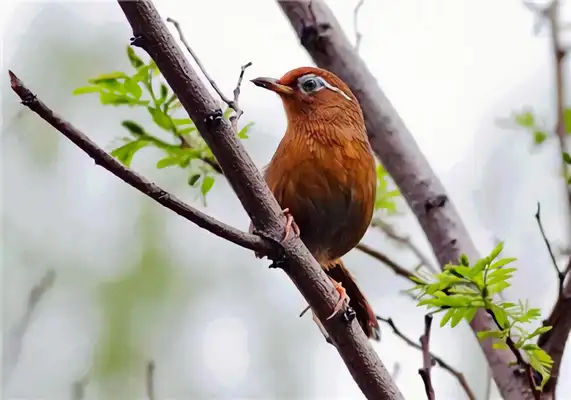
The appearance of Garrulax Canorus is so plain that, although there is no colorful feather, the bird has a very bright voice, sings very softly, is very lively and has been a famous cage bird in the country.
The euphoria likes to dwell in the bushes of the hills and in the bushes or bamboo forests near the villages. They are agile and afraid to feed in the grass under the forest and do not fly well. The males often hide in their own right during their breeding period in a very nice and beautiful place between the weeds and branches, with a very loud voice, a very sweet voice, a very beautiful voice and a famous cage bird. Insects are the main source of insect consumption, especially during the reproductive season; weed seeds, wild fruits. In the south-eastern coastal areas of Laos, Viet Nam and China, birds are found in China, South China, South China and Taiwan. For the City of Guangzhou.
Chinese literary name:
Chinese aliases: brows, tigers, gold brows.
English name: Garrulax Canorus
Two words:
Area: Animal
Door: vertebrate door
Platform: Birds
AAA: Draw Maiaco
I can't believe it.
Section: 鹟
Noose
Cast:
All over Yunnan. Central and Southern China. Draw a morphological characteristic of a brow
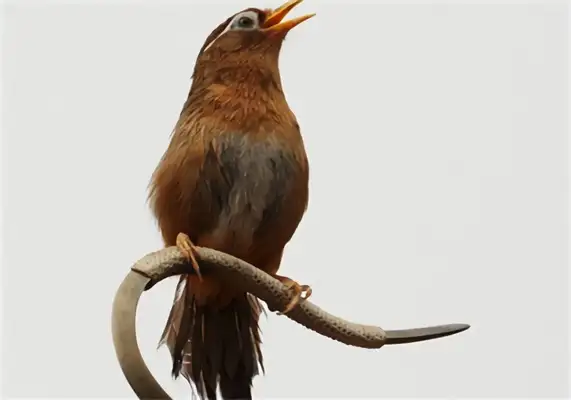
There is a clear difference between the color of a young eyebrow and that of an adult, and in July there are no stripes of light tan or tails, nor are there any stripes or stripes of brown and white in the lower body. In September, young birds were similar to adult birds, but the feathers were slightly dark, with black and brown stripes from the top to the back and from the throat to the chest.
Draws a similar color for females and males. Magnificent brown, top-to-top tan, large black-to-back stripes with a dark front-to-head tan. The eyelids are white, and their top edge is white and they extend backwards into a narrow line up to the neck, in the form of a brow, so they are called a brow (Taiwan Asians without a brow). The head side consists of the first eye and ear feathers of dark brown, while the rest of the upper body consists of the wings covered with brown olives, the two wings of dark brown feathers, the outer wing of flying feathers, the outer luminous feathers with brown colour, and the inner luminous base with broad palms. Inside fly feathers with brown olives, tail feathers with brown or dark brown, with dark brown spots that are less visible in multiple paths, and darker at the end. Blanche, larynx, upper chest and chest are mixed with black and brown stripes, with the rest of the lower body also brown, the two are relatively dark, the abdomen are grey, the anus is brown and the wings are covered with brown yellow.
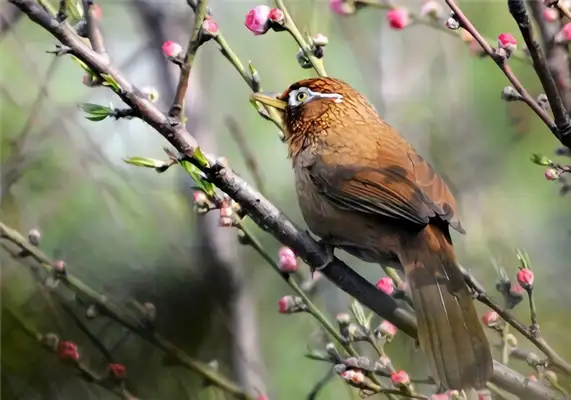
The eyebrow has a long body and is slightly in the middle of the two heads, with a fluid profile. The upper feathers are generally olive colour, the lower abdominal feathers are green or tan, the lower part of the abdominal feathers are white, with no stripes; the head, chest, neck feathers and tail feathers are darker and have black stripes or crosses. Its eyes are white, each with a white eyebrow, extending evenly from the front to the back, and with many mothbrows, which are very beautiful, so it is named.
An horny mouthnail (beak) at the front end of the head is an organ that paints eyebrows, combs feathers, fights and sings. The average mouthnail is about 20-25 mm long and the upper mouth nail is slightly longer than the lower mouthnail. The upper lip is brown, the larger, the lower lip is brown, but the colour is lighter and smaller. There's a nostril on both sides of the upper lip. The near-earth has long black hair (commonly known as beards).
Its two eyelids are round. The eyes produce colorful “eyes” of various colours due to the difference in eye color. The eyeball is protected by an amplitude outside, which is open and closed during flight. The eyeballs have eyerings at the outermost level and also serve to protect them. In the back of both eyes, there are ear holes of soybeans size, and around them are ear feathers that help to collect sound waves.
The wings of the eyebrows are long, the feathers are covered from the chest to the back, and are approximately 75 mm long. Wings spread 90-110 mm wide and around. The abdomen lack a gland body, and the only skin gland is called a lipid gland, born in the root of the tail feather, which is able to separate the oil to protect the feather from deformation and waterproofing. The bottom of the body is a foot claw, which is generally light brown, with feet about 40 mm high. Painting browsing knowledge
The number of pet-painting birds is numerous, but few are able to raise them by scientific means, and the following is a simple compilation of information on how to raise them, which can be found through simple and understandable articles.
1. Cages and cages are regularly washed. Note: Three days to clean. Lazy people can never feed birds.
2. As long as the bird you like is able to play, it is not necessary to care whether or not it looks like it.
3. New players usually don't feed too good birds. Bad bird practice first. When you have experience buying good birds.
There are no birds that won't scream. It's about your patience and the way you raise it.
5. The feed mix is much less supple than that of the general aluminum, one third of the aluminum and two thirds of the aluminum.
6. The health condition of the food and the birds is judged by their faeces.
7. Green vegetables and fruits have a soft and hard function in regulating feed. It also increases various vitamins.
8 The green vegetables may be cut or cut to feed directly.
9 Spider, cricket. Antlers are good. Feed as much as you can.
10. If it is hot, don ' t tan the bird, as early as possible and later as the temperature is low.
11, glass blocks ultraviolet light in the sun. Keep the birds out of the sun.
The birds are often bathed with no fire and their feathers are beautiful, increasing their resistance and protecting them from the mites.
Birds do not bathe and do not force them to wash. Put it in the water for five minutes, or the birds will come out.
14. Birds choose new ones and, as far as possible, not old ones.
15, birds first look at the legs. Mouth. Eyebrows, pick out the bright eyes and hairs of the legs and mouth before further screening.
The new birds go home to rest and try not to disturb them. Better for birds to collide and eat.
17, Big Pythroids are fast. Try to feed as much as possible.
In 18 to one week, birds are fed with a little nochococin to prevent diseases. (Note: 200 grams of a pill)
19. Singing is an expression of the upper hand.
20, try not to bathe without a lid. I'm afraid the birds won't have the resistance to wash them to death.
21 The bath can get birds in cages as soon as possible. It's okay to bathe the birds often.
22 After taking a bath, the birds are naturally dry. Don't put birds in low temperatures to prevent the bird's cold.
23 If the bird is in a cage at night, a small nightlight can be opened.
The new bird needs to look at the hygiene of the cages and the cages. The new bird has poor physical strength and the bacteria can easily invade.
25) Take a bath for birds and buy water from herbs stores in order to prevent the production of mites. (Note: 10 grams of grass to 2000 grams of hot water).
26 The sun is very expensive, with two hours of sunlight per day for birds, and ultraviolet light can kill many bacteria.
27. Feeds are not good enough to increase oil crops appropriately.
28) Some millet powder can be added to the feed, which has the effect of feeding the stomach. Help the birds digest.
Feeding birds more healthy red soil for river sand and pigeons helps digest and increase minerals. Enhance the body of the bird.
The bird of his own family can't meet and the old bird can keep the new bird quiet. So old birds and new birds have to be raised separately.
31. Heating or air conditioning, especially to prevent a cold, to prevent a bird ' s cold and to give the bird a balanced temperature.
The spring festival shall prevent the firecrackers from terrorizing the bird, and shall be put in a quiet room to cover the cage and light a lamp.
33. The birds are fed some good feed when they have sex, and more live worms.
34: More birds when you have sex. Help birds to put sex on their feet.
The summer feed and water must be changed in order to prevent deterioration.
At home, just play with the birds so they feel like you're their best friend.
37. The exchange of feathers requires a month in advance to feed fully nutritious feed, which will help birds to take off their hair better.
38- When changing feathers, don't move birds, keep them on top and feed them alive. Draw the beetle to feed.
Painting beetles is not fresh feed, but they also eat when they are hungry. Of course, eating unsanitary food is a gastrointestinal disease that leads to death from a pine. It is therefore appropriate to take a full day to feed each time. Depending on how much the bird eats on a daily basis, it is best to wait for one meal, two hours apart, before feeding it in order to keep fresh and avoid accumulated corruption.
Any one of the grains is the food preferred by the painting eyebrow, which makes the rice the staple food of the bird feeder and the most convenient feed. It is made in two ways: (i) by sun, and (ii) by tan.
The rice and the sheaths shall be rinsed with water, then dried up, then shall be mixed with egg yolk, so that the sun may travel in the summer and autumn, and the spring and the winter shall be gnawed with terror. The tan is not dry, making birds peaceful and easy to take off their hair. Spring and winter have to be sex-crazy, and they can fuel their activity. When cooking, however, the use of oil and shovels and the painting of eyebrows is the worst, so that when doing alkyl, the pot must be washed to cook. The tanning or cooking of rice must be stored in jars, so that the tide is not bad, and the spoiled bird food is not nourished, and if it is not indignant, it is better to make it once a week, with four or two twigs and two ointments, fresh, and more birds and other by-catchs. The three above are the most basic feed for the painting of the eyebrows and are indispensable bird grains.