Designation: PET4296
English name: Maureens Pritchardi
Origin: Most of China and Japan
Vulnerability to disease: decomposition
Life: A brief description of the species of water turtles that have been developed in Laifu for about 50 years
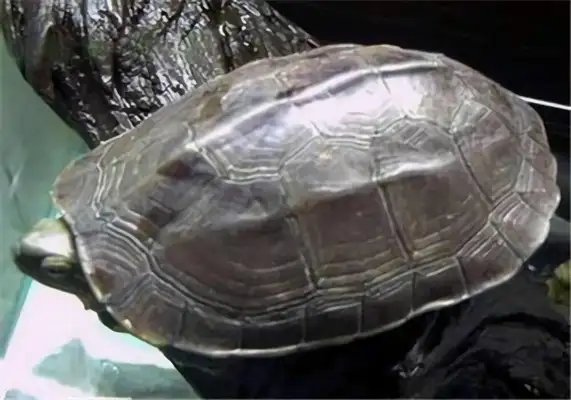
The ravioli are located in most parts of the country, and their appearance is similar to that of grasshoppers and yellow throat turtles, which, according to some researchers, is likely to be a hybrid of yellow throats and straw turtles, but which has not been officially recognized.
Chinese name: Luan Yuen Sea Turtle
Latin name: Maureens Pritchardi
Context: Animals
Gate: Pipeline gate
Amen: vertebrate Yaman
Programme: climb
ACQUA: ACQUIPMENT
Tortoises.
Asia: Aside the neck turtle
Section: Sea turtles
Aako: Ako the Tortoise
Group: Sea turtles
For: Water turtles
Asia: Sea turtles
Speciculture: Water turtles
Geographical distribution: Jiangsu, Zhejiang, Anhui, Fujian, Jiangxi, Hubei, Guangdong, Guangxi, Yunnan, Taiwan, Hainan. Outside Japan.
Reproduction: Eggs. The eggs were laid in May-September, 2-3 times a year, each with a weight of about 13 grams. Turtle's head is blue, and it's called the Green Head.
Practising: The ravine turtles live in flash-flow buffers or backwaters in hilly mountains. A variety of fruits, including fish, shrimp, snails, insects, and bananas.
Body characteristics: smooth back; small head; kisses beyond the lower jaw, tilting to the inner side; slightly dent in the centre of the front end of the upper jaw. The morphological characteristics of the water turtles are drawn up in Lagu.
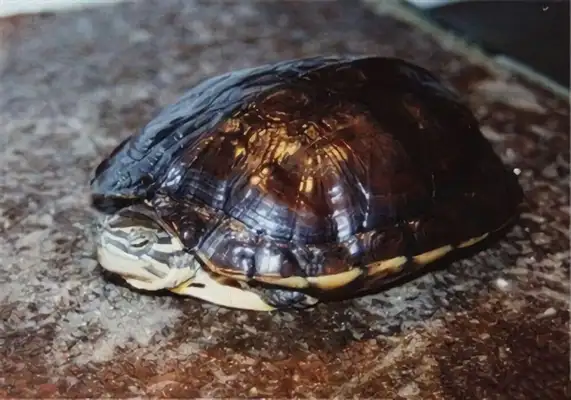
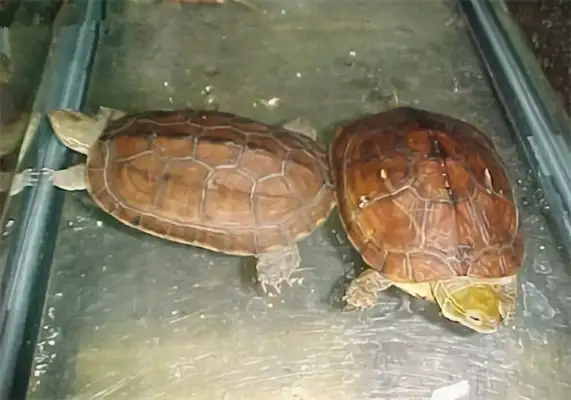
The look of the water turtle is strange, the head looks like a grass turtle, and the color and color of the back nail is like a yellow throat turtle. Many people think it should be a hybrid turtle, but some still think it is a special turtle.
The back of the head is smooth, the head is small, the kiss is beyond the jaw and it is tilted to the inner side, and there is a slight dent in the centre of the front end of the jaw. He's flat in his back, he's three-legged. Green yellow on the back of the head; yellow on the larvae and yellow on the larvae; and a yellow tattoo on the side of the head from behind the drums. Leather ash or tan, which is implicit in the chords of each shield. The bridge and the abdomen are yellow, with a large black spot in the centre of the rear edge of each shield. Four limbs brown. There's yellow stripes on the tail.
189 mm male, 193 mm female. The back is ambiguous, and the back is clear. On the back, the abdomen are stitched to the bone, if the abdomen are shorter than the abdomen; the larynx is prominent and the front end is dim; the back end of the anal shield is missing deep; the cortex and the abdominal shield is the longest, almost the same, and the condensation is the shortest. Toes are full. Seven cones, four sides of the first vertebrae; six sides of the 2nd to 4th vertebrae, with short sides behind; five sides of the 5,6 vertebrae, six sides of the 7th vertebrae, with short sides in front; and a medium-sized inner plate, with a ecstasy slit in one of the latter four parts. I've been working on the knowledge of water turtles.
It is not complicated to raise water turtles, and there are many issues that require attention if they are outdoors, such as the prevention of natural enemies, disease control, etc. The methods of care of water turtles are described below.
I. Prevention of natural enemies of water turtles
The enemies of the water turtles are mainly snakes, water rats, weasel, wildcats, etc. In the summer, water turtles are often active at night, while water rats and weasel go in and out at night, and while the water turtles are protected by hard shells, they are vulnerable to enemy bites and death. In addition, when eggs are corruptly spoiled, large numbers of ants are often recruited to endanger eggs and child turtles, to the detriment of turtle breeding. Care must therefore be taken to remove these hazards and to provide a good ecological environment for the breeding and growth of the larvae turtles.
II. Prevention and control of water turtle diseases
Artificial aqueous aqueous tortoises may occur in crustaceans. Although all of these are crustacean pathologies, the strain of pathogens varies depending on the symptoms. Gelanella, Granella positive. Symptoms include crust peeling, color deposition, ulcer, paralysis of limbs, loss of foot claws and death of internal organs. Animals such as shrimp, snakes, sea maggots as feed, soil, contaminated water, etc. may be the source of infection. Bacteria enter through bruises. The medication is used to bathe the body with appropriate antibiotics. However, the toxicity of water turtles that are allergic to some antibiotics requires special attention when used. It's a water turtle.
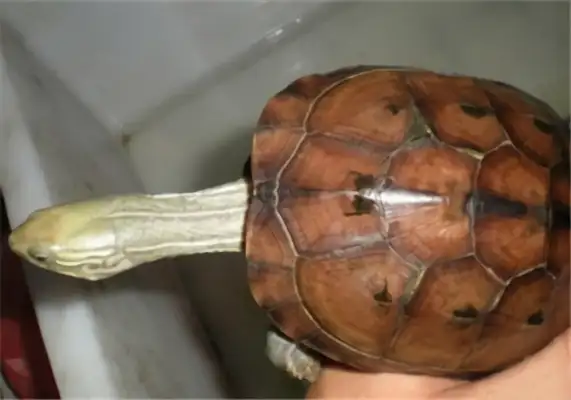
Water quality control is to be observed in the raising of water turtles, the depth of the water is not to be too deep and open to the use of tanned tap water, but the temperature changes in the water must be treated with increased temperature in winter if the turtle is not to hibernate.
I. Quality and level of water raised by water turtles
The water bodies of the water turtles must be fresh, and the water's transparency must be around 30 centimetres. Turtles are thermogenics, and changes in water temperature have a direct impact on changes in the temperature of turtles, so water depths increase and decrease over seasons. In the spring, the temperature is low and the water is shallow, generally around 0.5 metres; in the summer, the water is high and the water is deep, and in the autumn, the water is shallow; in the winter, the water level is stable because the temperature of the turtle changes with the temperature rising and the temperature of the water rising. If the temperature drops sharply and the water levels are high and low, the turtle can only regulate the body temperature with nutrients accumulated by itself and die when the nutrients are exhausted.
ii. Water treatment of water turtles
In general, water turtles tend to use piped water, which is essentially neutral, and whose hardness, acidity and alkalinity meet the requirements for raising water turtles, so there is no need to worry in this regard (with some exceptions, such as drilling, Marta, Japanese rock turtles, nails, etc.), but when running water is used to raise water turtles, chlorine gas must be removed. The main method is drying, chemical. The selenium-laying method is used in the sun for two days or in the absence of light for four to six days. The chemical method, sodium sulphate, which is removed from chlorine at a rate of 10 kg water plus 1 g sodium sulphate, is used after mixing and dissolved. I'm going to make some points for the turtle.
The provision of reasonable food is essential for healthy growth in the feeding of the water turtles, where newborns are vulnerable both in their body and in their digestive organs, providing soft and nutritious feed, while turtles have a rich choice of feed.
Shelled turtles are delicate and should be raised separately and carefully managed and properly fed to fine feeds such as ripe proteins, yolk, noodles, rice, fish shreds and shrimp. Tortoise food is widespread and can be eaten by small fish, shrimp, snails, mackerel, vegetables, rice, etc. Generally, when the temperature rises to more than 15 degrees, it starts eating. The food season of June-September began to decline in November.
When water temperatures fall below 15 degrees into hibernation. Temperatures are low in the spring and autumn, feeding time is set at 8-9 a.m. and during the summer season, the water turtles are expected to move at 4-5 p.m. The water turtles eat in the edema. Water turtles are fed about 4 per cent of their body weight at a time when they are fed the following day, after which they are cleared in time to prevent contamination. Keep the water fresh. The growth of the water turtle is related to the quality of the feeding, which is usually fed to animal baits, with an increase of approximately 50 grams per month.