No.: PET5076
English
Origin: Central Bolivia
Vulnerability to disease: decomposition
Life: A brief description of the species of a giant snake neck turtle for about 50 years
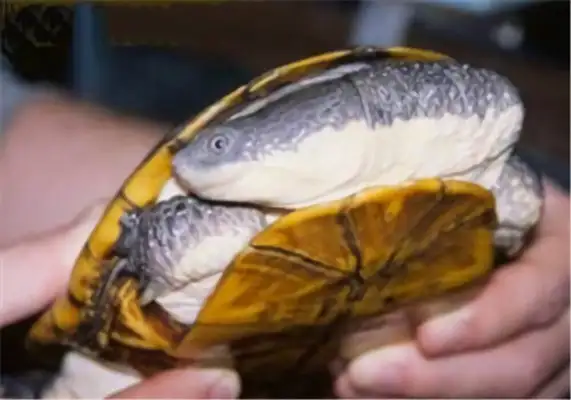
The giant snake neck turtle is not only the largest snake neck turtle, but also the largest snake neck turtle. A giant snake's neck turtle cannot shrink his head back into the shell, but he can bend his head to one side, which is one of the side neck turtles, with a small number of them and few artificially raised.
The jackal turtle is a snake's neck tortoise, a neck tortoise, alias a head tortoise, a head tortoise, and a head tortoise. The width of the headband from the position of the drum membrane is greater than 1/4.9 times its length. The maximum size of the acetate is 23.5 centimetres, with the four most medium-sized turtles.
Chinese name: giant snake neck turtle
Anonyms: Big-head neck turtle, Big-head neck turtle, Big-head neck turtle
English
Latin name: Acanthochelys macrocephala
Context: Animals
Gate: Pipeline gate
Amen: vertebrate Amen.
Programme: climb
I'm looking for a turtle.
C: Snakes and turtles
It's a neck-stabbing turtle.
Reproduction: Eggs
Body characteristics: Not only is the large head, but the largest of the four is the size of a neck-stabbing turtle, which can grow to about 24 cm, most of the backs are grey and brown.
Distribution: Central Bolivia (Mamore River water system) and South-West Brazil (upstream of the Paraguay River).
Lifestyle: Living in swamps, wetlands, or small rivers at a flat rate, feeding on a snail. Characteristics of a giant snake's neck turtle
The back of a giant snake's neck is brown, its head is large, it has a few dotted grafts, and its neck is long, a characteristic characteristic of a snake's neck. The main reason for the popularity of the jackal is the head, which looks more like a big head snake.
The head is popular as if it were already a strange phenomenon in the water turtle world, and it is rare to hear that the turtles have someone who likes the head, and that the legendary giant neck-stabbing turtle is not only large, but also the largest of the four, which can grow to about 24 cm, with gray and brown coats.
The largest size of the jackal turtle is 24 cm, and the largest of the four types is the medium size. There are many short circulars of ash or brown in the back and long in the neck. The width of the headband from the position of the drum membrane is greater than 1/4.9 times its length. They live in marshes, wetlands or small rivers at a flat rate, where they feed on snails. The head graft was found to be related to its eating properties. The knowledge of giant snake neck turtle care
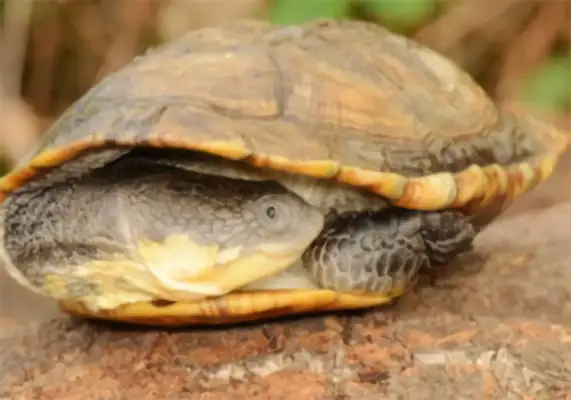
Cyclops are prone to disease, so in raising animals, care is taken not only to raise them but also to learn to examine their health. Artificial reproduction is more difficult in the case of giant snake neck turtles, and in the case of successful reproduction in general it is natural in the field.
I. The breeding of giant snake neck turtles
The breeding season for giant snakes is not widely observed, but it is assumed that they will lay eggs by the spring river. Its eggs are approximately 34 x 22 mm, white and fragile. The search for a spouse began immediately after waking up in hibernation. Their mating and end-of-life rites are somewhat different. The male would approach the female and circle around her repeatedly and then stop and face her face. He would stretch his neck, stare straight at her face and pull his head up and down. During this process, male tortoises and female tortoises are occasionally found. The end was accompanied by a series of high-strength “black” and “creaking” sounds.
II. Health monitoring of giant snake neck turtles
The weight of a healthy snake's neck turtle should continue to grow, with drumming and bright eyes, good appetite, solid excreta, and turtle excreta that can directly demonstrate their health. A healthy tortoise does not have any extra stickyness in its eyes and nose, nor should its tongue be white. Snake neck turtles are vulnerable to a wide range of parasitic diseases, so newly acquired turtles must be isolated for a certain period of time before they mix with other turtles. If the tortoise's weight is low or not healthy, it should contact the vet immediately. Insanitary turtles should be kept indoors to raise the temperature to 29 degrees. The humidity will increase accordingly. You can't let a sick turtle hibernate. The living environment of a giant snake.
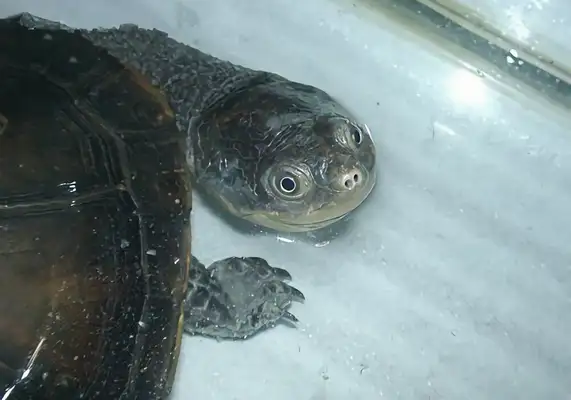
The breeding environment for the giant snake-back turtles is different from that of other snake-neck turtles. Cobra neck turtles prefer to live in a weak acidic water quality where they are less susceptible to disease and are growing fastest.
Viper neck turtles can be raised in large aquariums with sunback sites and light. The temperature should remain at 72-76 degrees Fahrenheit. You can consider the use of peat and extend some of it to water. There are indications that if the pH of water is kept at a low level, these turtles can be fine around 6.5 and can avoid some common skin problems, while peat or peat can reduce pH.
They can be found in swamps, lakes, tributaries of rivers and waterways with slow currents. Such turtles may migrate to land in the summer, and they are often found on the edge of the water when it rains. Snake neck turtles nested in the spring or early summer, producing 8-24 eggs for an incubation period of approximately 3-4 months. Turtles in wild conditions have a habit of hibernation, but they are still active, even at lower temperatures. The most appropriate growth temperature is 23.7 ~32.2 for the cobra neck turtle and 27.3 on average. The maximum is 30 centimetres. The point of the giant snake neck turtle.
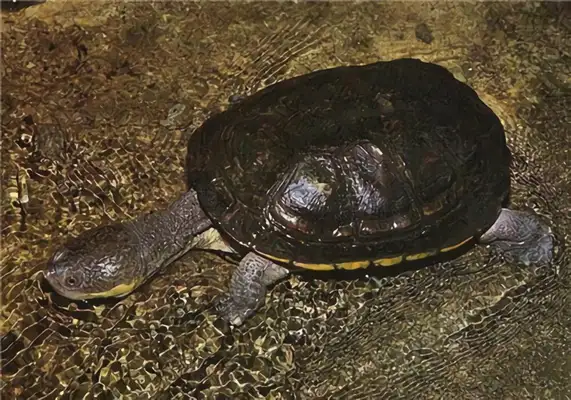
Because of the small number of animals raised, there is no uniform breeding standard, and in the wild, the turtle is a meat-eating turtle, and if you are lucky enough to get a turtle, choose as much food as possible in order to find his favorite food and ensure full nutrition.
The faeces of a giant snake's neck turtle should be solid and keep shape. If they are found to be rare, this is a good indication that turtles are undernourished or ill. This would involve improving the diet or taking samples of excreta to detect parasites.
The dry skin cracking of the cobras is usually a sign of malnutrition, dehydration or insufficient humidity. This can be cured by adding vitamins to feed and often bathing. The appetite of a healthy giant snake's neck turtle is very good, although sometimes the size of the diet varies slightly depending on the season. Some female turtles may close their food before laying, but their appetite will recover immediately after laying. If a giant snake neck turtle refuses to eat for more than three days, you'd better take it to a vet.