Designation: PET6526
National origin: Peru, Amazon tributary, Colombia, Brazil
Vulnerability to diseases: albino disease, rotting tail disease
Description of species of red and green light fish: 1-2 years
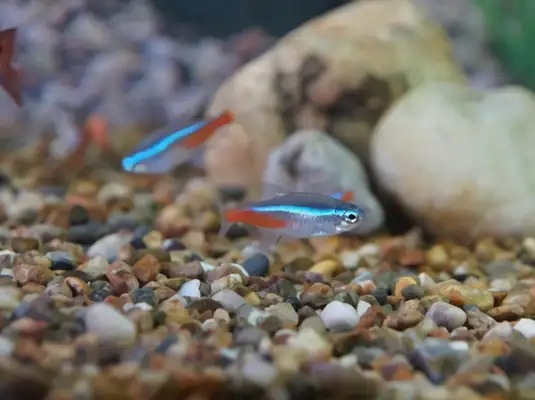
The red and green lightfish are a common species in aquariums, and many aquariums are kept in aquariums with ablutions. Such beautiful fish were originally distributed in Peru, Amazon tributaries, Colombia, Brazil, etc. Because the red and green lightfish are beautiful and beautiful, they are very popular with aquatic lovers.
Amen: vertebrate Yaman
Syndicate: Sculpture
Context: Animals
Section: Plasma Walls Section
Region: Sea
Gate: Pipeline gate
Chinese literary name: Red and Green Lampfish
Amen. Characteristics of the red and green lightfish of the vertebrate
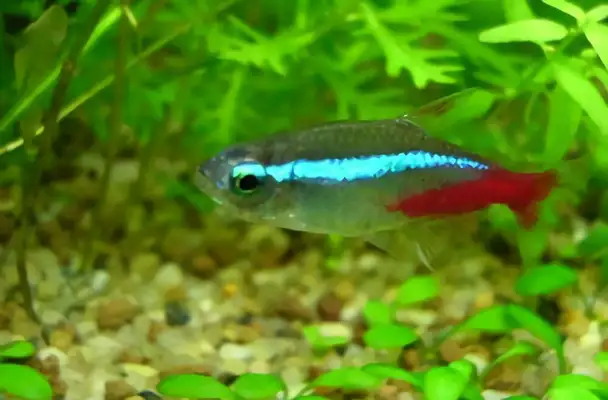
The image of the group of red and green lightfish is very popular with many fish friends, and because of the difficulty and mildness of raising red and green lightfish and the desire to move in groups in the lower middle of the aquarium, it is very popular with aquatic lovers and a common species in the aquarium.
The red and green light fish are small, small, flat, 3-4 cm long. Head is smaller than height. Shorter kisses, shorter than eyes. Small mouth, subtop. Large eyes, on the upper side of the head. The back fin is in the centre of the body and begins at a distance less than the end of the kiss. With a fat fin, long above the tail handle. Long hip fin, extended to the rear of the tail handle. The chest fin and abdominal fin are normal. And the tail handles grow higher. The tail is deep and shaped.
Red and green light fish are beautiful, green on the back. The eyes are black, the eyes of silver and blue are black, and they give green light. Up above the sideline, it extends from the eyes to the tail handle, with a light blue neon strip, which is beautiful. (b) The vertical belt until the back is converted from brown to black, and silver white before the bottom hip. The center of the body extends to the tail handle with a red stripe. The bright colour belt on the body is reflected in light from different angles, sometimes green, sometimes blue, combined with red stripes on the upper and lower parts of the body, red, green and glitter, and silver on the hips, with the right colours, especially in the night grass-making aquariums where the light shines, dozens of tails of red and green lightfish, in groups, and to make the water-making aquariums glamor, like sparks, glamorous and very attractive. Red and green light fish breeding environment
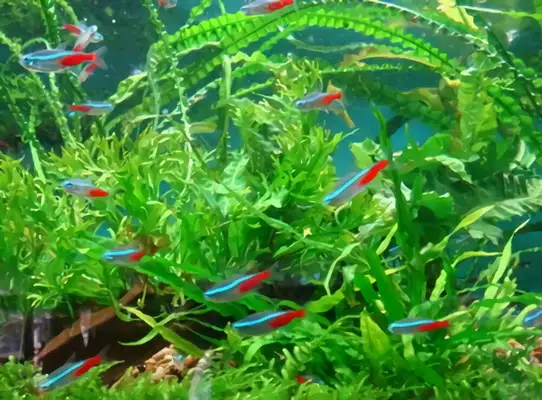
It is not very difficult to raise red and green light fish, but it is also necessary to take care of certain rearing techniques to keep them healthy. It is recommended that the aquariums of red and green lightfish should contain, preferably, sunken wood and watergrass and that water quality needs to be stabilized.
The red and green light fish are mild, easy to feed, grooved in the lower and middle layers of the aquariums and can be mixed with other species of fish. The water temperature is 22-24 degrees Celsius, the water quality is micro-acid soft water, and the water colour requires clarity and transparency. The bait is based on small live foods. Its joy lives in a water tank of dark light, where exposure to strong light is prohibited. The quality of day-to-day rearing is dominated by old water and it is inappropriate to add too much to new water; otherwise, it is prone to white spots.
Reproduction of red and green lamps is more difficult, mainly in the form of higher demand for reproductive water quality and special care requirements for papi. Reproduction of water requires the selection of very soft distillation water, which is then adjusted to 5.6-6.5 with sodium phosphate and pumped to air for two to three days, filling it with an enviable bottle of large mouth glass. A nylon plate is laid at the bottom of a large glass bottle (cal 90 mm, 180 mm high, 130 mm deep) (the eye size of the net should not allow for pass-through) and a small amount of hair weed is laid on the board and a pair of fish is placed in each bottle. In order to increase production, an incubator usually requires 50 to 100 bottles. The red and green lightfish.
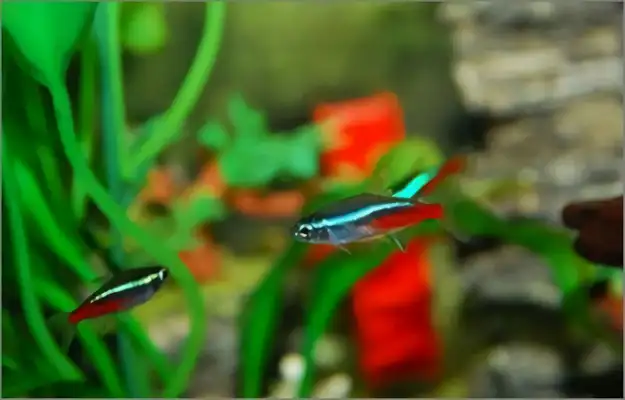
The normal life span of red and green lightfish is 1-2 years, so what can be eaten by red and green lightfish when they are raised to keep them healthy? In fact, raising red and green lightfish requires special attention in addition to the choice of feed for red and green lightfish, as well as the environment.
The red and green lamps are not choosy to food, but they are self-fed to live insects and dry feed as long as they can swallow. Fish (more than 1.5 CM) is fed to the red bug once a week, and usually small particles are dry feed, fish are strong and lively, and young fish are only dry feed.
Red and green lamps are sensitive to the quality of water, and the North is the most suitable source of water for temperature 24°C and acidic water. New fish enters at least one fifth of the new water to reduce mortality and, when adapted, to maintain an old water and high oxygen environment. In short: new fish, old fish. The new fish enters the tank and every time the water is replaced with a fungicide. It's not more than 4-6 pounds of 2,000MM.