As the ecological environment improves, it is clear that wildlife-related sightings are increasing. In the past, even in remote rural areas, it had been difficult to see wildlife, and even in large cities, animals were often found.
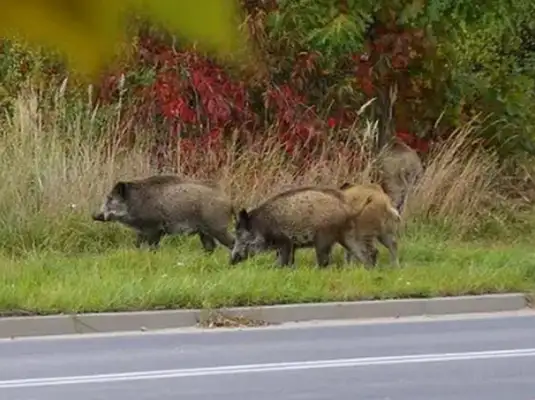
In the case of wild boars, these years have seen news headlines in major cities, becoming the first endemic species. The city of Nanjing is often visited by boars, and is often called “Cities of boars” by netizens. Wild boars will appear in places you don't expect, such as districts, schools, factories, shops, etc.
Wonder animal. Show yourself in the garden.
In recent years, the town of Li Sue, which is under the jurisdiction of the Beijing Shu Yi district, has benefited from the construction of the ecological environment, which has been improving and the number of wildlife is increasing. The number of animals up there makes it easier to break into human areas.
In recent days, villagers of Zhong Guo Village in Li Su Town have found a strange wildlife in their home garden. According to the villagers, he intended to work in the fields as usual, and suddenly it appeared that there was something different in the garden and looked closely at it before he found a wildlife.
This animal looks strangely different from the animals we usually see, and it's fierce, and when people come in, they scream.
Nose like a pig, body like a dog.
The animal found in a restaurant in Li Su Town, Beijing, is indeed strange in shape, and its most obvious feature is a kiss on the nose, like a pig's mouth, but its body is like a puppy. Later, it was identified by experts as a baboon, known as a pig baboon, or a civilian called a sardine or a mountain baboon.
The hairs of the pigs are mixed in black and white, and the hairs on both sides of the back and abdomen are black and brown; white stripes in the head extend from the kissing nose to the back of the neck, and white stripes in the lower eye. The pigs belong to the skunk, and within the skunk family there are two other animals that look similar to it: the dog and the skunk.
The main difference with a dog is in the nose, the dog has a nose like a dog; the difference with a dog is in the white hair on the face and in the white hair on the cheek, but it is in the irregular form of a clover, while the pig's is in the strip.
The porcupine is thicker, looks like a fat puppy, has short limbs, has small eyes and ears, usually has a tail of no more than 20 centimetres, has well-developed claws and has a strong excavation capability.
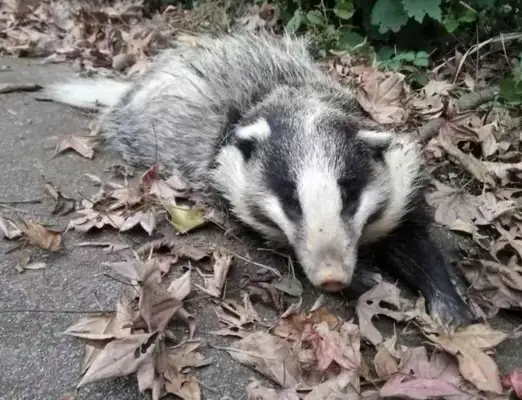
It is true that pigs like to live in caves, and that natural good caves can be found, so they usually dig themselves. They like to dig caves in fields, in desert hills and even by the road.
The structure of the caves dug by pigs is relatively simple compared to that of his big brother, the dog, which usually has one or two holes, which are cleaner and dry, and which are covered with dry grass where he sleeps.
It's more gruesome.
Even though they also have sharp-toothed claws, they rarely catch larger animals, which are grotesque. Animal foods are mainly frogs, lizards, mudslides, insects, rats, crustaceans, etc., and plant-based foods are generally fruits, seeds, roots, maize, wheat, peanuts, potatoes, etc.
Pigs are less visible, but they have a strong sense of smell and usually rely on a sensitive sense of smell for food. In addition to excavating the food in the ground with claws, a pig's mouth and nose can indeed act as a pig's mouth, turning out insects, plant roots, etc. in the ground.
Most of the skunks, as is well known, are more ferocious, for example, when they typically represent the Hindley bead, which is recorded in the Guinness Record as “the world's bravest and fearless animal” and is described by netizens as being either on the shelf or on the way to it, even in the face of a lion.
Although it is not strong, it also inherits the ferocious nature of the skunk, which, when confronted with an enemy or threatened, makes a violent noise similar to that of a pig. They will then stand up for the first half of their body and demonstrate with their teeth. If there is a fight, it will strike back.
It's all over the provinces, mostly south.
Porridges are mainly located along East Asia, and South-East Asia is its main distribution. In our country, the distribution of pigs is also widespread, with almost all the provinces of China, especially in the south, and more so.
Porks are highly adaptable to the environment, whether in low-school mountain forests or in plains, hills, bushes, etc., where their caves are located in steep or dense areas of the sunside mountains, where, in addition to digging themselves, they occupy the caves of other animals, or directly exploit natural rock cracks, trees and caves as their own.
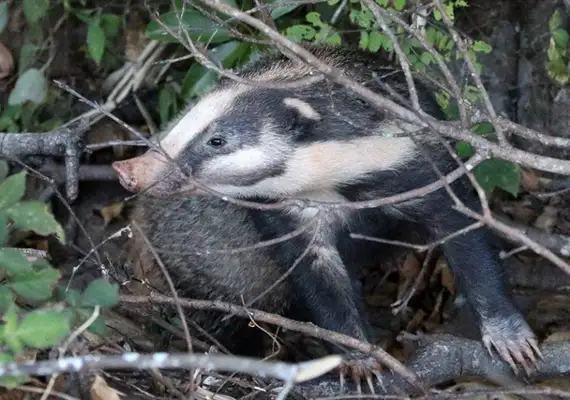
The pigs are nightly and usually sleep in their caves during the day, when they come out in the evening, and the morning and evening are peak periods. They have a very small range of activities, in most cases only in the vicinity of caves, and when they need to be eaten, they run to dozens of metres for food.
Porks also have the habit of hibernation, which is the time when they begin in late October each year. In order to get through the whole hibernation, they eat a lot before hibernation. Around the next March, as the temperature rises, the pigs wake up from hibernation.
As pigs are animals with more crop hazards, they have been hunted in large numbers in earlier years, resulting in a sharp decline in the population. However, as the country ' s ecological environment has improved over the past 12 or 20 years, the number of pigs has grown, so finding them in places such as vegetable gardens is not new.
It's worth mentioning that the pigs belong to the State's "triples" to protect the animals.