Designation: PET3206
English name: Tabascomudturtle
Origin: Out in the Caribbean lowlands of Mexico
Vulnerability: aqueous diseases, gastroenteritis
Life: About 50 years
Price: Brief description of the species of molasses: 1500-1800
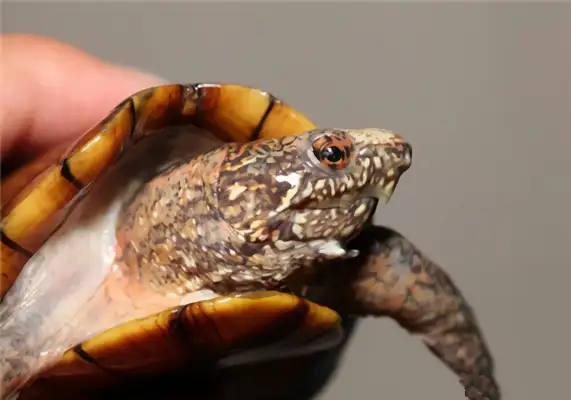
As a species that is more scarce than a narrow bridge, it has always been at the top of the egg turtle with its beautiful headlines, and most of the country ' s sandy turtles are currently from the Mexican Caribbean Sea, with a large number of wild ones, but the market is rare.
Living in small, medium-sized rivers and large streams and even dams are ideal habitats, with laced mud turtles generally present in the upper and downstream waters of Alabama (Jerveson, Marshall, Lawrence, Walker, etc.). Historically, it has been reported and found to be living in the Black, Wally River in unknown numbers, and in the current circumstances, only about 15 per cent of the habitat retains these healthy, reproductive turtles, so the population is slowly retreating.
English name: Tabascomudturtle
Latin name: Kinosternonacutum
Geographical distribution: laced mud turtles are found in the Caribbean lowlands of Mexico, from central Veracruz south-east to northern Guatemala and Belize City (capital of Honduras). It is clearly not located in the northern part of the Yucatán peninsula.
Reproduction: Eggs. The season of spawning is usually between March and April.
Practising: Living in lakes, streams, temporary ponds at low altitude and humid forest lands up to 300 metres above sea level.
Body characteristics: This is a medium-sized tortoise, which is about 12 cm long, usually has a vertebrate bone in the centre of the back, and perhaps an ill-defined and blurred vertebrae on both sides of the larvae. Stained mud turtle morphological characteristics
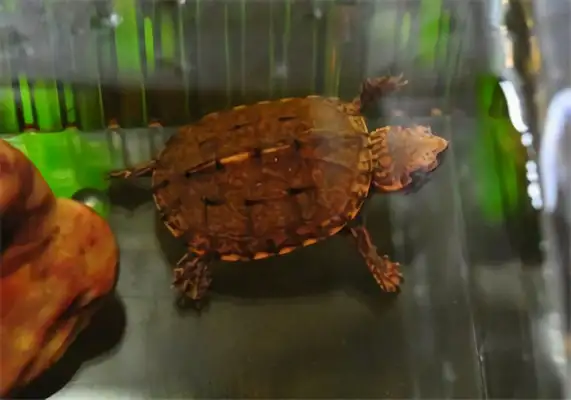
Striped mud turtles are medium-sized tortoises of about 12 cm size, usually with a vertebrate bone in the center of the back, perhaps with an unclear and more blurred vertebrae on each side of the larvae.
The width of the vertebrae is greater than the length, the first vertebra is in contact with the first pair of the two rims, the fourth rib shield on both sides of the back armour intersects with the eleventh bulge, and the tenth and eleventh bulges are higher than the previous ones. The back armour is usually brown or black and there is a black stitch between the shields.
There are two front and back chains of abdomen, and there are no dents at the end of the back. When closed, the abdominal armour can almost completely cover the exposed parts. The Lobe behind the abdomen has contracted slightly on the lid. (The length of the larynx is more than half the length of Lobe prior to the abdomen) At the wide bridge, the larger groin shield is usually in contact with a lower than its abdomen. The abdomen and the bridge are generally yellow or light brown, and there are black seams between the shields.
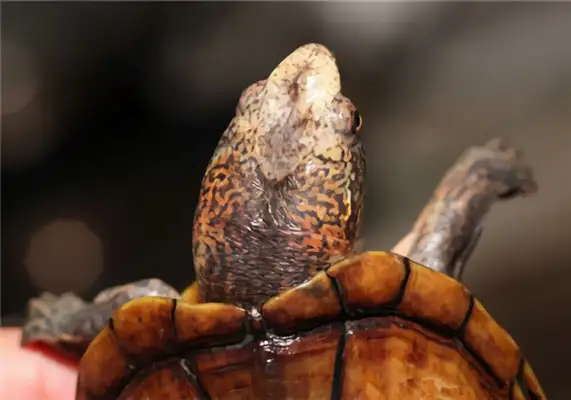
The head is generally not very large, and the shields on the beaks occupy a considerable area of the back, ranging from gray to yellow or red on the head and limbs. Yellow and red stripes often appear on the head, with creamed jaws accompanied by black colours, and brown or black stripes may also appear on the head, neck and limbs. There is no tectonic drops (coupling) in the thighs and back legs. There was a thorn in the tails of both sexes with a strong horn. The male body has long and thick tails, is smaller and grows about 10.5 cm. The female has a short tail, 12 cm long. Stained mud turtle care knowledge
In the past, many of the trailed mud turtles have been bought and sold over the years, leading to a sharp reduction in flatback numbers. In May 1984, the Alabama legislature enacted a bill prohibiting the capture and trading of laced turtles, which is a good deterrent to commercialized trade in that species.
Sedimentation of silt resulting from the initial soil erosion is a major factor and a negative impact on subterranean habitats.
Reduction in molluscs and invertebrates.
Natural environment with rocky habitats has changed so much that it is impossible to find food and hide in hiding.
3. The development of the subsurface layer in search of metal and chemical substances further poisons the musk. A study that rejects the impact of sedimentation on scavengers also points to the destruction of habitats and the serious threat to their long-term survival. Epidemic diseases are the second factor in the erosion of shells due to exposure to chemical and sewage contamination, the loss of food such as molluscs and invertebrates, the sources of pollution from acid water released from mines, agrochemicals, industrial waste and human waste, and diseases as by-products of pollution, which ultimately affect all aspects of turtles, slow growth and lower fertility rates.
The last three decades of research have shown that the category does not exist for a very long time, but certainly it has decreased significantly. The majority of the historical geographical distributions were noted by Mount 1981, Dodd 1988, Ernstetal (1989) and others, and only a fraction of the previous distributions generally covered the health status of the category. The reduction in this category was initially caused by several factors, such as water quality and excessive ground deposition. Stained mud turtle living environment
Speculous mud turtles inhabit small, medium-sized rivers and large streams and even dams are ideal habitats, usually upstream and downstream of Alabama ' s waters. Historically, it has been reported and found to be living in the Black, Wally River in unknown numbers, and in the current circumstances, only about 15 per cent of the habitat retains these healthy, reproductive turtles, so the population is slowly retreating.
Despite the fact that it is possible to live in different circumstances in streams and lakes, its habitat is more suitable for free streaming and rivers and has about 2 inches of aquatic vegetation. Rocks on the surface of the river are rich in molluscs, shallow sludges and piles, medium nutrients and appropriate bacterial quantities, appropriate water temperature, low pollution, and a constant accumulation of sand without harm.
The shy, mysterious flatbacks rarely tan the sun, prefer the faint sun and come out at night, especially in the middle of summer. It is clear that larvae are better active during the day, with a greater range of male than female activities, and within a season and within an area, a greater range of adult, male and female turtle activities remain mainly within 20-30 metres. For active individuals, snails and clams and clams are the main foods. Young children eat small snails, but apparently rely mainly on insects to a lesser extent. A strong correlation is the abundance of food and the density of populations in one place. It takes four to six years for males to reach sexual maturity, the back to be between 6.0 and 6.5 CM, and the female to reach sexual maturity between six and eight years, the back to be between 7.0 and 7.5, and the female tortoise to give birth to two eggs in one year. (May to mid-June or early July) There are approximately one to four eggs in each nest, and the female tends to lay her eggs in sandy and non-deep caves or near the river. When they were young, they were often hunted by water-related birds or by predatory fish, and bears were the main predators for the body. Giant crocodile turtles are also predators of larvae and adult bodies, whose lifespan is typically 30 to 40 years. High 4-7.5CM. I've got a few points for the laced mud turtle.
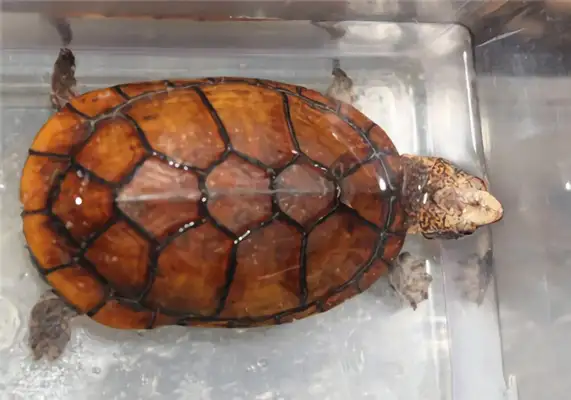
Aquatic-type striped mud turtles, which can be raised by water-filled containers such as water tanks. The actual size of the laced mud turtle is larger than it looks and the amount of motion is high, and other laced mud turtles do not UV exposure and are similarly unable to use calcium.
While laced mud turtles eat all kinds of food, they continue to feed cheap and low nutritionally valuable foods, which can cause malnutrition and must be given special care. Stained mud turtles require large quantities of calcium and should be fed with large amounts of calcium. The recent introduction in the market of nutritionally balanced feed for turtles is reassuring.
In addition, carp feed and dog food are appropriate food. Once in a while, fresh food, such as boneless fish, snake meat, rats, etc., must be found in the love of the scavengers. Feeding fish, meat chips alone leads to malnutrition and requires the addition of water soluble nutrients. What is described above is the food that is often provided to water-dwelling laced mud turtles, such as land turtles, which are not watered and love plant-based foods, and are less suitable for feeding with artificial feed. Vegetables such as cabbage, cabbage and carrots are generally used to feed with nutrients.