Designation: PET5224
English name: Macroclemystemminckii
Character: Fragile
Origin: South Central America, Mississippi River, Georgia
Vulnerability to disease: decomposition
Life: 50-80 years
Price: Summary of alligator species, $800-1200
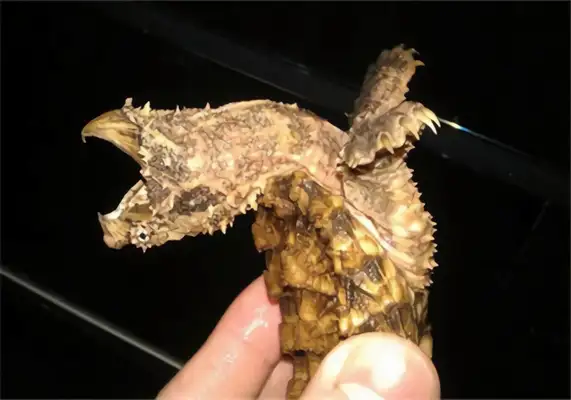
Large crocodiles, also known as turtles, are a more violent species of turtles, which are usually not mixed with other species, and many call them meat turtles because of their simple rearing, rapid growth and fast meat hoarding.
Real turtles are mainly located in Louisiana, Arkansas, Tennessee, Kentucky, Missouri, Kansas, Oklahoma, Texas. Large crocodile turtles can be seen in much of Mississippi, south of Alabama, in the marshes of Georgia and Florida. However, the artificial reproduction of large crocodiles is more difficult and is not yet documented.
Latin name: Macroclemystemminckii
Alias: Big crocodile turtles, camel turtles, crocodile turtles.
Categorized status: Croc turtles.
Distribution: South Central America, Mississippi River, Georgia.
Lifestyle: likes to live in rivers, ditches, lakes, marshes and deep-water ponds.
Growth temperature: Adaptive, water temperature at 3 ~ 45 °C.
Habitat: Surface amphibians.
Eating: In nature, tortoises, mainly animal feed, feed frogs, snakes, insects, shrimp, crabs, shellfish, fish, watergrass, etc. In a state of artificial rearing, fish, skinny meat, the inside of poultry and a small amount of vegetable leaves can also be fed to some mixed feed.
Individual size: Large size with up to 75-80 centimetres in back armour.
Female and male identification: female tortoise bodies are more round, tails are slightly thin, spill holes are located within the edge of the back armour; male turtles are larger, have longer tails, and spill holes are located outside the edge of the back armour.
Reproduction characteristics: In February-July of each year, 8-50 eggs are laid. Egg white ball, 30-51 mm diameter. Incubation period 100-140 days.
Whether or not to mix: cannot mix.
Difficulty of raising: easy.
Special request: like to stay at depths of 1 to 1.5 metres. Large crocodile morphological characteristics
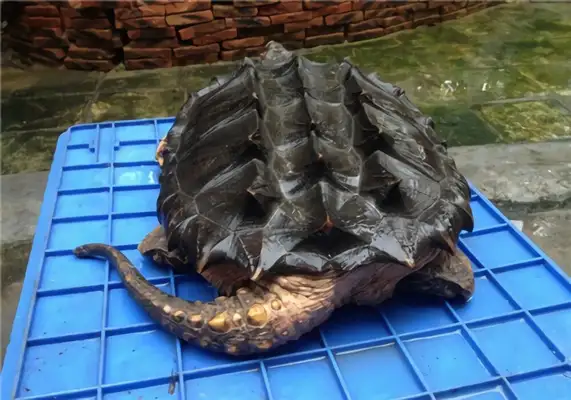
It's a strange tortoise, and it looks like it's passing from time to time to modern generals, heated and fierce. It's a turtle that bites a man's finger and has a strong upper and lower jaw.
The real turtle only produces the Mississippi River Basin in North America. One of the world's most famous crocodile turtles. It maintains the identity of the original turtle, and the mouth, the back armor shield, and the red tongue are extraordinary. The upper and lower jaws of the front mouth, like the eagle's mouth, are sharp enough to bite off a man's finger. The back armor shield is brown and 13 pieces of shield are like 13 hills in a row and three rows, and the edges of the back armour are a lot like a carving up, with eyes on both sides of the mouth, small and godly, and a lot of bumps on the head and neck. It has a little red worm-like graft on its tongue, which is connected to its tongue through the middle round muscles. Both ends are free to stretch. Its tails are thin and hard like steel whips, unlike the rest of the turtles, where its head and foot cannot fit into the shell.
The turtle looks like a crocodile, collects turtles and crocodiles, so it's called a crocodile. Its head is thicker, it cannot be fully condensed into the shell, its neck is short and thick, its neck is brown, its neck is small, its mouth is small, its kisses are small, its tails are sharp and long, both sides are vague, it has a pelvis on its back, two thirds of its back, it has a pelvis and a serrated mouth, it is thin, its top is brown, it is occasionally brown, its back is vague and it is radioactive. The abdominal acetal is smaller than the back accelerator and has a “ten” shape. The neck is brown, and the limbs and the tails are very strong. The backs are teeth, the abdomen are white, there are small black spots, black spots at a young age, big limbs, muscles, claws are sharp and strong and can crawl.
The size of the tortoise is large, with adult turtles having a size of 0.4 ~ 0.7 m long, weighing 45 ~ 75 kg, with a maximum weight of 200 kg, and a size of 0.75 ~ 0.9 m long, with males being larger than females. Great crocodile conservation knowledge
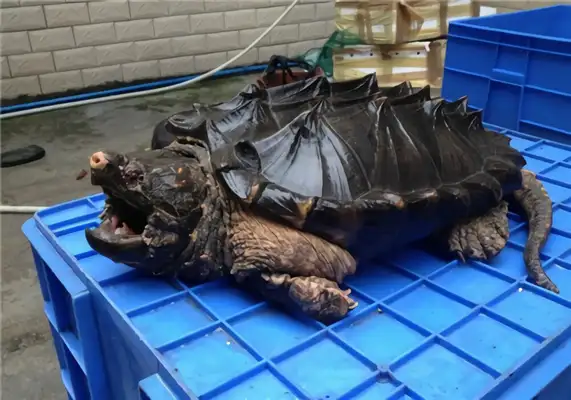
The way in which all people grow big crocodiles is simple, and because big crocodiles are a turtle who can't get sick, there are a lot of alligators. Even so, in the process of raising big crocodiles, we have to pay attention to the following.
I. METHODOLOGY
Eggs. After 11-13 years of adulthood, the males are larger than females (in contrast to other turtles), and the females lay eggs in April-June, with 10-60 eggs per nest. The eggs shell is hard, hatching about 1.7 inches of juvenile turtles with tails longer than the body.
II. The food of the crocodiles
The big crocodile eats the live food that automatically swims into its upper and lower beaks. But big crocodiles also eat anything like fish, beef, chicken and commercial turtle feed. The water should be clear and warm for the big crocodile turtles.
III. The difficulty of raising crocodiles
It is known that only females leave the water when they lay eggs. There's a unique pink structure on the tongue of a giant crocodile, like a worm. They lie silently under the water, grow up in their mouths and shake their “fish bait” to attract prey. They also eat anything that can be captured and swallowed, including other turtles. There was an individual who lived in circles for over 60 years.
IV. RESEARCH OF GROUND
The big crocodile eats the live food that automatically swims into its upper and lower beaks. But big crocodiles also eat fish, beef, chicken, and any meat and commercial turtle feed. The water should be clear and warm for the big crocodile turtles. Big crocodile living environment.
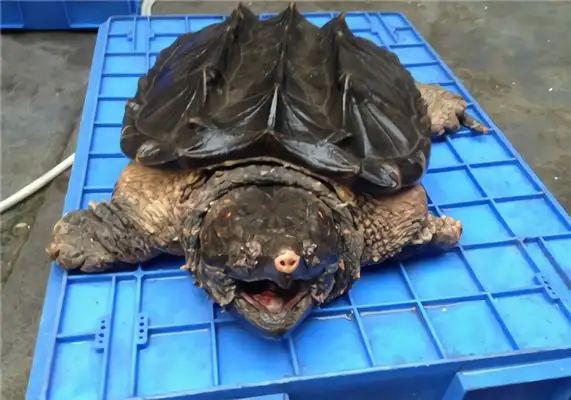
There are still a number of problems to be addressed in the breeding grounds, such as the density of raising, the filtering of ponds, etc. The turtles are strong, but they are very aggressive, and excessive death intensity can lead to fighting and death.
I. Rating ponds
Each square metre can be fed by a species of turtles group l (one male and two female) or a turtle group 3 or a turtle group 5 ~ 10 or a turtle group 10 ~ 20, which are raised by different sizes, and cannot be combined to prevent the growth of turtles.
II. POINTS, STATES, QUIREMENTS
In the early spring and early winter, one meal per day at noon, two meals per day at the end of spring and autumn, 40 per cent at 9 a.m. and 60 per cent at evenings, a fixed feed, one and a half hours before the next meal can be eaten less, the food must be small, the food must be soaked, ready, young turtles fed nutrient-rich, and the food must not be used. Feeding is based on animal feed, which can be properly fed with some vegetable fruit and vegetable feed, or with nails.
Time change, disinfection
Large pools, 20d ~ 50d part water exchange, 2d ~ 3d or 6d ~ 7d part water exchange, transparency is maintained at 10cm ~ 2ccm, and in winter, as little water as possible should be exchanged in time for the tatters, and the pool usually uses 10d ~ 30d bleach powder to prevent turtle disease.
Summer pool
80 cm must be maintained, the pool must have a shade of more than one fifth, and the pool should have a bit of plumbing, with trees planted around it, and fresh cooling should be injected, so that the water temperature does not exceed 45°C. Great crocodile food advice.
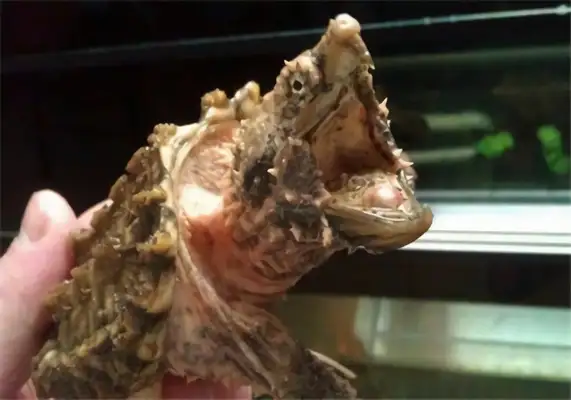
There is no special requirement for food, but it is a dangerous tortoise and do not try to bite it in his hand because it is a very dangerous move. And try to match his appetites with alligator food choices.
Under natural conditions, they are fed once a day in the early spring and early winter and are fed at high noon temperatures. In the middle of spring and autumn, the turtle eats and feeds twice a day, at 9-10 a.m. and 4-5 p.m., 40 per cent of the feed is fed in the morning, 60 per cent in the afternoon, 60 per cent in the corner of the slope or pool, and a wooden board in the side of the slope is used for feeding, and once a fixed place is fed, it does not change frequently, and the feed is finished within 90-150 minutes. If you do not finish, next time you will have less to feed the turtle, more to feed the turtle, less to feed the turtle, between 3-5 per cent of the turtle's body weight in the general feed, less in spring and autumn, and more in summer.
There is a lot of feed, but it can also be matched. But be careful, big is small, hard is soft and ripe. Small tortoises need to feed more nutritious feed and be as thin as possible to facilitate indigestion. No spoiled feed. Vegetable feed, such as guacamole, can also be appropriately fitted.
A special green feed for crocodile turtles (over 48% protein content) is recommended. At the time of adaptation, the field is called the formulation, adding to the overall mass of the ingredient 5 ~ 10 % of the luminous bacteria and about 45 % of the clean water, so that a long particle of 2 ~ 3 millimetres in size can be formed. It is more effective to produce floating-inflated grain feed, if conditions permit.
Feeding with feed amounts to 1.5% ~ 2.5% of alligator weight and 5% ~ 10% of fresh feed. Three feeding sessions per day at 0600, 1200, 1300 and 1700. The input is more and more even and makes as much noise as possible when the feed enters the water. They concentrate in one place, creating a pile of feed. The number of feed stations per pool should be determined by the size of the pool, usually 3 ~4 per square metre.