No.: PET5101
English name: Termsiphone atrocadata
Vulnerability: respiratory, digestive and parasitic diseases
Life: A brief description of the type of purple belt 10-15 years
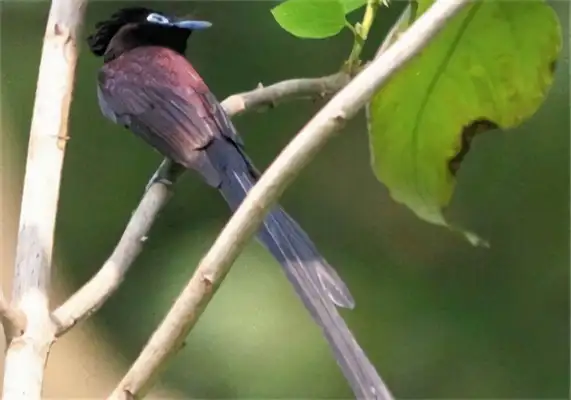
It is a medium-sized chirping bird. The bird is tougher, more territorial, and likes to chirp. It is best to be domesticated at an early age, otherwise it is easy to disturb the population.
Migration: Taiwan, China, is a bird, and the rest of the region is a migratory bird, only during the spring and autumn migration season. The violet belt breeds in the cold, broad-leave forests of Japan, Korea, Taiwan, China and the northern Philippines.
Chinese literary name: Purple Lifebird
Latin name: Termsiphone atrocaudata
Don't call it a Japanese bird.
Context: Animals
Gate: Pipeline gate
Programme: Birds
FREEDOM: FREEDOMS
Section: Volume Section
Yes: Life belt bird
Speculator: Birds of purple life
Asian: 3 Asian
Named by: Eyton, 1839
English name: Papanese Paradise Flycatcher
Purple Belt Form Characteristics
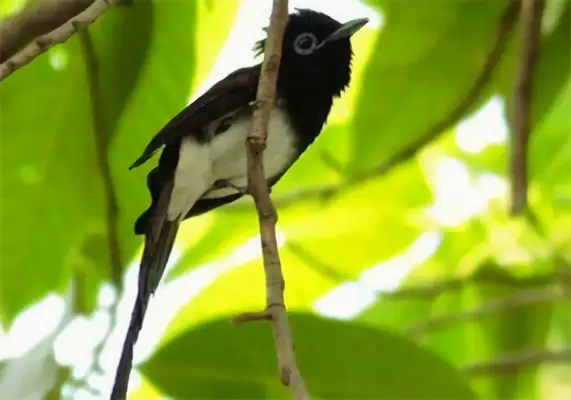
Many people confuse the virulent cord with the virulent bird, but the distinction is still relatively simple. The violet cord is smaller than the wiring bird, usually about 20 cm in size, and the male tails are twice as big as the female.
The male breast of the adult male is black and grey, with purple and blue light and crowned feathers. The lower body is white. The wings, back and hips are black and chestnut. There are extremely long black tail feathers in the middle of the tail, and the male chicks have a shorter tail feather. The difference between male birds and their life belts is in wing and tail black, close to purple. They don't look like birds. There's no white variant. The females are male, but the breasts are darker brown. Their feet are black, with big eyes and small blue beaks. The mouth is wide and flat, the mouth is elastic and the mouth must be thick. Heads, necks, chests, black, crowns, dark browns and metal glitter; lower chests grey, to the abdomen gradually white; tails black. Ion membranes are dark; eyes are naked around the skin blue; mouth blue; feet are blue. The violet life zone.
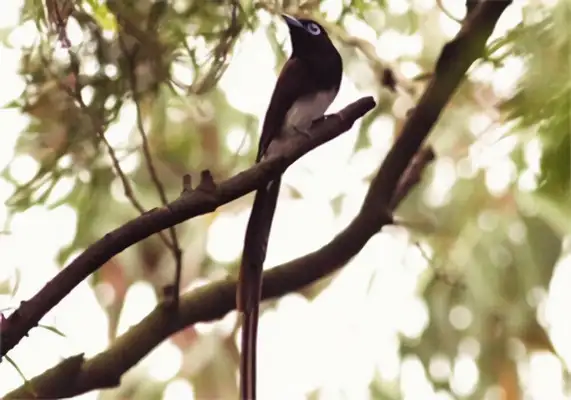
The violet belt is not very big, it's beautiful, it's pretty, it's very popular. In the wild, they mainly live in broad-leaved forests of low hills and hills below 1,200 m above sea level, as well as secondary-leaved forests.
They also happen to be found between the forest and the bamboo forest, particularly in the broad leaves forest near the valleys and streams. Most of the purple life belts in family cages are domesticated by captured wild birds, and they should be raised in larger cages. Because of the length of its tail, and in order to ensure the beauty of its feathers, it can be tamed in the form of mating. Winter room temperature is 18°C-25°C. The violet belt breeds knowledge
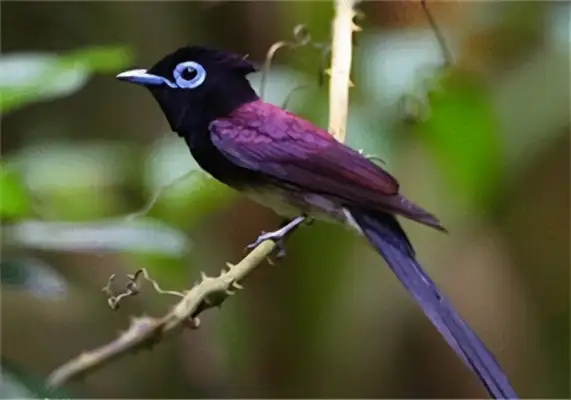
The violet belt belongs to a groceries bird whose diet does not need to be too concerned. The weakness of this bird is that it likes to sing, has a strong personality, is more territorial, and if it is not properly domesticated, it is more difficult to raise it later than other birds. The following is a detailed review of the breeding and diet of the purple band.
The violet belt is breeding in May-July. Most of them started camping in late May and early June, and encamped on small, broad leaves branches and bamboos in broad-leaved forests near the stream, as well as on young trees under the forest. The nest, which is shared by the female and male, can be completed in five to six days each, with a cone of reverse shape and a fairly sophisticated structure. The outer wall of the nest is woven with plant varnish, moss, feathers, cotton and spider webs, and the inner wall consists of fine grass roots, grass leaves, straws, bark fibres and moss. High 1-3m. Two to five eggs per nest, three to four more. The eggs are elliptical or pear-shaped and the colour of the eggs varies significantly, ranging from milk white or white to small red brown, white or grey spots. Incubation is primarily carried by females, and males are also involved in hatching activities during the female ' s absence from the nest for a period of 15 ± 1 day. The chicks grow late, the females and males grow together, and after 11-12 days of feeding, the chicks leave the nest.
The violet belts often operate alone or in pairs and occasionally see groups of 3-5. The sexual shyness is often found in the thick branches of the forest, when they jump and jump, when they fly between them or from one tree to another. The flight is slow, with long tails swaying, such as kite bands, which are extremely elegant and generally do not fly at long distances. They often fly from their nesting branches to catch insects in the air, and occasionally land on the ground with long tails. High and bright, high and high. During the breeding period, which is highly territorial, as soon as another bird invades it, it is removed until it is removed.
The violet belt, which is a hybrid flyer, usually feeds from lower forest habitats and is often mixed with other species. Food is mainly fed by insects and larvae, mainly beetles, gold tortoises, snakes, larvae, butterflies, moth larvae, locusts, larvae, larvae, straight-wings, twin-wings, and insects and larvaes.