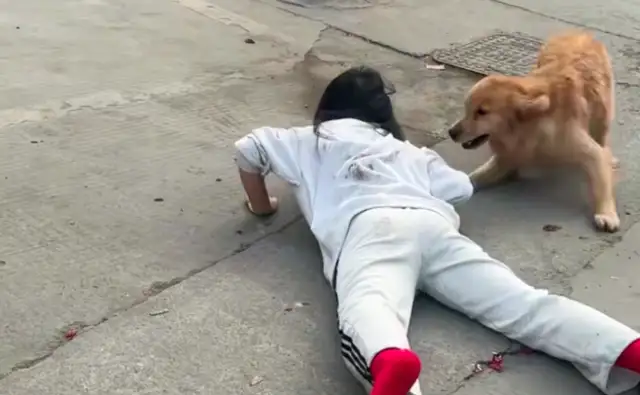
In recent days, journalists have learned from the Hunan High Court of a typical “no contact” violation of animal breeding, which is not without warning for dog breeders. A day ago, when Zhang was driving an electric car through Wang's house, he was suddenly chased by a dog raised by one of Wang's families, and the plaintiff fell from shock, causing a broken arm. After calling the police, and in coordination with the civilian police, Zhang ' s family was taken to hospital for treatment. Zhang was later identified as constituting a category 10 disability. As a result of repeated consultations with Wang, Zhang has not paid compensation, and proceedings have been brought before the People ' s Court of Hyuk Mountain, Liyang City.
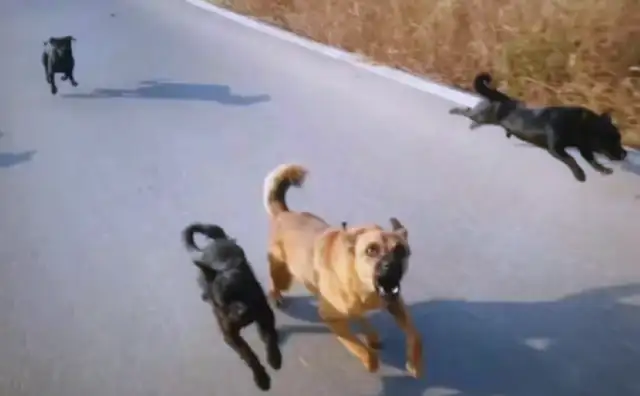
"My dog didn't bite him. He fell on his own bike. Why would he pay for it?" During the Court ' s pre-court meeting, both sides became more and more excited.
The investigation revealed that the incident took place in 2023 and that the contradiction continues to this day, after two public security operations and numerous mediations by grass-roots organizations. There was no surveillance at the place of the incident and no one was passing by. The hosting judge went to the police station to retrieve the police records in order to restore the facts of the case. After having obtained evidence, the judge organized mediation between the parties.
The judge explained to the defendants that the dispute was a typical “no contact” violation of animal breeding, and that, in accordance with the relevant provisions of the Civil Code of the People's Republic of China, the principle of responsibility for damage caused by animal breeding was applied to persons without fault. Generally speaking, Wang is liable as an animal breeder if Zhang does not cause the dog to fall off the motorcycle as a result of deliberate or gross negligence, such as flirting with the dog. Torts do not necessarily mean that they are bitten by dogs, and the barking of dogs, chase, etc. carries a certain risk, and the breeder is liable for damage caused to others by such dangerous acts. As a plaintiff, Zhang Yai, despite the fact that the incident had been recorded in the police report, was still required to provide evidence of causality and to prove that the injury was caused by the pursuit of a dog by Wang, but there was no surveillance or a third person.
In this regard, the judges took the law into account, in the light of public morality and communal harmony, and led to a change of seat between the two parties, culminating in a voluntary settlement between Zhang and Wang, who paid Zhang ' s compensation and offered to shake hands. This troubling event, which lasted for some two years, was finally substantially resolved.
The judge recalled that the principle of accountability for animal damage was no fault, i.e., responsibility for the violation of human rights should be incurred whenever the animal that was raised injured the person, whether or not the breeder or manager had been faulted. Thus, during the rearing process, the breeder or manager must comply with the relevant laws and regulations and take safe management measures, such as rearing or leashing, for the animals to be raised, in order to fulfil his or her duties of management and care.
On the other hand, the person who is the victim of a violation is bound by his or her behaviour, and he or she refrains from actively flirting with the animals that he or she breeds, and from being exposed to danger and triggering acts of animal stress. When such “no-contact” violations are encountered, in the absence of evidence of direct injury to others by animals, such as wounds, it is recommended that, in order for the victim to better fulfil the burden of proof, relevant evidence be gathered as soon as possible after the injury has occurred, such as timely alerting of the police, collection of witness statements, maintenance of medical records, etc., to assist the victim in proving the causal link between the injury and the violation.