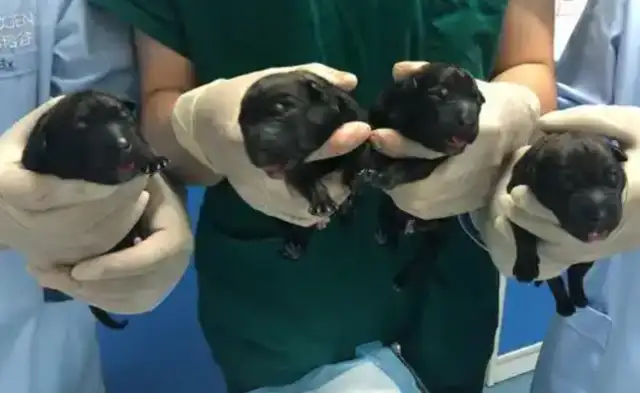
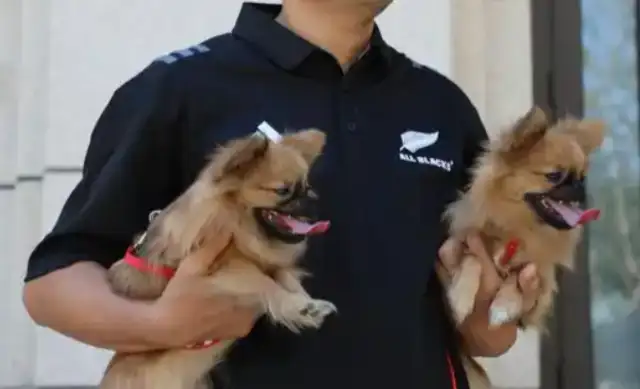
The two Marzis pups successfully cloned by the team of Dr. Zhao Minghui of the Zoological Science and Technology College of Aoshima University had recently completed the vaccination and care process, marking a revolutionary breakthrough in dog cloning. This innovation, which is a combination of AI visual recognition and micro-operation technology, has not only resulted in a cross-cutting increase in the efficiency of cloning, but has also broken the international “high-cost, low-success” technical impasse in canine cloning.
I. TECHNOLOGY STRENGTHENING: AID DESIGNING HOUND CLIMATE
Dog cloning has long been regarded as a “technical elevation” in the field of animal cloning. cytological nuclei are made invisible by the low in vitro maturity of canine ovaries, high cell fat content, traditional technology requires the transplanting of 50-60 embryos to produce a cloned dog, and operators are required to search for cell nuclei blindly under microscopes, with great labour intensity.
The Zhao Minghui team has developed over the years to integrate AI visual recognition technology with micro-operational depth. The team trained thousands of micro-images of cytocellular cells using the Volatile Neural Network (CNN) and succeeded in building artificial visual models that can accurately predict cell nuclei within tens of milliseconds. In combination with virtual reality (VR) technology, models project predictions into microscopes in real time, enabling operators to “visualize” to nuance, increasing efficiency more than threefold. Only 67 embryos had been transplanted for the current cloning, giving birth to two healthy pups, a success rate nearly 10 times higher than the international average.
II. Synergy in production research: process-wide nationalization to break down technology Break
Since the success of the first cloned dog in 2016, the Zhao Minghui team has continued to break the technical barriers. The development of an in vitro system for dogs, the absence of embryo implantation techniques for cat animals, etc., has enabled cat and pig cloning to be nationalized and free of dependence on imported equipment and reagents. This time, AI-Assisted Cloning works more closely with national scientific institutions to achieve a seamless link from research to industry - the project team combines the AI model with hardware equipment through the autonomous design of a portable reverse microscope, creating a complete intelligent cell core to the nuclear system, significantly reducing the cost of the equipment and increasing the standard level of operation.
This outcome has attracted international attention. The same type of technical coverage has not yet been found, as found in databases such as PubMed. The experts noted that the technology could be applied not only to pet cloning but also to significantly reduce the cost of breeding livestock, such as through the accelerated improvement of varieties through the cloning of high-quality animals.
Ethics and the future: technological breakthroughs trigger multidimensional thinking
Despite the significance of technological breakthroughs, the ethical dispute over cloning still needed to be confronted. Current canine cloning requires the operation to obtain eggs and implant surrogate mothers, and Animal Welfare International calls for stricter industry norms. In response, the Zhao Minghui team indicated that its technology had been ethically reviewed and that the surrogate mother dog had recovered well and that it would explore in vitro mature egg technology to reduce animal injuries in the future.
From an industry perspective, AI-driven cloning is opening new scenes. The team plans to extend technology to endangered species conservation, such as the cloning of rare animals such as the Northeast Tiger. Industry projects that the global market for animal cloning will exceed $5 billion by 2030 and that AI technology will be the core driver.
China's Power: Crossing from “following” to “leading”
It is no accident that Qingdao farmers made a big breakthrough. As early as 2001, China's first-ever cloned cattle, “Concien” and “Twice”, was born; and in 2023, the “Peace” of the whole-process national cloned cat was born to mark our complete technological chain. The success of the AAA-aided cloning dog has not only demonstrated China ' s autonomous innovative capacity in the field of biotechnologies, but has also contributed to the advancement of global animal cloning technologies towards precision and intelligence. As Zhao said, “Our breakthrough on the dog will provide a universal solution for other animal cloning”.
This innovation, which integrates AI with the life sciences, is not only a triumph of technology, but also a model of synergy between productive research and development. In the future, with the deep integration of genetic editing, stem cell technology, cloning techniques or the release of greater value in areas such as disease modelling, organ transplantation and so forth, balancing technological advances with ethical boundaries remains a common issue for the scientific community and society.