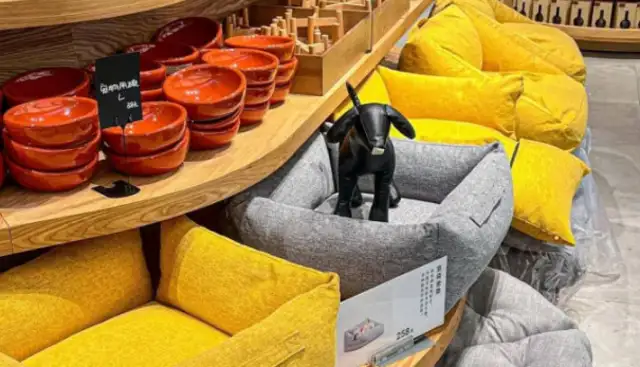
Japan's well-known lifestyle brand is unprinted, and a new move has recently taken place and is in the process of adding a new layout.
At the end of July, the MUJI parent company's good products programme officially announced that the “unprinted good goods” of the living grocery store had begun selling cat and dog commodities on 6 August.
Since the beginning of the year, many industry giants have moved on the pet track:
In March, Zhou Dafu launched his first pet exclusive jewellery series, built more than 20 cat and dog theme caps with full gold and ran a water test on the pet economy; in May, Adidas organized the “First Love Day” in Shanghai Rock Park; and in August, it was brilliant to buy 51 per cent of the shares of the Master of Frozen.
A cross-industry “pattern competition” was officially launched. Players in various industries have broken across the product lines, entered the border with differential advantages and injected fresh energy into the pet economy.
In September 2024, the unprinted parent company's “goods programme” was made public, with unprinted goods falling by 12 per cent over the same period to double digits for three months and 6.2 per cent in East Asia. The continuous decline in performance forced unprinted goods to seek new growth points.
It is well known that unprinted goods have long been known for their simple, high-quality life philosophy, and their products cover a wide range of areas, including home, clothing, food, etc.
The entry of cat and dog pets into the market is clearly an important step in further expanding the business landscape to meet the diversified needs of consumers.
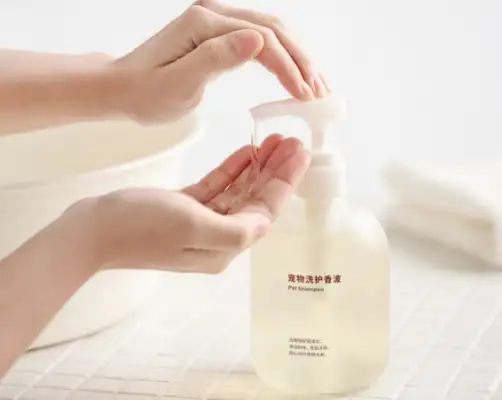
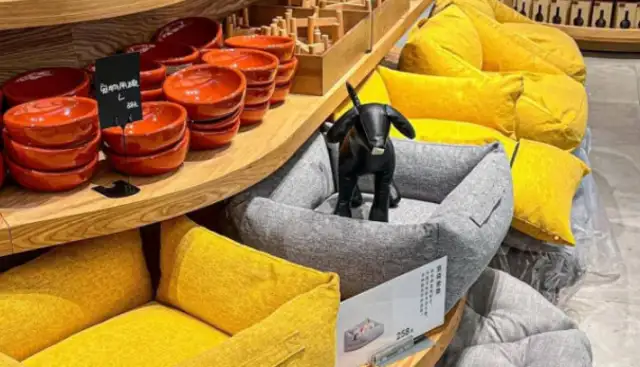
According to the announcement issued by the unprinted parent company, the new pet supplies covered a total of 14 varieties: they included ultra-fiber fibres sold for Yen 790 and towels for bags of pets; and 100 per cent of the natural ingredients sold for Yen 790 to care for mammograms. Products such as travel kits, ceramic dishes, pet mattresses and a variety of interactive toys, with emphasis on product safety and functionality.
Indeed, the exploration of the pet market began in November last year. At that time, its first test of water introduced cat foods and indoor groceries, which had a good market resonance, thanks to the fact that cats were mostly indoors and had a natural bond with the MUJI brand of home and lifestyle.
It was this initial attempt not only to validate the viability of unprinted brands in the pet area, but also to pave the way for further expansion of dog commodities. The extension of the product to dog commodities and the inclusion of generic household goods mark the official launch of the “second phase”, which covers a wider group of pets.
From a single product to a way of life, all development is being covered, and unprinted goods are gradually woven into a pet-centred life matrix.
Over the past five years, the pet industry has grown at a combined annual rate of 18.6 per cent, much faster than the growth of traditional retail trade, and has become a “smooth” in the eyes of capital. The cross-border movement of unprinted goods is only a microcosm, and in this competition a number of enterprises have come to the fore.
Consumers is making cupcakes for pets. How do merchants know that? It has been mentioned that in recent years many food enterprises have looked to the pet market. Like the new pet baked last year. Branding — Holland Pet cake, focusing on pet cakes and pet service experiences; three squirrels this year established the Emid three squirrel pets, Inc.; and the Inner Mongolia Congeitech Company, Inc., launched the pet food brand “Ee-Boo” ...
In the pet home electricity market, apart from vertical professional brands focusing on pets such as Homen and Pie, technologists, represented by Haile, Dyson and Matsune, have long begun to migrate the technological advantages of intelligent homes to the forward-looking layout of the pet landscape.
Specifically, Hale has integrated mature laundry technology innovatively into the petting scene, where the drying equipment in its X11 integrated machine mix, with a four-heavy air purification filtration system and an over-sized filtration area of 1508 cm2, enables the efficient capture of minor impurities such as pet hair, filtration, etc.
Dyson has also launched the Lovers programme to build a closed circle clean solution by publishing a pet hair cleaning technique that can identify 0.1 micrometres of microdust, with a mixer Hepa filter.
Overall, cross-border industry giants entering the pet market have responded more or less precisely to the growing sophistication and quality of consumption demand of the current pet population, moving from “fulfilment of basic needs” to “a search for higher quality experience”, bringing not only cutting-edge technology and advanced ideas, but also, in intangible terms, driving the entire pet household electricity industry to upgrade and transform.
However, behind the popular track is not an open road.
When companies such as Haile and Dyson are technologically suited to the pet market, the other giant's cross-border attempts end with a “silent retreat”.
Zhejiang Mei New Pet Technology Ltd., a fully-funded pet appliance company under the umbrella of the United States, is a case in point. According to publicly available information, the company had completed a summary write-off last year and, as early as 2023, there had been news on the market of a planned exit from pet operations and, during the same period, its official flag shop for pet supplies had announced the cessation of operations, marking the end of that cross-border attempt.
The withdrawal of the beauty from pet lanes is not an example, but it is a very representative reflection of the reality of “separation like mountains” in the pet economy – even when technology is in place to accumulate and channel resources, it is difficult for large businesses to filter markets if they do not actually capture the demand for a breakdown of the pet landscape and the core pain of the pet population.
The back-to-the-earth pet business layout, which targeted pet smart-home electric track in 2020, introduced cat-drink, odor, etc., and designed two sub-brands of “cat with gravity” and “fluffy & floppy” in an attempt to cover pet families at different levels of consumption.
But the problem is precisely the imbalance between “reproduction” and “adaptation”. For example, when designing a drinking water machine for humans, the core consideration is that water is stable and energy-depleted; but the core need for a pet water machine is much more than that.
The pets are more concerned about whether the current is in the nature of a cat “likes the flow of water”, whether it avoids hair, dust and dust that leads to bacteria, and whether it is easier to remove clean water to reduce the burden of water exchange.
In recent years, small bear appliances, millet groups, OPPOs, and conglomerates have entered the pet appliances market, but for the time being, except for Mi, who has achieved some success with strong brand influence and unique marketing models, the development gains of other giants in this area are not ideal.
However, neither the obstruction of the development of some enterprises nor the eventual withdrawal of the beauty proved that pet power was a “false demand” — on the contrary, the constant presence of new cross-border players was an indication of the real existence and potential of market demand.
The real problem is that some cross-border enterprises equate “petty economic heat” with “simply transplanting existing products for profit”, neglect the core of pet products — never labeling the product as a pet — but rather act as pet family members to address the tiny pains that traditional household electricity ignores.
The charisma of the pet track stems from real emotional demand and consumption escalation, but to stay on that track for a long time, the advantages of the past industry alone are far from sufficient.
Despite the challenges of pet lanes, it can be seen that “outside” players are still moving forward, with a core driving force behind them: rising demand for pet people is fundamentally reshaping the pattern of the pet consumption market.
Qingshan Capital stated at the beginning of its 2023 annual report:
“We are experiencing dramatic changes in the world — increasingly large cities, impenetrable commerce, explosive information and the re-construction of life and faith by technology... The modernization of the city as a carrier has led many people to leave their homes and communities, and the high level of commercial development has led to the replacement of emotional links between people by value swaps, and the perception of scales and boundaries has slowly become an important part of society. We have a deeper sense of the `solony, isolation and atomization' of sociologists, and we are becoming more and more lonely in more uncertain and cold environments...”
In the context of a fast-paced life, the rise of the “lone economy” has led directly to a rigid demand for pet escorts, while, in addition to 90 and 00, the coverage of the pet population has been extended to multiple groups:
As a result of the ageing of the population, a growing number of silver-hairs see pets as an important support for later life, while Dink families generally assign the role of “psychiatric children”.
More importantly, society's awareness of pets has been fundamentally upgraded, from “tool properties” to “family members properties”, and the practical need for “dog watchers, cats and mice” has been diluted in the past.
Emotional ties, on the other hand, have given rise to a strong willingness to consume and have contributed to the emergence of “humanized” consumption trends. Instead of eating leftovers, pets are provided with special staples, snacks and nutrients; they are not only fed, but also toys, clothing, beauty, medical care and even insurance and training services.
In terms of specific consumer categories, traditional pet foods and daily supplies are no longer able to cover current demand, and the consumption landscape is extending to the “full life cycle” of pets:
Health care for elderly pets, functional foods designed for hair care became market hot; specialized medical services, vaccinations, health check-ups, etc. were further disaggregated in the area of pet medicine;
The pet insurance is also gradually entering more foster families to provide protection for the health of the pets; the pets service covers foster care, beauty, behavioural training and even funeral services, each with an independent and mature consumer market.
At the policy level, normative documents such as the Patient Feeds Management Scheme and the Patient Hospital Management Scheme have fallen in recent years, clarifying not only the industry standards for pet food production and pet therapy services, but also providing clear guidelines for companies to comply and effectively reduce the risks of industrial operations.
The maturity of the supply chain has accelerated the efficiency of product landings - • The upgrading of pet food production processes, with the application of technologies such as cold drying, baking and so forth achieving a double breakthrough in taste retention and nutrition; extensive coverage of cold-chain logistics networks has addressed the conservation challenges of fresh pet food transport.
The penetration of technology has given the pet economy an entirely new space for development, and the Internet-connected image technology has facilitated the remote control of smart feeding devices and automatic drinking-water machines, which can provide accurate care for pet diets even if the owner is not home; health monitoring equipment provides timely warning of health risks by collecting the amount of pet activity and dietary data. The application of technology not only optimizes the experience of petting, but also upgrades the landscape of pet consumption to intelligent, accessible, and further unleashes market potential.
It is the same “potential” that makes the pet market a visible “cake” — from the cross-border layout of enterprises in various fields, such as electricity, dairy products, solarization, food, sports clothing, to capital-intensive influxes to explore the subdivisions of the tracks, where competition is increasing, but the enthusiasm of participants remains undiminished.
But the consumption discipline believes that there is also a need for a sobering sense that the heart of the pet economy is never a short-term competition for flow dividends, but rather is built around the long-term value of “ pets” and “nurse” demand, and ultimately goes back to the essence of “healthier pets and safer pets”.
It is only by keeping “peter health” and “paternity experience” at the heart of the enterprise, and by continuing innovation in mature industrial ecology, that the path can move more steadily and further, allowing the pet economy to continue to release growth energy that fits demand and is dynamic in a wave of rising consumption.