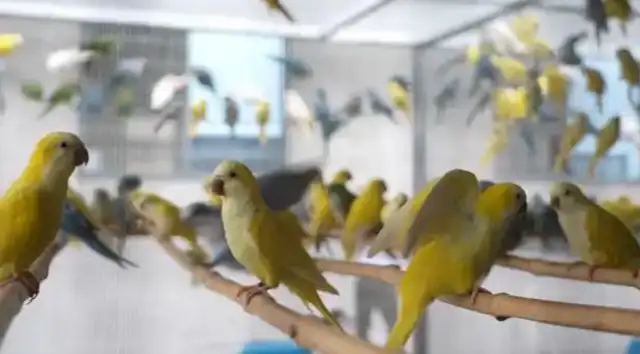
The small parrots have always been a good carer, and the derived parrot farming has become a different track for the rural revival industry. In the Mall, these ferocious parrots not only bring joy to the citizens, but also give nearly 50,000 people access to employment without home and become “new engines” for local farmers to grow wealth.
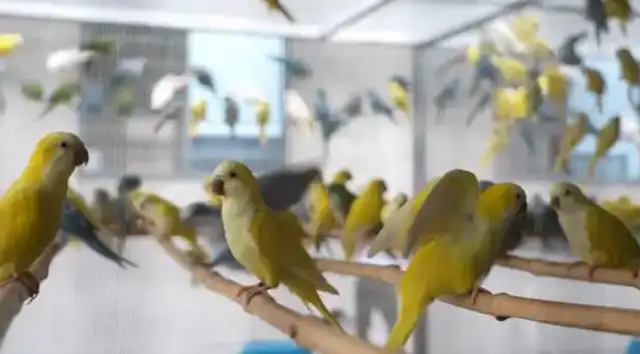
A parrot breeds a dream.
On 5 September, more than 600 different and coloured parrots settled in Liu's home in the urban-rural integration demonstration area of the city of Machou, where they were playing and playing with each other.
"Look at this monk parrot, it's only been born for more than a month, and it's of great value." The farmer Liu Zhongbing took a presentation of the parrot, who had been raising the parrot for seven years and had learned to raise the parrots technically because of the disability of his right leg. Today, he earns 3.4 million dollars a year from raising parrots to live happily.
According to the information received, the development of parrot farming in the city of Makoto has been going on for more than 30 years, and in addition to the family farming model such as Liu Zhongbai, there have been a number of expanded parrot farms.
There are more than 1800 parrots at the Delaware farm in Yuen County. In a spacious cage, beating and screaming, as if a moving elf.
Hendwa, head of the farm, was one of the first parrot breeders in the city of Mt. According to him, the commercial hill area, the climate was well suited to the growth of parrots, and mature farming techniques had accumulated over the years, and the macaw industry had been well developed and profitable. With the new coronary pneumonia epidemic in 2020, law enforcement has stepped up its regulation and repression of wildlife trade. Criminal cases have been brought against many breeders who are suspected of illegally selling the country's vital wildlife protection. A growing parrot can no longer be sold abroad. This has created a difficult situation in which artificial parrots are “daunted to sell, to feed and to feed”, and many growers have returned to poverty, with almost desperate parrots.
In order to address this challenge, the municipality of the City of Chongryon has given high priority to the fact that the Municipal Natural Resources and Planning Authority has actively addressed the Provincial Forestry Authority and the National Forest Grass Office. As a result of field research, in April 2021, the National Forest and Grass Office sent a letter to the Forestry Department of Henan Province authorizing the loading of a special logo for four artificially grown parrots, by which transport could be sold and the marketing difficulties of parrots could be properly addressed. Subsequently, the National Forest and Grass Office approved the opening of 11 parrots and 7 reptiles in Henan Province to pilot the loading of special markings. The city of Maguire became the first pilot city in the country to be artificially bred by parrots carrying a dedicated logo, and the first medium-sized and large parrots and reptiles in the country carrying a dedicated logo.
"At that moment, our farmer's spring really came. This policy not only solves the problem of parrots' inability to sell, but also contributes to the rapid growth of the whole city's artificially growing parrot industry.” Hendrow smiled, “Sold to 10,000 each, and the supply is not enough. Without going out, the villagers will be able to relive their dreams by raising parrots.”
Industry booming and revitalization
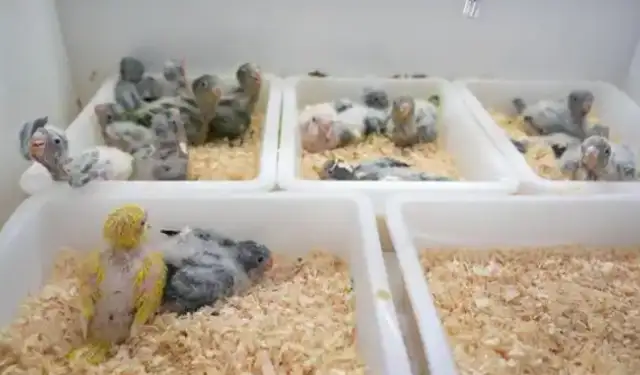
Journalists have found that every parrot farmer has a parrot nursery, large or small, equipped with smart temperature control systems and professional incubators to ensure that chicks are healthyly bred in a warm and wet ideal environment.
Hendwa said, "The parrot's breeding technique is mature, and I have to check the eggs every day to see if there's a shell break. Once a shell is found, a series of tasks, such as disinfection, umbilical cord cutting, etc., will be performed, followed by breastfeeding for young birds, as if they were caring for children.”
When the parrot grows up and sells, each growing parrot wears a footring with a separate code, each matching a two-dimensional identification card. Foot rings, as “identity cards” for parrots, provide detailed retroactive access. The name of the parrot, the farm, the “ID” code, the authorization documents, the source, etc. are clearly visible through the 2D code of the micro-intelligence or payment of the treasure scan.
In interviews, journalists also learned that commercial parrots used to be sold in a more traditional and single manner, relying mainly on underground channels such as bird merchants, zoos and florist markets. These channels, which are more geographically restricted and have a limited range of radiation, are difficult to meet the growing demands of the market and have to some extent constrained the development of local industries. However, the situation has changed as the heat of the parrot-related content on the shivering power company platform continues to rise.
“Now that more and more young people like to play parrots, parrots become a new `pretty', and all of us now mostly sell online. Small and medium-sized parrots, such as tiger skins, and phoenix prices, range from $20 to $500; while twilight parrots, with special markings, and small solar parrots, cost thousands of dollars, and are still in short supply.
Little parrot, big business. Today, the parrot farming industry has become a special business card in the city of Machou.
The Chief of the Wildlife Protection Section of the Natural Resources and Planning Bureau of Mungchu City said: “With the benefits of national policy driving, Maunghu City's artisanal parrot industry has gradually shifted from its old family farming model to factoryization, scaling and standardization. The city has become one of the country's largest artificial breeding grounds for small and medium-sized parrots, with more than 3,000 parrot breeders and a stock of about 2 million nests, bringing nearly 50,000 people to work in front of their homes, forming a complete chain of artificial parrot production from farming, marketing, cage production, fodder production, disease prevention and so forth, with an annual value of over $2.5 billion, which is truly a feature of a steady increase in the population.”