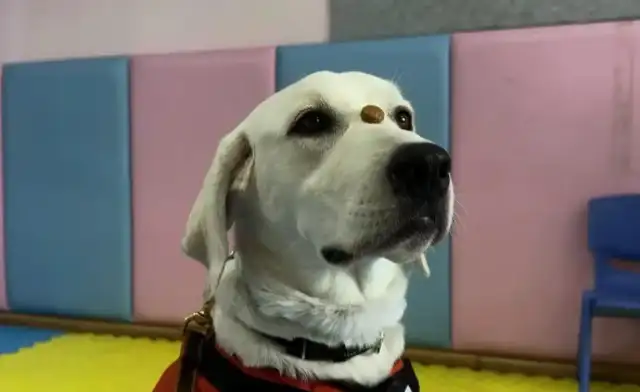
The bell rings at a rehabilitation centre in Hunan Changsha, where several children, unlike most dogs, are squeezed around a Labrador dog, facing the temptation of snacks, the screams of the children, and even blundering, do not react too much and put their heads quietly on their legs.
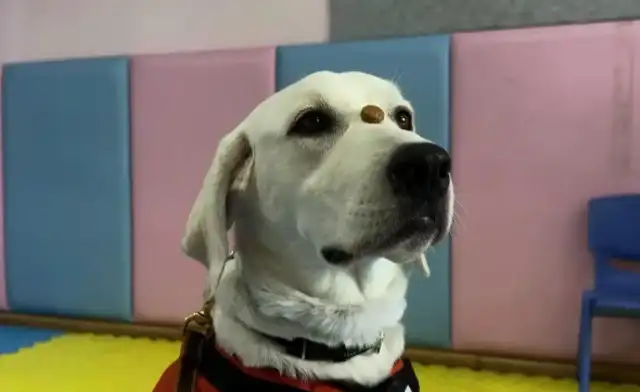
In the classroom, the dog works with the trainer to interact with the child: a gargle, handshake, touch ... After the trainer gives the rest order, the trainer returns to his one-year-old dog and lays down with the trainer.
This one, known as “juvenile senile” in the eyes of an outsider, is called sugar, an autistic service dog (therapist dog), with children who are undergoing rehabilitation training and classroom studies and who are also known as “star children”.
In recent days, the 9th National Disability Prevention Day Campaign in Changsha City and the first ceremony for the arrival of Chinese autistic dogs took place in the colored building of Changsha City's Tiancai Heart. After the event, the autism service canine sugar officially began its work.
For some time thereafter, sugar will accompany the children in classes and out. Staff described such treatment dogs as not being a complete substitute for treatment or absolutely perfect, but their involvement in the treatment environment for autism would have a positive effect on some children.
At the end of 2024, a multi-sectoral organization, the Hunan Disabled Federation, jointly published the " Programme for the Promotion of Action for Children with Autism in Hunan Province " .
However, according to many of the interviews, the low level of social acceptance due to the relatively short time the dog enters the country, coupled with the lack of clear legal norms to define it, has an impact on the work of such dogs and their promotion, such as the practical difficulties of not being able to travel on subways and high irons, which need to be addressed in a continuous process of exploration.
"It's a 15-month-old Labrador." An autistic canine sugar is now in contact with sugar in July and there is now some agreement with sugar.
"Doggy also knows, what fell on the ground?" "Don't eat, teacher." In the classroom Chen spoke to the children. On the other hand, a piece of dog food fell on the ground, but the professionally trained sugar was ignored. “Now it has several snacks on its nose that can stay on for a long time.” Chen Yuen introduced.
In the case of parents who fear that dogs will bite, Chen Zhen, who has not had a dog for more than a decade, indicated that he was just about as worried about the parents as he was when he first started training, but later found that this was not the case.
"There's a need to adjust the dog's mood before class, to take it to the state, for example, to get too excited to slow it down, and to have an assessment of the kids who are in class together." Chen Zhen said.
At other hours of the course, the children are queuing and interacting with sugar, so that the sugar can be used for snacks, gargars and caressing ... At the stage of the course, the sugar is quietly accompanied by the sugar, which means that it takes about two hours a day.
The school bell rings, some children run out of the classroom and sugar gets a break. There are, however, many children who look for sugar, during which time they touch, while others lie on sugar, even once on sugar.
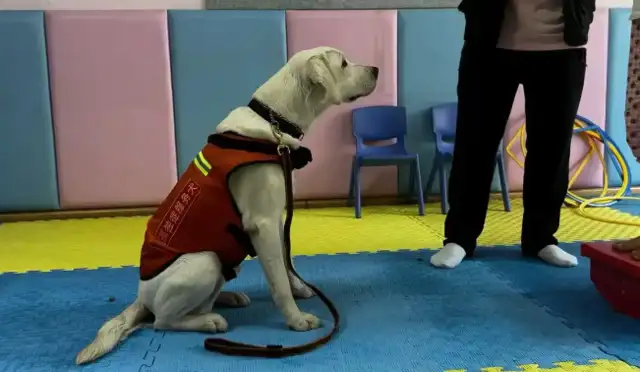
One of the children suddenly tore his ears off and was "urgently withdrawn" by his parents, but the sugar didn't show an over-heavy reaction and smelled the child's face. On the ground, the eyes were lifted and journalists were crouched around to interfere as strangers, and sugar was unsettled.
On the day of the interview, a child cried loudly and Chen suspended the interview and entered the house with sugar canine treatment to calm the child ' s emotions. "When the dog intervenes, the child wonders, touches, interacts, diverts attention, and the pre-existing mood of volatilism is eased." Chen comments.
"It will also be tired, and it will give itself an independent rest space." Chen Zhen introduced. At noon, Chen Zhen placed the sugar cage in the house for rest.
"Not just to adapt dogs." Chen Shui, as sugar has just arrived, one of the most recent priorities is to familiarize dogs and children with each other and to accompany them in the field, which is also a necessary shift from “new people in the workplace” to “bones”.
“To reach a common understanding, for example, that some children may suddenly crush it, that they can do something, but not be aggressive, that the child's dog is a friend, that it cannot be crushed, that the child understands the dog as a growing partner rather than a pet.”