
Along with the rise in living standards and the shift in consumption perceptions, pets have gradually moved from traditional “animal partners” to a significant member of emotional care and family, which has led to a growing market for pet consumption.
The industrial chain of the pet economy, from pet food, supplies to medical services, to services such as pet beauty, foster care and training, continues to grow, both as a growing emotional demand for pet owners and as an emerging industry innovation.

The White Paper on the Chinese Petty Industry (Consumer Report) 2025 shows that the number of Chinese urban pets reached 120 million in 2024, an increase that is the result of a combination of many factors, including the notion of pet consumption, demand for pet consumption markets and industry development.
From “feeding” to “family members”: rapid development and upgrading of the pet consumer market
Today, the shift from a “child feeder” to a “family member” is not only a reflection of the pet care and importance attached to the pet, but has also contributed to the rapid development of the pet consumer market and the innovation of the industry.
A growing number of pet owners see pets as family members and are willing to invest more time and money in them. Mr. Han, the curator who lived in the Hoang district of Beijing City after 90 years, stated that “every month he spends about $1,500 on Koki dogs, mostly on dog food, snacks, toys, and some health care expenses, regularly bathing the pet shop”. He said that while he would buy his own things, he would spend no money on pets.
High-quality, natural, non-additional, functional and other high-end products are favoured as the role of pets changes and consumer attention to their health. The head of the Fregart brand said that, from “saturation” to “good eating”, pet owners placed higher demands on the quality, nutrition and safety of their pet foods, focusing not only on the functionality of the product but also on the philosophy and emotional values behind the brand.
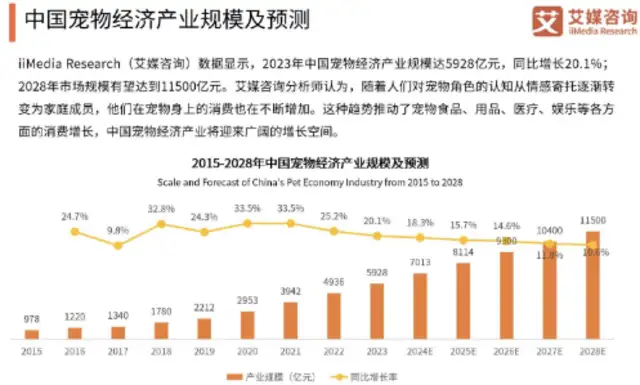
According to the Report on Monitoring the Performance and Consumer Markets of China ' s Petty Industry 2024-2025, published by the APT, the size of the Chinese pet economy in 2023 was 59.28 billion yuan, an increase of 20.1 per cent over the same period; The market size is expected to reach $1.15 billion by 2028.
The pet economy leads to innovation and temperature behind the market for new and dynamic consumer industries.
The Deputy Secretary-General of the National Alliance for Animal Health and Food Safety Innovation said that the rise of the pet economy was reflected not only in the expansion of the market, but, more importantly, in a shift in consumption perceptions. In the past, pet owners focused only on the basic subsistence of pets, while now they focused more on their quality of life and emotional needs. In his view, “youth groups are more focused on online consumption and purchase pet products through channels such as live platforms and social media. Silver hairs are also an important force in pet consumption, with a greater focus on pet health and escort functions, and a relatively high demand for services such as pet medicine and elder pet care.”
Brand innovation-aided pet food industry: integration of quality and health is key
As pets become indispensable members of the family, so does the caring for pets. They no longer simply satisfy the basic needs of the pets, but focus more on their health and quality of life. This shift has contributed to the rapid development of the pet food industry and to the continuous upgrading of the quality and nutritional value of products by enterprises to meet changing consumer needs.
In response, Zhang Lin, Deputy Secretary-General of the China Society for the Leisure and Leisure Industries and Secretary-General of the China Society for the Leisure and Leisure Industries, pointed out that the product not only meets the consumption habits and aesthetic needs of the owner of the pet, but also the dietary and behavioural habits of the pet and the special needs of different species. “If brands were to be positioned in these areas, it would be easier to gain consumer recognition and trust.” Zhang Lin said.
A good example of this is the system of “pornography” as a pet food brand under the umbrella of Shandong Eye Animal Nutrition. It provides tailored nutrition programmes by analysing the needs of different species and stages of life. This scientifically accurate nutrition is one of the core competitivenesss of quality.
By introducing state-of-the-art equipment and high-end nutrients, together with home-grown quality raw materials and global advanced research and development teams, Persia is committed to providing home-grown pets with safe, healthy and comprehensive feeding programmes. “The rate of imports of equipment from own plants is 85 per cent and the rate of imports of core equipment is 100 per cent.” The director of the Persia brand said that in the future, the strategy of “localizing global vision services” would continue to deepen, increasing investment in research and development for functional products, promoting visualization and quantification of standards for healthy feeding of pets and making “good feeding visible”. Zenium
Looking at the MAG pet health brands under the umbrella of GGC, increasing the number of pet families served by quality products through continuous innovation, research and development, and production of high-quality, secure animal health products, and so on, some rows of brands seeking such details not only increase the scientific nature of the product, but also increase consumer confidence in the brands.
With regard to the competitiveness of national product boards, enhanced product R & D and innovation are necessary paths to development. In recent years, the naughty brands under the umbrella of medium-sized pet stocks have focused on the breakdown of the demand for and the demand for pets, introducing a variety of high meat formulations, while at the marketing end, the shaping of brand culture and the emotional connection with users are also important, and many autonomous brands under the flag have successively enhanced brand temperature through pet IP alliances, pro bono activities, etc. The head of the CPC stock also stated that “both the import of pets and the development of human food brands provide an empirical reference for the development of national brands”.
At the same time, precision nutrition has rapidly emerged in the pet industry. The Fregart brand, which is under the umbrella of Beacon Group, introduces the concept of “precision of fresh meat nutrition” and provides different stages of cathood with nutritional intake commensurate with their physical development and health needs. It uses a standardized treatment system for fresh meat, stabilizes the value of fresh meat and improves the purity of fresh meat. It also innovates a series of zero-pressure milk products, providing a more scientific and high-quality choice of pet food, and boosts the development of the pet food industry towards higher quality and sophistication.
It is easy to see that brand innovation plays an important role in the pet food industry and that the integration of quality and health has become key. Enterprises can emerge from intense market competition and achieve sustainable development only if they continuously pursue innovation and meet the diversified needs of their pets and their owners.
All-round care of pets: medical care extends from basic to full life cycle
As the emotional commitment to pets increases, so does the concern for their health. Referring to the size and growth of China ' s pets health market, CEO Lee Shek gave a set of data on the average annual medical expenditure of about US$ 1,000 to US$ 1,500 for a single pet, representing 20 to 25 per cent of total pet spending, after food consumption. There are also over 30,000 pet hospitals nationwide, with a chaining rate of about 10 per cent.
According to Liu Jiaxuan, the market manager of the Northern Market Department of Riiphua, the number of Chinese pets is over 200 million (dominantly) and there is a clear trend towards “humanization”. At present, 90 years later, it has become a force of curators who are more willing to pay for specialized and sophisticated medical services. At the same time, the treatment and care of geriatric diseases has become a new engine of market growth as the age of the elderly enters a rising period.
With regard to the need for medical care for pets, Lee Xue pointed out that there was a growing demand for preventive medical consumption by the owners of young and young pets, particularly in the areas of vaccines, deworming, sterilization, oral care, nutrition management and behavioural correction. The owners of elderly pets, on the other hand, are more concerned with slow disease management and longevity care. “It is worth noting that new needs such as genetic testing (genetic screening) and customised medical examinations (by variety/age) are also growing rapidly.” Lee Xue said.
In selecting a pet hospital or clinic, “price transparency, professional competence, equipment facilities, service experience are the most important factors. It is also expected that more accessible and efficient medical services will be available to ensure the health and quality of life of pets.” Ms. Zhang, who had had a cat for six years, said in an interview.
As the pet economy continues to warm up, a number of pains and challenges are also revealed, “Despite a wide range of prospects, the industry still faces the pain of lack of standards, disruption of markets by low-quality products, and insufficient scientific awareness among consumers. “Pet food companies say that it’s not the same. There are, of course, some challenges in online channels, as the Chinese and Chinese shareholdings add: “We have gained a lot of trust in people and users through social media such as shivering, red books, etc., where consumers have difficulty understanding the tasteworthiness (e.g., fresh food) or quality details of products online.”
According to Zhang Lin, “the uniqueness of the pet industry is that it is a great abbreviation of the human industry, and we cannot regulate its development with a single standard and regulation.” Through policy support, more national standards and even international standards can govern and empower the development of the industry.
In the future, pet food enterprises will continue to adhere to high-quality product concepts, focus on the precise nutritional needs of pets, participate actively in industry-building and contribute to the healthy development of the pet food market. “Only an increase in the overall level of the industry can bring better products and services to consumers and pets.” As Xu Xi said.