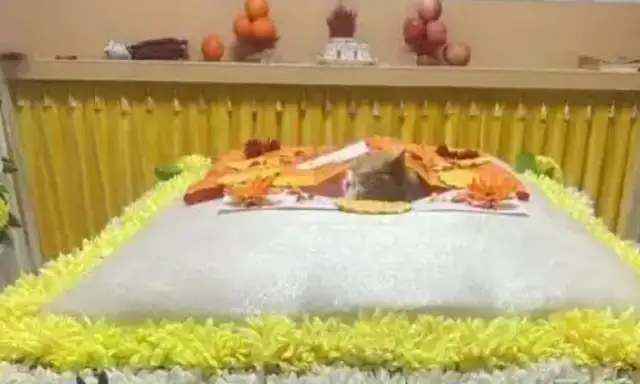
“Why do you make young people love and hate when you say goodbye to a 1.8 billion-dollar goodbye”.
The Quadripartite casket, lying on a little cat, was quiet as if it was just a normal sleep. It is covered with a little orange blanket, with four chrysanthemums placed on its four corners. The casket is surrounded by two laps of daisies, with yellow in it and white in it.
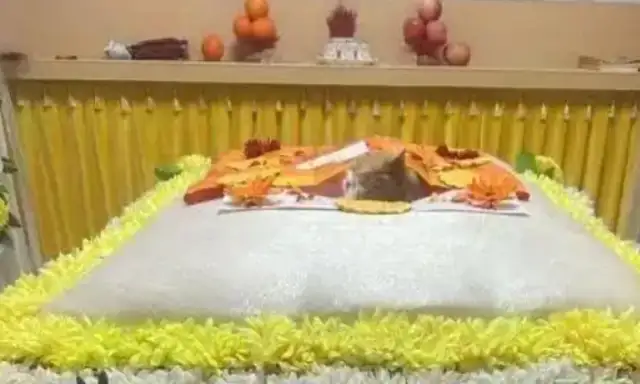
There are black and white pictures of cats in the centre, and there are scents in front of them, and there are two bouquets of flowers.
It's a social platform where small fish share a big farewell ceremony with 14-year-old cats.
In recent years, as the “single economy” and the population living alone have increased, the number of foster workers has increased. In day after day, pets are no longer a mere animal, but a spiritual attachment to the master and become close family.
Compared to the length of human life of 70 to 100 years, pet life is generally only 10 to 15 years. This means that separation from pets is the established future that each owner cannot avoid. In the past, a cat or a dog had died and people would choose simply to bury themselves. But now, as the level of sociocultural and spiritual civilization rises, especially in developed, second-line cities, pet providers opt for pet burial services, with a big ceremony to say goodbye to pets.
In many homes where animals are spoiled, pet status has been raised to the same level as the master ' s children. In families where pets are well raised, tens of thousands of pets are spent a year, “more expensive than humans”. So it doesn't seem surprising that when pets die, they are “like people”, funerals and mourning.
The funeral of pets, a small industry of the small, is rising rapidly. According to the Report on the Analysis of Trends and Investment Prospects in China ' s Pet Funeral Industry (2024-2031), the market size of the Chinese pet burial service in 2023 was RMB 1.825 billion.
The industry carries both the softest emotions and the most realistic profit games. The paradox is that the burial of a pet is more than just a business. When love leaves, the sorrow of the master becomes a “catalyst” for merchants to dig for gold, while the lack of transparency and confusion in the industry complicates or perpetuates the farewell of this life.
The 2024 White Paper on the management of Chinese pets showed that 60.4 per cent of pets would opt for “scene farewell” services, while 56.3 per cent would focus on “remain cleaning”. With the emergence of a single economy and the emergence of a time of solitary living, pets are increasingly becoming a demand for companionship and emotional healing.
For young people living alone, karate elders and Dink families, pets have become substitutes for their intimate relationships. The death of a pet is the death of a close family. They cremate pets, perform funerals, even write medals, enter temples, and integrate pet DNA into glass products as a souvenir. This has given further impetus to the rise of the pet burial industry.
The data show that 62 per cent of the 120 million pets are willing to pay more than $500 for burials, and more than 60 per cent of consumers consider pet burial services to be “an important farewell service for their families”.
From body cleaning, custom farewell ceremonies, ash storage, pet overdoing to souvenir production, the pet burial industry has now formed an industry-wide chain.
Zhang Ming is a pet funeralist who believes that pets are more than just an animal, but also a spiritual attachment to human beings.
“I have always believed that the burial of pets is an industry worth growing and that honesty is the greatest killing skill in this industry.” Zhang Ming also experienced the death of a pet, and he felt personally that parents were facing a very difficult moment when the pet died. At that point in time, pet funeralists were not only supposed to put their pets behind them, but, more importantly, to calm parents and actively provide them with emotional values and human care.
At this difficult time, the sharing of small fish on social platforms has gained a visualized experience. “Following the farewell ceremony, the cremation process was initiated by rounding. The air around us is so silent that I hear every sound on the scene. I spent a moment alone with it, whispering farewell, touching its head and claws as if it could feel its temperature again.”
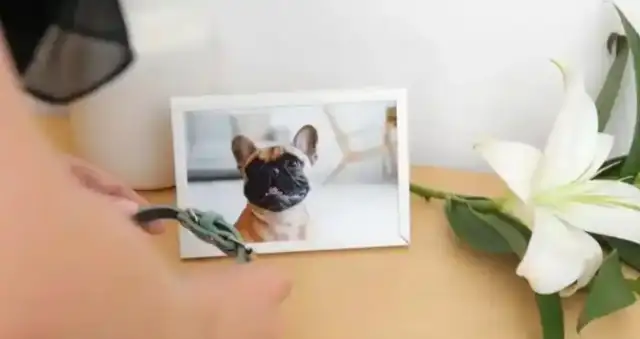
Many owners experience profound emotional fluctuations when a pet dies. At that time, human sensitive and thin nerves became vulnerable and any term could cause harm.
It has been argued that pet burial is a “service business for the living”. So when dealing with pets, practitioners pay special attention to words, not to die, but to say, "Did our baby just leave?"
In the view of pet funeral practitioners in the field, pet burials are faced with life, not with commodities, “We have to be careful at every step, if not properly done, not only to the pet, but also to the parents”.
The industry is still a cold door. Even though the market for pet funerals is growing in size, it remains a relatively small area, and many do not know its existence. The pet burial services are mostly concentrated in first- and second-line cities, where services are almost non-existent.
“Most profits” are another label for pet funerals. The data show that over 40 per cent of first-line urban foster families are willing to spend 5000+ on funerals, with a Māori rate of 72 per cent. The 300-dollar crystal-crystal urn box, with the Starboard Memorial label, sells $5,800, just one sentence: it just goes to the universe and continues to love you.
There are many small businesses that lack the qualifications to make “treasury”, and some of the informal small funeral rooms do not even have a fixed space, so that they can be cremated for pets by a “mobile crematorium” modified by a van.
The cremation equipment for pet and human burials is different. Human burials usually use professional, fully automatic cremators and equipment for cremation, while pet burials usually use small cremators or manual cremation.
The practitioners indicated that the formal pet burial facility was not profitable and that a formal pet burial facility would need to obtain an incineration certificate if it wanted to be cremated, and would need to undergo an environmental assessment and fire inspection. The price of a set of furnaces varies from $200,000 to $500,000, while pet agencies tend to buy more than one set of furnaces to accommodate the cremation needs of different types of animals.
In addition to this, there are false incinerations in the market: some unlucky traders have simply abandoned pet bodies for cost-saving purposes, and there is no cremation service at all. And the most common feature of these things is that they are not visible.
In addition to false incineration, the pet burial industry has high prices, invisible consumption and differing service standards.
The King's heart bought $50,000 for pets who died from the dog's food package, which was described by the merchants as including basic cremation, urchin boxes, dry cleaning of the whole body, use of the farewell room, prayer hall table, soul communicators, various souvenirs and pet cemeteries.
Instead of being cremated alone, the pet remains were buried with the bodies of other pets in the suburbs in the wasteland, and even some of the pets were uncleaned with stains and hairs.
"Brooming should be the last and most important part of the farewell to the pet." The King was very dissatisfied with this, arguing that the merchants had not given her due respect to the dog and had failed her trust.
Another victim of hidden consumption, she had revealed to the media that the package would have included the cost of an urn box, but that the vendor had later informed the urn in the package that it was a very rough base for work and that additional costs would have to be paid if the formula were to be changed. The ad hoc increase in the commercial price gives her a feeling of being “swindled”.
Disorders have surfaced, and some agencies have used the term “pets are family” to induce higher prices for chain consumption. Or commit to “separate cremation”, which is processed in bulk. Others charge long-term fees for “ash storage” and simply dump and even discard pet ashes.
The pet burial service was introduced in China around 2005 and, after 20 years of development, our pet burial industry has gradually moved into public view. But in the eyes of the world, the pet funeral industry has grown more mature in countries such as the United Kingdom, the United States, Japan and Russia.
The British pet crematorium has launched an online service system and developed virtual pet cemeteries on the Internet; there are temples in Japan that provide pets with divinity; and there are comprehensive animal body disposal laws in Russia that prohibit the direct burial of pet bodies or their disposal in dumpsters.
In contrast, the pet burial industry is just beginning. As an emerging industry, there are no uniform laws and regulations and industry standards for pet burial services in China. With regard to legislation on the treatment of pet deaths, only the Animal Vaccination Act, promulgated in 2021, states that animals should be treated in a non-hazardous manner.
The disposal of pet remains in most cities in the country is limited to local regulations, such as the harmless treatment of pet remains as special garbage, but specific processes and oversight mechanisms are often lacking.
Even “innocent disposal” is a difficult task for untrained pet funeral service providers. In dealing with pet bodies, they may also be unable to properly take effective sterilization measures, leading to disease transmission, environmental pollution and even disease. More spoils are buried at random, causing land contamination.
In addition to policy oversight gaps, there is a lack of industry standards for the burial of pets. Different project prices vary from one day to another, with simple cremation of 298 VS complete ceremony 3980, but what criteria define the items included in the whole set of ceremonies? To date, there is no established standard in the industry, which can easily lead to consumers being “slaughtered” and interests being compromised.
Many pet owners often choose funeral services without too much accountability for the price and quality of services based on emotional factors. This “condonation” is also a breeding ground for pet burials.
When a pet has just passed away, it is when the pet owner is psychologically most vulnerable, when it can easily be instigated by words for impulse consumption. Such emotional consumption often lacks rational norms and a balance between the two is also an issue that cannot be reconciled with the development of the pet funeral industry.
Death is often a heavy topic that everyone fears. Education for death has been increasingly mentioned in recent years. In a humorous style, the millions of fans of Station B's thumper soup thumper told you about the experience of working in the mausoleum, easily dismantling the theme of “death” and attracting millions of fans' attention, which is a proper “death education” for the public.
The burial of pets is also a “death education” for pet parents. How can we face the important existence of life when it leaves, and how can we continue our lives?
From this point of view, the burial of pets is not just a business, but a farewell to respect for life.
As the fish at the end of the post remembering round's departure:
“I pray to you that in the next life I shall cast a good man, a balanced food, a master who loves you, and that he shall be stable, always at your side, and that you shall not suffer again.”