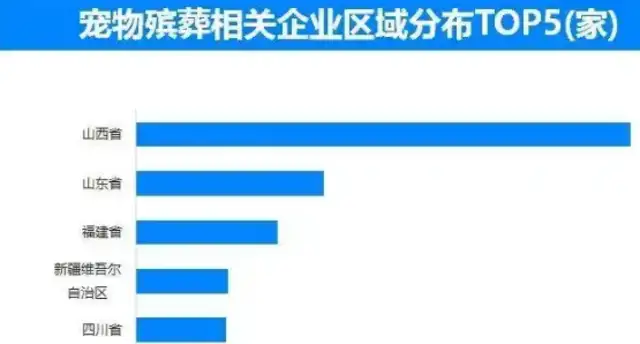
In recent days, Skywatch data indicate that the number of businesses involved in the burial of pets in the country has exceeded 43,000, of which Shanxi, Shandong and Fujian Provinces together account for more than 17,000 businesses, or 40.6 per cent of the country ' s total.
The increase is due to the continued rise in demand. The data show that the total number of Chinese urban dogs and cats in 2024 exceeded 220 million, of which 42.16 million were elderly. Based on an internationally common 3 per cent annual mortality rate, approximately 3.6 million pets die each year. Many of them are domestic.
And more and more pets no longer opt for “discretionary”, but instead take the initiative in seeking more dignified and complete ways of sending off. They would like to leave a memorial and to complete an emotional farewell.
The burial of pets is moving from a cold-door business to a visible sex industry in such real needs.
The pet funeral is getting hotter.
On the one hand, the huge “back-to-back” demands of millions of pets die every year, and on the other hand, tens of thousands of businesses are coming in.
Pitt said it was understood that in the Little Red Book, over 400,000 notes had been written about “Pet goodbyes” and that UGC content such as tremors, live video of the pet farewell ceremony, and the opening of souvenirs had been popular.
As can be seen, more and more pets are beginning to focus on the “last journey”, and the industry is being pushed forward by emotional demand. The pet funeral, which was a low-key business, is getting hotter and hotter.
In the past, pet burials were often seen as “grey demand” and services were mainly low-cost, simple. Today, however, the location of pet “family members” is becoming increasingly clear, and industry patterns have changed.
For example, in the above-mentioned sea, the number of shops is assessed from the point of view of the general public and nearly 200 pet funeral service stores are available. The price of the basic package ranges from hundreds to thousands of dollars, and the price can range from 5,000 to tens of thousands of dollars after superseding customized services, based mainly on pet objects weight, cremation methods and commemorative content. For example, there are institutions that provide services such as “personalized urchin urchin pelt” “hand-capture resin sealing” and “remote mail” with market prices ranging from $1,500 to $6,800.
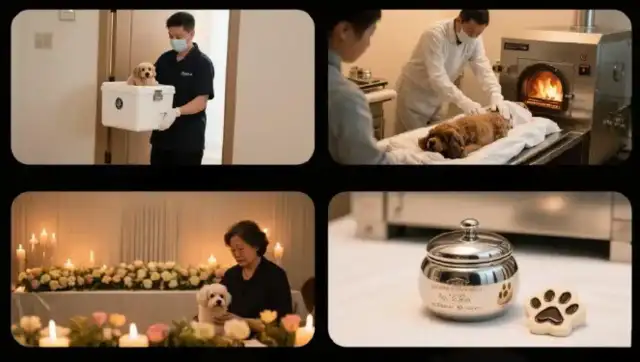
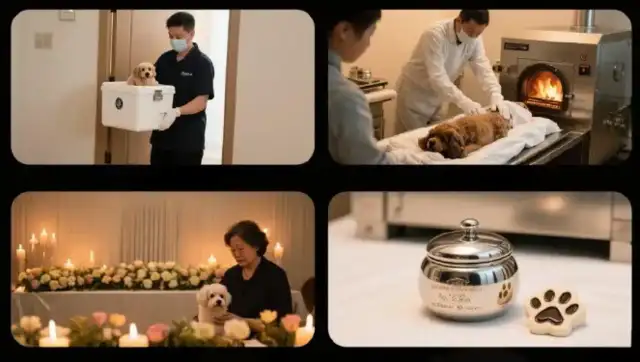
In general, a complete pet end-of-life service begins at the moment the owner calls. The agency arranges for visits within 24 hours, using a professional stretcher or exit box to carefully trans-ship the “Firty Child”. Subsequently, the staff will clean, disinfect and synthesize the remains so that it can complete its final farewell in the cleanest and most secure form.
And then there's the most ceremonial part -- the farewell ceremony. In a nice room with flowers, candles and photographs of pets, the master can live alone with love and speak the last words. Throughout the process, staff members will remain silent, guide emotions and provide the necessary support.
At the end of the ceremony, the crematorium is a crematorium, ensuring the purity and uniqueness of each ashes. Ultimately, the owner receives a fine urn of urn, and some institutions offer souvenirs made from pet claws, or seal a bundle of hair as a souvenir.
A whole set of processes, though not low overall prices, is motivated by a high appetite for consumption. For example, in 2017, the pet burial facility was set up to collect 23 million yuan in 2021 and to serve 100,000 pets per year; by the end of 2023, the company had located 277 underline shops in 100 cities throughout the country.
Behind pets' "good-bye" is a business that is difficult to regulate.
In fact, despite rapid market development, the difficulty of legal compliance in the industry is generally underestimated.
In order to be legally eligible to operate, it is understood from a number of practitioners that, in theory, a pet burial facility is required to perform a number of qualifications, including health certificates, health certificates, environmental protection certificates, harmless treatment licences, business licences, quarantine certificates, veterinary certificates, fire safety compliance, burial certificates, etc., which involve almost more than one department for which there is currently no specific authority.
In practice, there are very few institutions that can truly fully acquire these qualifications. Together with the tightening of environmental policies, most of the urban core areas are unable to undertake cremation operations.
As a result, most pet funeral doors now operate at “AB Point”: opening a shop and ceremonial space in the urban area (point A) and transferring actual cremation to the suburbs, mountains or factories (point B) dozens of kilometres away. As most points B do not have formal cremation qualifications, a number of stores can only rent short rooms or mobile stoves to operate.
As a result, the lack of supervision has also led to the fragmentation of the pet burial industry:
Ash mix: For some non-compliant agencies to compress costs, a large number of pets are cremated at a “one-manufacturing” rate.
“Ash falsifying”: There is even bad behaviour on the market, which causes serious harm to consumers.
Price trap: take advantage of information asymmetries, lead first to low-priced food packages, then to the sad owners of the high-priced souvenir harvest.
In the past year, for example, disputes have arisen in Shanghai, Tianjin, Wuhan and Guangzhou: a pet burial facility in Shanghai was blown up to “mixed cremation”, i.e., more pets were concentrated in cremation, but the price was still charged for “one pet stove”; Mr. Chen, a petist in Guangzhou, paid $3,800 to buy the “shelter” service, but went to the scene to find that the so-called mausoleum was just an open space and without any surveillance video; A mobile cremation vehicle was found in Tianjin, with heavy emissions of equipment exceeding the standard, leaving many of the bodies of the pets untreated; A petist in Wujiang, who was unable to obtain a cremated video record, suspected that the ashes were dropped and eventually prosecuted for lack of fruit.
It's on the side of the sky view. Of the 43,000 pet funerals in the country, 1.29 per cent were reported, of which nearly 60 per cent were related to “service fraud” “environmental violations”.
Moreover, the grey space in the industry goes beyond that. There are not a few advertisements on the platform to search for “Pet funeral businesses”.
Some agencies have issued the “one-stop shop without a cremation certificate” slogan, committing to provide a “formal fusion” “hosting B-point-to-fire platform” “short video tape” with fees ranging from $30,000 to $120,000.
However, according to a number of practitioners, most of the so-called “Qualification Packages” do not pass genuine clearances, “Headquarters interfaces” are mostly outsourcing intermediaries, crematories do not have environmental and animal processing permits, and alliances face very high legal risks if they are complained of.
Industry standards have not yet been harmonized, platform clearance mechanisms are missing and space is being left for a large number of “grey entrants”.
However, no one has tried to solve it. Some cities have begun to explore the integration of cremation into visualization, for example in Beijing, where a collection and treatment system has been set up for the non-hazardous collection of animals, with all districts having temporary storage sites where animal corpses can be transported and then cremated by institutions with relevant qualifications.
But it immediately raises deep concerns in the industry: as environmental and municipal governance policies continue to tighten, will the pet burial industry move towards a “human burial” model — a high entry threshold, licensing, semi-monopoly?
If it materializes, a large number of small and medium-sized entrepreneurs, full of humanistic and flexible services, may be discharged.
How to make this final farewell, with both temperature and order, avoid a cycle of “disturbed and dead” is a matter of thought.