Designation: PET4362
English name: Crossocheilius siamenis
Origin: South-East Asia
Vulnerability to diseases: fish plague, white cloud disease, skin disease, rotting tail disease, etc.
Life: 10-year profile of black-line flying fox species
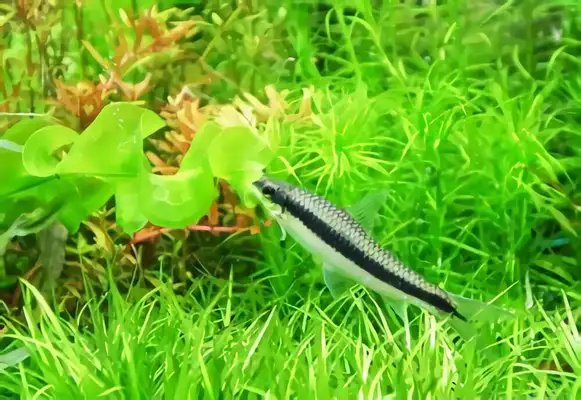
The black-line flying fox, which originated in South-East Asia, is well suited to view because of its whole body is brown and long. Black-line flying foxes can have a maximum length of 15 cm and a lifetime of more than 10 years.
Chinese literary name: Black-line flying fox
Latin name: Crosssocheilius siamenis
Don't call it Siamese algae, Siamese fox.
Context: Animals
Section: Fish Section
Yes: Fish
Region: South-East Asia, including Thailand and the Black Line Fox Flying Fox Flying Fox
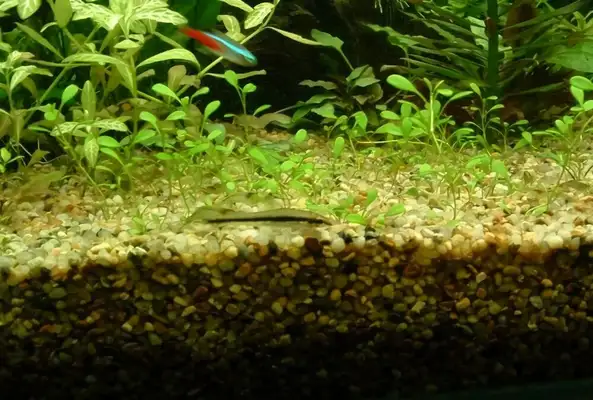
The maximum length of black-line flying foxes can be 15 cm, but since they can have a lifetime of more than 10 years, they usually reach this shape within two years, which can be said to be very slow.
Black-line flying fox fins are transparent or light milk white and do not have any yellow or red glitter. The black stripe extends from the nose to the end of the fork, and the edge of the stripe is in the form of a scavenger. When it gets nervous or fights, the black of this stripe will recede. The silver white below the body and the bright stripes above the black, but the whole body is brown and the edges of each piece are black, which makes it a net from above. Some black edge scales are likely to grow below the black stripes.
The black-line foxes have a small pair of forward mustaches, and when they swim or rest, they turn to their cheeks. Black long stripes are also readily visible among young fish, but until they reach 5-7 cm (2-3 inches) they do not clearly see the shape of their black edges and the edge of their black stripes. The length of fish sold in aquariums is typically 3 to 5 centimetres (1 to 2 inches). Black-line flying fox breeding environment
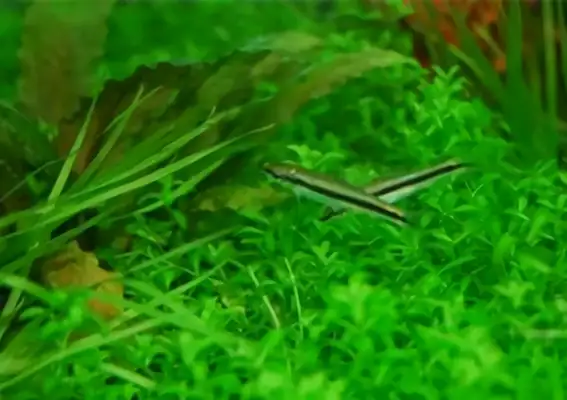
The black-line flying fox, which is a mesofish, does not yet have a defined method of distinguishing between its male and female, and only a rough estimate can be made from the surface that adult females are generally slightly overweight than male fish.
Black-line flying foxes suggest water temperatures of 24-26°C (75°F). Better with soft water and pH 6.0 to 7.5. Due to the slow growth of the black-line flying fox, it was suggested that the aquariums should preferably have a hydrograss view to mimic the original ecological environment and improve the environmental quality of fish activity. Because the black-line fox is a famous jumper, it's important that the aquarium be capped. If the aquarium is customised, the accidental break in the glass cover cannot be replaced, and a large number of floating plants may be resorted to, an approach that is quite effective in preventing the black-line fox-tray. Black-line flying fox.
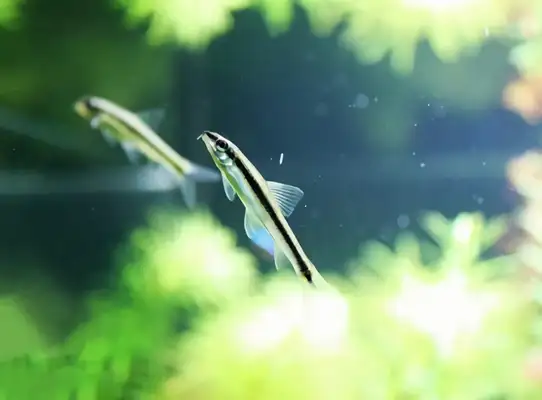
Black-line flying foxes are vegetarian fish and are not selective, so it is easier to feed when raised. Black-line flying foxes are also very compatible and can coexist peacefully with most fish, but not with black sharks.
Black-line foxes don't pick. General fish grains, algae feed and cucumber slices are acceptable. Inadmissibility of over-feeding may lead to the lazyness of the black-line flying fox. Likes to eat thin fish rather than algae. If the aquarium is heavily attacked by black haemorrhagic algae, feeding is minimized in order to encourage black-line foxes to eat black haemorrhagic algae. Black-line flying foxes are told that they even eat turbo worms, which are an ideal added value for aquariums infected by turbo worms.