In recent years, the pet economy has become an important engine of growth in new areas of consumption. As “cat-sucking dogs” become the way of life of young people, the size of the cat-dog pet market has exceeded $300 billion, with a compound annual growth rate of over 13 per cent.
On the electrician platform, this year the Skycat 6-18 pets are well consumed, with a total of $7.5 billion, an increase of 36 per cent over the year. The industrial chain of the pet economy is expanding from the cross-border introduction of pet clothing in sports brands to the addition of pet food lanes by food giants to the emergence of new services such as pet domestic service.
In a fast-paced life, pets have long become “family members”, driving the industry from basic services to “emotional values + full-chain ecology”, with unlimited potential for the future, and many new changes are worth exploring.
The economic rise of pets: from pets to family members Change
“The more urban human beings become, the further away from nature, the greater the importance of pets in human life.” As the zoologist and Nobel Prize laureate Conrad Lawrence once said.
For now, “cat-sucking dogs” have long been an integral part of many people's daily lives, and many cats and dogs have eaten well and used it, making a wide range of online friends laugh that “people live worse than dogs”. And on all major video and social platforms, millions of bloggers share a funny little video and daily life of their own pets, and these enjoyable content creates a lot of web-crowding, attracts competition from a wide range of netizens and breeds a variety of behaviours, such as reward, delivery, and pursuit of the same money.
As a result, the basic concept of the pet economy has also emerged, namely, a range of commercial practices or activities surrounding the production, consumption and services of pets.
The history of our pet economy dates back largely to 1992. At the same time, the establishment of the China Society for the Protection of Small Animals has made the concept of “protecting and caring for animals” “an animal is a friend of mankind” widely known in society. The concept of “petty” has been redefined and the way of life of pets has been raised to an entirely new level. In the meantime, students studying abroad have also introduced fresh pet perceptions, which have given rise to domestic pet industries. This was followed by the entry into our market of such giants as the famous international pet food brand Marx and the Royal, which opened the way for the development of our pet industry.
In the new century, with the gradual rise in the level of national income and the growing maturity of the concept of pets, the number of pets in our country has begun to grow rapidly, and the role of pets has begun to change, moving away from the status of “home-care homes” in the family, to the gradual emergence of role attributes such as “children, loved ones” as an important attachment to family emotions. Later, there was a proliferation of large-scale chemical plants for the production of pet products and a number of home-owned and well-known enterprises began to emerge.
After 2010, our pet industry entered a rapid development phase. While the number of pets continues to grow, pet owners are increasingly willing to spend money on pets, and pet hospitals and beauty shops continue to emerge, and the pet economy is an important component of consumer upgrading. Under the wave of the Internet, the growth of the online economy has greatly facilitated the growth of the pet economy, with pet service platforms appearing in the public eye and new service models such as the shared economy and cloud pets growing.
02 Data Discovery: The pet market's “robbery” and potential
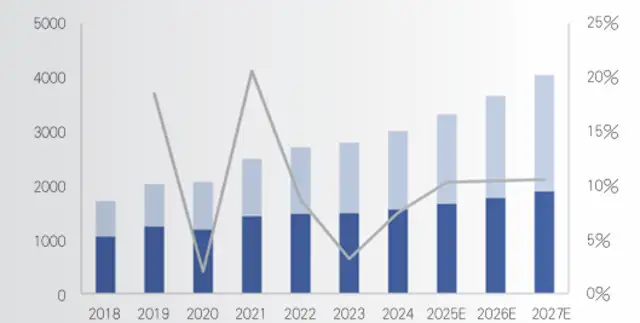
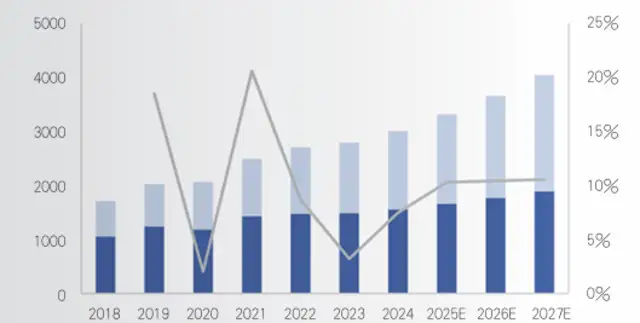
According to the White Paper on the Chinese pet industry 2025 (hereinafter referred to as the White Paper), the domestic pet market grew at an average compound rate of 13.3 per cent per year from 2015 to 2024, significantly above the average rate of GDP growth over the same period. In 2024, the urban pet (dog and cat) consumer market grew by nearly 7.5 per cent each year, breaking the 300 billion yuan threshold and reaching 30.2 billion yuan, of which the dog market grew by 4.6 per cent and 1557.7 billion yuan, while the cat market grew by 10.7 per cent and 144.5 billion yuan respectively. According to the White Paper, urban pets (dogs and cats) consumption markets are expected to reach a peak of $400 billion by 2027, reaching $404.2 billion, with a compound growth rate of 12.6 per cent between 2015 and 2027.
In terms of breakdown, the size of pet food and pet health care is leading and constitutes the two core pillars of the pet economy.
Data show that in 2024, the size of the pet food market was $15,851 million, representing 52.8 per cent of the overall size of the pet economy; the size of the pet health market was $84.06 billion, or 28 per cent. Between 2018 and 2024, the health-care combination growth rates for pet foods and pets averaged 10.06 per cent and 16.39 per cent, respectively, highlighting strong consumption dynamics.
At the same time, the high performance of the pet economic market is also reflected in the financial statements of listed companies, with a number of enterprises achieving performance growth in the 2024 Annual Report.
For example, the annual reports of listed companies on the basis of their shares show a profit of RMB 1,798 million, an increase of 34.41 per cent over the same period, and a net profit of RMB 215 million, an increase of 108.34 per cent over the same period. The annual newspaper of Petit ' s shares also shows a profit of 1,659 million yuan, an increase of 1756 per cent over the same period, and a net profit of 182 million yuan, an increase of 1742.81 per cent over the same period.
It is worth noting that domestic pet economies still have great potential compared to overseas markets. In 2023, for example, the domestic penetration rate of our pets was only 22 per cent, compared to 70 per cent in the United States and over 50 per cent in Australia and Canada during the same period, leaving considerable room for growth.
In conclusion, it is because of the fundamentals and industry boom that the pet economy in the capital market has attracted investors and has emerged from a wave of strong growth this year.
03 Emotionally driven: its “economic” boom in a time of isolation
Indeed, such a high level of activity in the pet economy, in addition to such factors as the escalation of consumption as a result of sustained growth in national income, is all the more important because of the emotional “heating”.
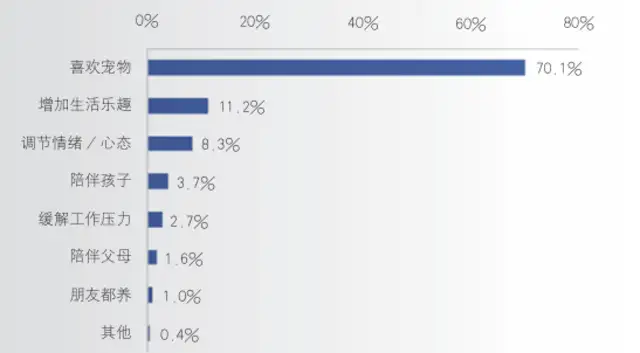
The White Paper data show that 70.1 per cent of pet owners raise their own or family “likes their pets” and then for the purpose of “enjoying their lives” or “regulating their emotions/conceptions”. As can be seen from the three above-mentioned options, the proportion originating from people's “emotional warming” is almost 90 per cent.
This phenomenon is mainly due to the increase in the number of demands for pet escorts from the population alone, mainly from the single population and the silver family, which have become the dominant forces in the pet economy.
The pattern of our single society is emerging. According to official statistics, the single population of the marriageable age (20-49 years) has reached 260 million, representing 37.8 per cent of the total population of the same age group, a record high, with 37.3 per cent in the 25-35 age group, an increase of 18 percentage points over 10 years ago.
In addition, according to the Shell Research Institute ' s New Solo Era report, the number of people living alone is expected to reach 150 to 200 million by 2030, with a single-occupancy rate of 30 per cent or more; among them, the number of young people living alone between 20 and 39 years of age, or from 18 million in 2010 to 40 to 70 million in 2030, has doubled, which is also evidence of an increase in the tendency of the population to be single.
By contrast, the single population has a different consumption structure than traditional households. Because of the lack of family burdens, the marginal consumer preference of single people is much higher than that of non-single people. Single persons are concentrated in the white collar and middle-born population, which, in addition to their weaker mental consumption concerns, have greater material capacity.
The single group appears to have a good life, but it is also difficult to live alone long enough. As a result, many single people alleviate their loneliness by raising pets. They devote their money and energy to raising their pets, enjoying their absorption and feedback on their emotions.
It is worth mentioning that the “second dimension” is the most rigid group of singles, which has characteristics such as a high profile and a keen interest in social networking. The pets happen to fit - they are cute, curable, human, and different pets have characteristics that make people feel comfortable and needed. In addition, pet breeding has social attributes that allow single people to find ways to talk to the world, such as using web social platforms, sunscreening of pets and short videos.
Taken together, the expansion of the single population and its consumption characteristics have become important underpinnings for the continued prosperity of the pet economy.