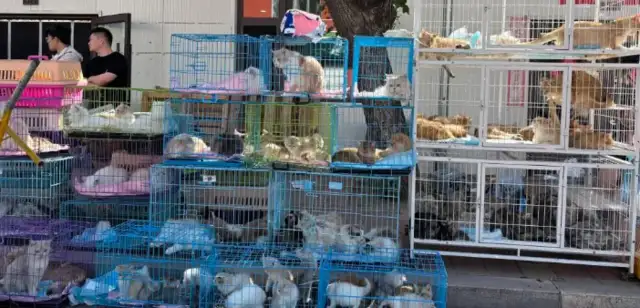
On the day of the opening of the Liaoning pet market, traders from all over the country gathered here. Most of the cats and dogs here need to make a leap in fate: the best-fitted ones are taken by intermediaries or pet shop owners, and the best jumps are successful; the wrong ones, the bad ones, the bad ones, the bad ones, the wrong ones, the wrong ones, the wrong ones. When the fair is scattered, there may be a whole cage of “failed jump” cats in the corner, or a dog in a car.
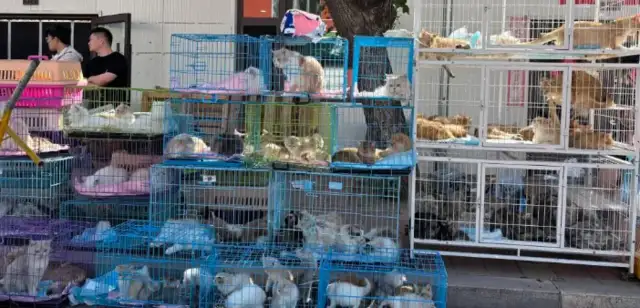
This is the country's largest pet production export base, sending 5 million pet dogs and cats to the country each year, accounting for more than 60 per cent of the national market. However, what coexisted with “low prices, full variety” was the rumor that “some cats and dogs from the Northeast would not survive a week”.
"Liao Ning breeds the best pets and cats in the country, and bears the worst ratings." This year ' s 42-year-old snowflake is the Executive President of the Saddle Mountain City Pets Chamber and the third generation pet breeder of Saddle Hill. In his view, Liaoning had no shortage of fine cat and dog houses, but the lack of standards in the industry and the gaps in the relevant laws and regulations had led to the expulsion of bad currency, which not only undermined consumer rights but also failed to guarantee the health of dogs and cats.
In April this year, more than 10 government agencies, industry agencies and enterprises, such as the China Livestock Association ' s pet industry branch, the Iron West Agricultural and Rural Directorate of the City of Sadayama, and others, formally drafted a guide to the pet dog and cat trade service. As one of the participants in the drafting process, Shang Xue Feng hoped that the guide would be available to address the problem of poor information in the industrial chain and that the whole process of cat and dog breeding, transportation and trading would be documented.
“On Wednesdays and Fridays, on Wednesdays and Fridays, on Thursdays. If you're looking for a cat, you're advised to go to Shenyang's rich town on Saturday." In Liaoning, anyone who's in the pet dog business can give you this information behind your back. On these fairs, a pet businessman can find all the resources needed for the business: borrowing, live broadcasting, shipping, pet supplies, quarantine tests...
The eight children ' s pet market in the western region of the saddlehill is the largest pet trading market in the saddlehill. Under the huge tin sheds, several iron displays go from one side of the market to the other, with cages on the shelf and various coloured dogs and cats. The eight-child pet market has been in existence for over 20 years since 2001. At present, according to the Liao Ning daily newspaper, eight sub-markets have an annual flow of about 300,000 passengers and a turnover of about 500 million yuan.
At 5 a.m., on the opening day, the merchants put their pets on the market. Traders with local accents stopped in front of the booth, put on one-off plastic gloves, grabbed the larvae, looked at the face, teeth, and cut prices in the noise of dog bark.
Through live webcasts, it is also possible to reach the consumption end across the country. After the booth was fixed, the anchor took up the handle, “cleaned” both inside and outside the market, and stopped for a while when the pet looked nice and clean, and asked the booth for a price with a hand gesture, plus its own running leg charge, for an offer to the audience on the other side of the screen.
The Executive Director of the Saddle Mountain Pets Chamber recalled that, in the early 1980s or so, a group of flexible-minded saddle-mounted people had come south to find business opportunities. It went north to the Zulfan River, close to the border in Manchuria, where it was strange to see a beautiful giant dog coming across the border and brought back the saddle mountain. Heading south to the south to bring back small pet dogs.
These dogs from abroad caused a sensation. “If a foreign dog appeared in the fair one day, people would drop what they had and go to the fair.”
Sang Fung said that in the 1990s, some locals had time and the savings they had had were not enough to make a big investment to buy a few dogs. “The result was to raise the dogs, send the children to college, and bring old age to an end.” After 2000, the growth of pet cats also emerged.
According to Saddle Mountain, it has nearly 30,000 breeders, and has grown to a scale of over 2 million class industries annually. According to the 2025 White Paper on the Chinese pet industry (Consumer's Report), Liaoning transfers 5 million pet dogs and cats to the country each year, accounting for more than 60 per cent of the national market.
There are 2,000 square metres of “minut” cat base in Mount Sang. In the cathouse of Mount Sang, the cat is divided into a “symmetric” and a “petty” class. The cat can score in the cat race for $100,000. The pet cat is for the public, starting with a thousand dollars. Cats have been carefully cared for since their birth, have been trained in socialization, etc., and three doses of vaccine have been administered and their bodies recovered before being removed by their owners.
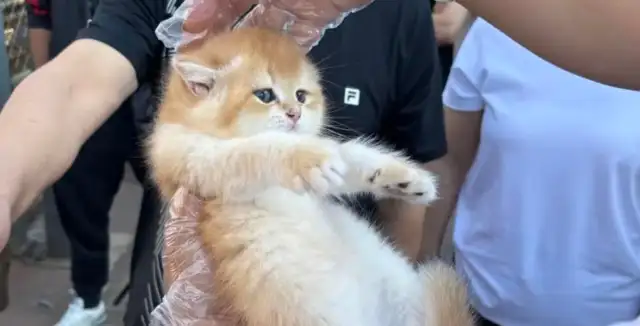
Precious canine houses like this are expensive and do not make up the majority of the industry. Farmers scattered in communities and villages usually sell to intermediaries instead of directly to the end market. Once the intermediary has lowered the price, the breadwinner may compress the cost - sold when the dog or cat is about 2 months old and is not vaccinated. After a number of shifts, it is also difficult for the intermediaries themselves to know which breeder they originally came from and whether they were vaccinated.
In about two months, the calves are the cutest, and it is not easy to sell them at an “afflicted period” (i.e., a period of temporary physical changes caused by the rapid growth of cats and dogs, inter alia, physical disorders and hair exchange). However, the February-year-old pups are vulnerable and, if not vaccinated, are vulnerable to disease and death in an environment where the air is in circulation, where animals are packed and touched. Probably just handed it over to the buyer, and it didn't come out until a while later.
“A significant part of the supply chain is monopolized by intermediaries. Cats and dogs may be subject to stress during the course of the flow and may have cross-infection, heat, typhoid, etc. Consumers bear the consequences, and pet stores and brokers throw pots to breeders, saying that pets come from the northeast.” Sang Fong said, “There is a scorn in our business that no cat house does not work as a dealer, and no dealer does not call himself a cat house”.
Old Li is the cathouse dealer. Sitting in a door shop with two rows of gold-grained cat and cat cages, Old Li taught reporters how to play the show: “Show me where there is a lot of traffic, a little cage, a little cat, a little bench. People ask you for a price, and you say that your family is fertile and that there are many. Call me if you want anything. I'll find the source."
Li said that he had tried to develop a gold-grained layer and had nearly 100 gold-grained layers, but that “cat prices fell fast and the money was lost” needed to do so as soon as possible. Last year, Li sold most of the gold gradients and left behind a few front-rowers. For most of the time, Li collects cats at the market, sells them to others at higher prices and sometimes collects more than 200 cats a day.
Zhang was the one who recovered the defective cat and dog. He pushed a cage of cats through a cat stand: “Sold for $100 and paid for $50!” Two cats hit, a blue cat's eye was scratched and blood ran out. Chang threw two fighting cats out of the cage and kept moving.
Chang's business is good and hard to sell. When he sells cats, he talks about their age, health, and is always perceived by experienced merchants. When collecting cats, some stand-ups don't have to pay the old ones, and they put poor, different cats into old cages.
In June this year, journalists visited several pet fairs in Shenyang and Saddle Mountain, and saw no cats that could be sold, some of them abandoned in the corner; some dogs were sold to dogs waiting by the market. A number of practitioners described the dog car as usually a stench truck carrying a cage full of dirt. There is no shortage of precious pet dogs in the cage: Koki, French bulldogs, border rangers, dubins but hairs are dirty and tongues are spitting.
Many practitioners have revealed to journalists that dogs and car owners prefer to sell their dogs to volunteers who stop cars to save their lives — people who are desperate to pay for their lives.
In May this year, 1,500 dollars was spent on “punching” from a dog car to a black giant Shernary. Shennery looked beautiful, had a great personality and then went to the pet show. However, most of the dogs in the car, even when rescued, are unable to survive because of infectious diseases, injuries and poor living conditions.
Yang, who works as a stray cat and dog rescuer in saddle hill, told Red Star journalists that he and volunteers save thousands of dogs each year from the car, which accounts for the majority of the animal rescue at the base.
Walking into Yang's base, it's spicy. A sick bulldog lies in a cage with flies stinging. The food in the pot doesn't look fresh enough, and the cat's casserole is still clean. Dozens of medium-sized and large dogs are confined in narrow coops, and as soon as people get close, all the dogs are squeezed into cages and make tsunami-like barks.
Young Yang's base, which can accommodate only about 200 homeless animals, is always saturated, although “in and out” is achieved through such means as foster care.