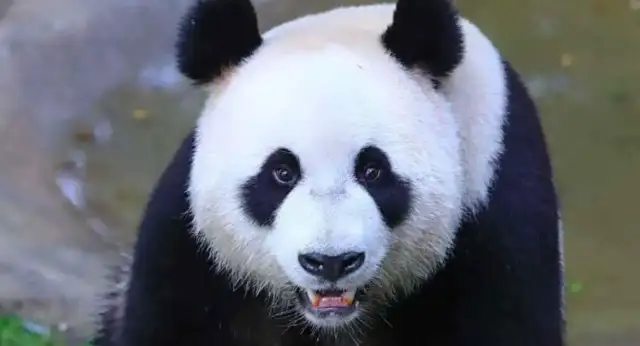
The Shanghai Wildlife Plant announced yesterday that the Great Panda “Golden” had successfully given birth to a pair of dragons, the second of the great pandas born since the Shanghai Wildlife Garden was established, and the first of the great pandas “two generations”.
The birth of the first one and a half of the “month” of the Big Panda Dragon was nine years ago. On 4 October 2016, they were produced at Shanghai Wildlife Park by a large panda “excellent”.
"Equal" mother-in-law.
“Golden” was born in Shanghai on 10 October 2017, and is a popular 8-year-old.
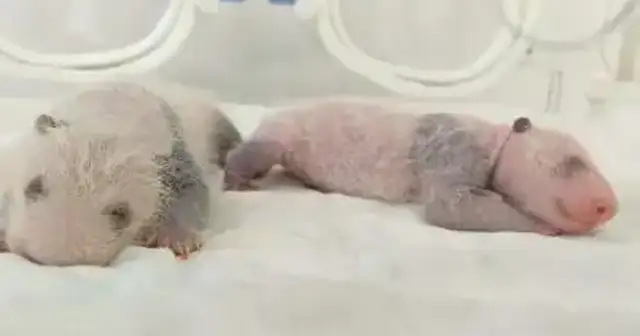
On 22 August this year, at 1611 hours and 1717 hours, two cubs, female and 200 grams of weight, were given birth to “golden”, male and 160 grams of weight.
At present, the health status of the pups is stable. As of 4 September, there had been a marked increase in the weight of both cubs, which weighed 499.8 grams and 394.5 grams. The white fur on their pink skin is already visible, and the eye, ears, shoulderbands, and back and forth limbs are also becoming marked black.
She was excited to witness the birth of a giant panda child this time, the first time that she was involved in the production of a large panda, a giant panda nurse with five years of experience.
“Despite being a mother for the first time, the ‘gold’ mother is very strong, and the first time he licks a new baby with a thick fur to keep it warm.” Sun Wengxie said that, while pleased with the birth of the panda and the enjoyment of maternal love, the entire team was very nervous, because the vast majority of pandas chose only one of the pre-born cubs to nurse them, regardless of the children born, a survival strategy developed by the panda to adapt to a harsh field environment, and the female pandas were not able to bring in two or more cubs at the same time.
It's true that the gold doesn't matter to the offspring. The team immediately set up a plan to lift it out, nurse it, and regularly defraud it of the “silent gold”, exchange the two cubs secretly for “silent rain” and make it easier for the “silent gold” to become familiar with the smell of the two babies, and in the future, “the hands and the backs of the hands will hurt”.
After all, artificial care is not a substitute for “mother-in-law” feeding, and the long-term coexistence of the calves and mothers is most conducive to their physical and mental development.
This method was used after the “half-and-a-half” of the month. At that time, it was only after 10 days of nursing that the situation stabilized because of the poor state of the post-natal calves and the impatience of the staff for a moment.
On the fifth day of life, the staff exchanged the two cubs, the second child was raised by “excellent”, and the second child was taken out of the care. In the early stages of artificial feeding, panda cubs defecate manually every two hours and breastfeed manually every four hours. When they grow up, the interval between feeding and excrement of panda cubs also increases. This is the first time that the Shanghai Wildlife Park has introduced artificial child-rearing and baby-exchange techniques since the construction of the Shanghai Large Panda Protection Research Base.
Since 2016, with the guidance and technical support of the Centre for the Study and Research of the Great Panda of China, Shanghai Wildlife Park has succeeded in breeding eight large pandas, including two pairs of children.
According to the park, the panda baby is still very young and vulnerable and requires careful care, taking into account particularly stringent requirements such as vaccination, and is considered for exhibition only if the conditions are fully met, for public visitors to understand.
However, visitors to the public can in other ways express their joy and affection for the birth of a panda baby. According to Shanghai Wildlife Park, 22 September is the full month of the birth of a child and public events such as the naming of a child will be launched.
The twins are much higher than the wild ones.
It's not easy for a panda to have twins. Especially under the natural environment, the proportion of wild panda twins is low.
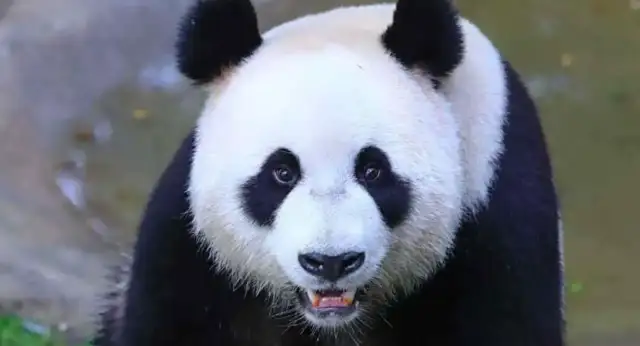
According to the 1994 Study on Wild Panda Reproduction in the Pyramid Nature Reserve, in 1978-1992, out of a total of five large wild pandas in the Pyramid Nature Reserve, six females had 15 births, of which only one was a twin.
On 18 December 2019, an infrared camera set up by the staff of the Pyramid Nature Reserve filmed a pair of sub-adult pandas, suspected to be twins, with rare records in recent decades.
By contrast, it's not so unusual to have big pandas with twins.
The Vice-President and Secretary-General of the Animal Behaviour Division of the Chinese Society of Animals, Liu Ting Shui, described the relatively high rate of twins being born under conditions of rearing. According to the records of the Hong Kong Centre for the Protection of Panda in China, the proportion of twins was 44 per cent over the past 30 years, mainly due to the upgrading of artificially assisted child-rearing techniques.
In addition, well-nourished conditions, as well as the presence of “composed eggs” in large pandas themselves, make it easier to excrete two eggs and make it easier for pandas to bear twins.
Data also show that the global probability of the birth of large panda twins is between 44 and 66 per cent, much higher than that of wild pandas.
Although the probability of twins is not low, the experts stressed that the birth of pandas remains a global challenge, with the main difficulties being the short reproductive window, the difficulty of mating, genetic management difficulties, and the low survival rate of pups.
Large pandas are solitary animals and there is a lack of interaction between females and males even in the wild.
At present, artificial insemination has become the main method of procreation, but the ovulation time of the panda is difficult to determine with precision and the rate of fertilization remains low.