In terms of patterns of industrial development, if spontaneous market expansion is the first half of industrial development, then clear top-level design is the second half of the industry ' s move towards mature and high-quality development. From the depth of the long triangle to the scientific and technological battles of the Pearl Triangle, to the special breakout of the Mid-West region, the precision of the local government's “physical hand” has become the “grand trend” for a new round of growth, accompanied by the flourishing Chinese pet economy.
A combination of policy and capital drives, city-level pet economic planning is becoming “spraying”. For example, there are 3 billion “minor targets” in Mount Foshan.

China's pet industry is entering a new "big leap"
A notable shift in China's pet economic development to date has been that the future of industry is no longer dependent solely on “wild growth” of market demand, but is increasingly integrated into the strategic blueprint for urban development. Policies go first and are becoming an unstoppable trend.
In recent days, the city has been set “small targets” for its pet economy of 3 billion.
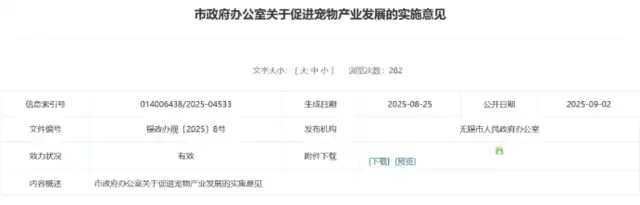
Of these, in August 2025, No Tin was the first to throw out an Implementation Opinion on the Promotion of the Petty Industry, setting a target of over $3 billion by 2027 for the city-wide pet economy.
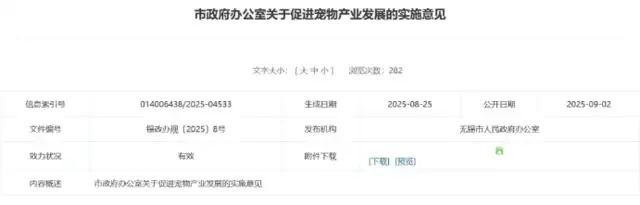
The policy not only sets clear targets for the size of the industry, but also plans for five players:
First, the high-end manufacturing drive - around key tracks such as pet foods, functional health care, smart supplies, diagnostic equipment, supports enterprises and scientific institutions such as the University of Gangnam to build a platform for research and development, introducing new technologies such as artificial intelligence, 3D printing, precision manufacturing, and promoting the development of high value-added products such as pet life-cycle management, health monitoring, prostheses, etc.
Second, capital works with parks - there are plans to build two to three pet estates that combine R & D, production, testing, demonstration and marketing, and build high industrial lands for supply chain integration.
Third, the innovation of retrieving prizes — a maximum of $10 million in one-time awards for major projects such as pet foods, health care, medicines, smarts, etc.; and a financial incentive ranging from $500,000 to $0.8 million for enterprises that have received national awards for “specialty new” or “single champions in manufacturing”.
Fourth, the Enterprise Breakup Authority - encourages enterprises to develop new veterinary medicines, with subsidies of up to $500,000 for approved pet drugs and a ceiling of up to $10 million per year for single enterprises.
Fifth, friendly landscape-building — pet theme parks, pet-friendly communities, pet business circles — creates a production-consumption closed circle through a double-wheel drive between industry and consumption.
At almost the same time, the objective of the Plan of Action for the Development of the Petty Economy (2025-2027) revolved around the three water zones. On the one hand, the manufacturing industry focuses on core areas such as pet food, medicine and smart supplies, building high-end manufacturing clusters based on the industrial base of the three water zones and the advantages of the Guang Buddha supply chain; on the other hand, the agro-blogging industry experiences the activities of the axes around pet-friendly communities, commercial circles, landscapes and cultural brigades, and innovates the “pattern + pet + socialization” model to bring industry and consumption together.
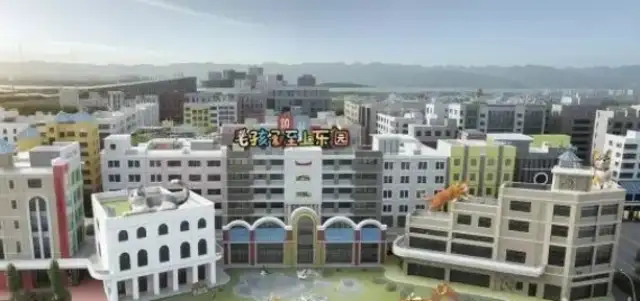
The three waters were the first in the city to build a pet economy.
The three water zones have been re-engineered through the pet plus model, with a plan to start with a base of 1.3 billion yuan in 2025 and reach 3 billion yuan by 2027.
If tin-free represents a long-triangular path of “high technology + hard nuclear manufacture”, Foshan takes the lead in moving out of the integration paradigm of “industrial cluster + consumption scenario” in the Pearl Triangle. This is a bi-nuclear conversation in China's pet economy: one that breaks industry value added upwards, and one that extends pet lifestyles outward.

The pet economy “national flowering”
Throughout the country, the pet industry is expanding rapidly. The Long Triangle is a major town in the pet economy and, in addition to the aforementioned tin-free zone, Suzhou has also flourished: the Guangsu region, with the advantage of the “Integration of the Cultural and Commercial Brigades”, has launched a one-year action plan for the promotion of quality development in the pet economy in the Guangsu region, which has made every effort to create a pet-friendly pole town.
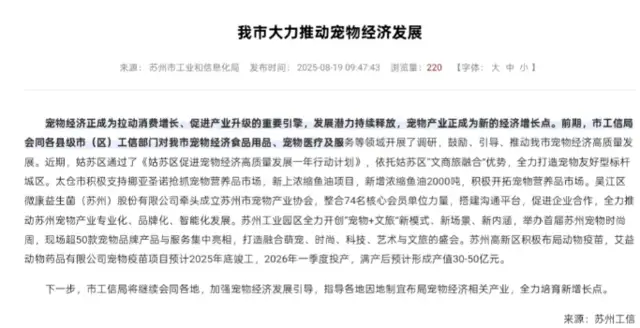
For example, Taikura supports the Pitt Nu Nu Nut project to expand fish concentrate, adding 2,000 tons of capacity; Wu Jiang District, led by the Suzhou Petty Industries Association; and Suzhou Industrial Park, exploring the “Pet+ Letter Brigade” model, creating new consumption scenarios for the integration of technology, art, literature and pets.
Shanghai is more focused on consumption. The Pudu region has built a “Pet-Friendly” commercial complex around business circles such as Globeports and Peaches to form a closed circle of products, services and experiences, while Yangpo District has piloted the “Doggy Master Autonomy” in the coastal space to drive the growth of pets with urban governance innovations. Together with Hangzhou ' s digital configuration and Ningbo ' s cross-border industrial parks, the long triangle has not only continued to reinforce supply chain advantages at the manufacturing end, but has also evolved into stereo-growth poles at the consumption, technology and export end.

At the same time, several urban consumption sites in Hangzhou have been marked as “peter friendly”. Gauttland Square has built the “Pit Here” pet neighbourhood, which combines pet supplies, pet restaurants, entertainment and social spaces, making “Put Out” normal. In addition, the pet economy has been actively promoted in Ningbo, Wenzhou, etc.
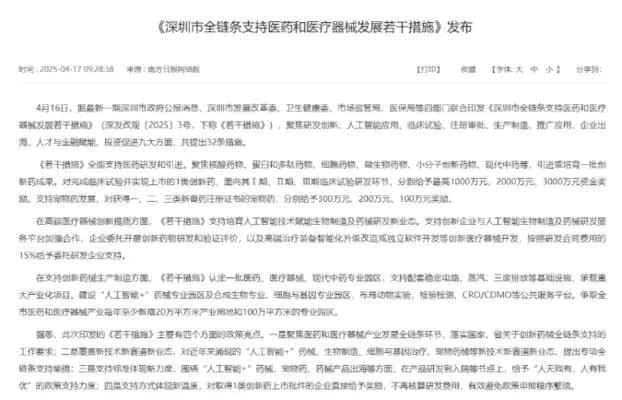
And look at the Pearl Triangle, where competition and collaboration are as intense. Shenzhen plans to promote more than 90 city-wide pet friendly malls and parks by 2025.
It also supports the holding of exhibitions, such as a pet show, a new product launch, and the creation of a “Puppet + Letter Brigade” consumption scene, which promotes the development of the pet theme park, pet friendly hotels, etc. In addition, Shenzhen piloted the limited use of human medicine in pet hospitals and explored new models for linking pet and human medicine. In addition, pet enterprise development subsidies, rental subsidies, etc. are supported by a range of policies.
In addition, in addition to the above-mentioned Faoshan, a $65 million pet industry fund has been set up at the Itosong Hill Lake Biomedicine Industry Base in the town of Zhuang Zhilong in East China, to attract leading businesses such as the King's pets' health and Hertz's life to land, focusing on hard pet vaccines, medical devices and smart wear equipment, making the dragons a new pole in the Gulf Area pet industry chain.
The Kyo Jin-ai region, for its part, has developed a layout for the integration of industrial parks and cultural brigades. In 2025, the Ping Valley region of Beijing launched its first “Beijing Petty Economics Park”, which consolidates the scientific resources of the Chinese University of Agriculture and locates the “Peters' Health+Peters' Services” bi-nucleus, with a plan to develop 10 head enterprises and produce 5 billion yuan over three to five years.
In addition, in recent days, the Beijing Municipal Market Supervisory Authority and the Agricultural Rural Authority have jointly organized a standard demand match meeting for pet industry enterprises. More than 20 revised national standard systems were initially agreed at the meeting, covering three core areas of pet food nutrition, safety of supplies and clinical services.
Similarly, a symposium on the economic development of pets in Tianjin City was held this year, at which the leaders of the Association said that the next step would be to promote, in conjunction with the relevant agencies, the project's landing and to use it as an opportunity to move the pet economy into a new phase of “government-business-gin-council” 4-dimensional solidarity, so that the “paternity” would become a new business card for the city's businesses, depending on the “economic” support for Tianjin City as a new high ground for the northern pet economy.
The central and western regions, thanks to the size and characteristics of the consumer market, have become a “back-to-back show” for the pet industry, forming a differentiated development path in Chengdu, Wuhan and Changsha.
Traditional pet industries such as Shandong, Hebei and Anhui have continued to build on their strengths, and the Inner Mongolia and Xinjiang regions have also begun to explore niche paths.
The development logic of the pet industry is undergoing a profound shift from the south-east to the north-west, from the long triangle to the Bay region to the centre-west. Industry is no longer a puzzle of single-point enterprises, but a 3D network of industrial parks and urban policies: R & D, manufacturing, circulation, services, cultural brigades and cross-border integration into multidimensional ecosystems.
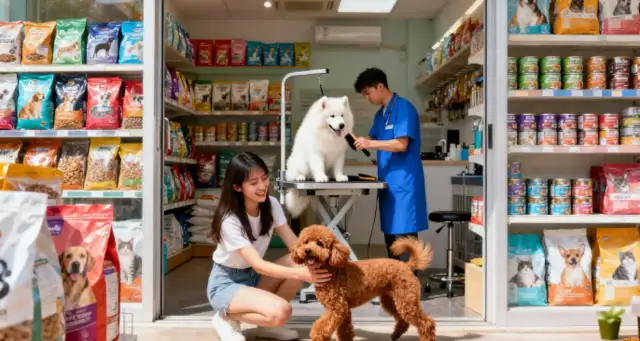
In addition to official additions, pet economic estates are growing.
There are now more than 20 pet parks in Shenzhen Lake Petty Park, the Anhui Lake Long Triangle Petty Industries Cluster, the Peking Valley Petty Industry Park, the Pingyang Pet Town in Wenzhou, and the Yantai Mountain Petty Estate. Some of the parks have been set up as full supply chain ecosystems for R & D, production, testing, demonstration, and sale, providing enterprise support from raw materials to markets.
This clustering is accompanied by the emergence of new and ongoing policies that not only allow competition among firms to escalate into resource integration, but also allow the innovation and iterative pace of the entire industry to be dramatically accelerated.
It is foreseen that, over the next three to five years, China ' s pet industry will enter a high-quality development phase with industry clusters as its base. As the industry has said, the efforts of individual firms are “plus” and industrial clusters and official synergies are “multiple”. The growth logic of China’s pet industry will also evolve from a “single-point breakout” to a “multipolar drive” when business and government work together, and the future map will also usher in a “national boom” in a resonance of policy, capital and technology.