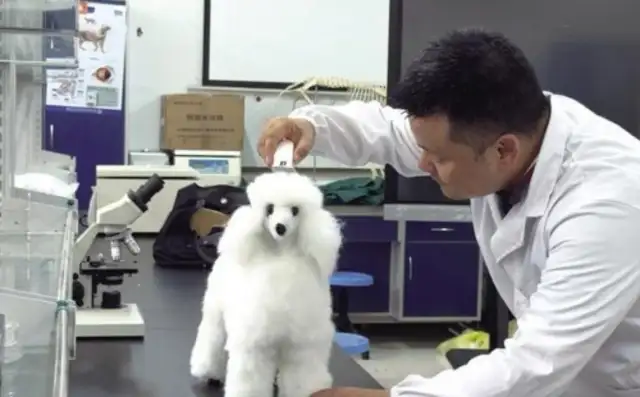
Recently, at the Institute of Biology and Medicine of the Sian Institute of Vocational Technology, the director of the school ' s teaching services, Yang Mon, demonstrated pet cutting techniques at the laboratory.
From pet burial to AI health monitoring, from custom food to pet friendly tourism lines, from pet restaurant to pet fashion week Currently, our pet economy is experiencing a two-wheel drive pattern of “emotional plus technology”.
According to the China Petty Industry Market Report 2025, the size of the country ' s pet-related business market increased from $97.8 billion in 2015 to $59.28 billion in 2023, with a compound annual growth rate of 25.4 per cent, which is expected to exceed $81.4 billion in 2025.
The rise of the “billion-dollar track” of the pet industry stems from the escalation of consumption in the “familyization” of pets, which also opens up new opportunities.
Medical upgrading: from treatment to prevention
On 24 July, at the Beijing and Animal Hospital, located on the sixth road of Phoenix, in the Uyon district of Sion City, Xi'an, a citizen of the Si'an, Liu Xiaoyu, performed a full-bourbon check on pets and bear dogs. This was the third consecutive time that she had arranged a medical check-up for “muff”.
"B is able to screen for intestines such as liver, gall, spleen, intestine, etc., and spends hundreds of dollars a year on examining it, which is reassuring." Liu Xiaoyu said that her petism began to change in 2022 with a disease of “fry”. At that time, “crop” had spent over $6,000 on abdominal carboma.
"From then on, I realized that pets can't be treated just because they're sick." Liu Xiaoyu said that she was going to make another look at the hair after every medical examination. Liu Xiaoyu told reporters that she spends about $1,000 a month on “fry”, mainly on dog snacks, dog toys and dog clothes. It also reflects the extension of pet consumption from a “functional” to an “emotional experience” type.
Currently, a growing number of families view pets as “family members” and are willing to invest in their physical health, among other things, with a significant increase in their interest in the institutional environment and the professional nature of their services.
As the head pet hospital, which grew up in Xi'an, Kyoto and Animal Hospitals are equipped with specialized facilities such as specialist clinics, X-ray rooms and ICU wards, capable of carrying out complex surgeries, as well as precision services such as pet beauty services.
In the past, most consumers used to take their pets to health care, mainly in small clinics near their homes, more for deworming and vaccination purposes.” The co-founder of Sianging and the Animal Hospital Limited stated that the rapid development of the pet chain hospital in recent years, the introduction of video equipment, specialized testing rooms, etc., had significantly increased the chances of pets receiving specialized medical treatment.
Integration of maternity education: breaking the supply of talent
On 25 June, the Community for the Integration of Pedagogy in the Shaan West Industries was established at the Sian Institute of Vocational and Technical Sciences, marking the beginning of a new phase of in-depth synergy in the development of the pet industry in the Xinxi region.
This cross-cutting collaboration platform was launched by more than 50 institutions, including the North-West University of Agroforestry and Technology, the Shaanxi University of Agroforestry and Vocational Technology, the West Anging and Animal Hospitals Ltd.
As a key initiative in the innovative development of the pet industry, the Community was created to point directly to the core contradiction of the “large and weak” pet industry - • According to incomplete statistics, there are more than 600 animal clinics in Shaanxi, and more than 500 pet services, but there is a gap of more than 2,000 certified pet doctors and an imbalance in the supply and demand of professionals such as pet health nurses and trainers.
“With regard to occupational pain, the Community will integrate scientific and educational resources with clinical cases in enterprises by optimizing the system of specialized courses in pet medical technology, pet conservation and training, innovate modern apprenticeship models, such as `order classes', create a platform for the integration of labour and education, and crack down on the `largeness' of the pet industry and the shortage of talent.” According to Yang Mon, Director of Teaching, Institute of Biology and Medicine, SIT.
The surge in demand in the pet industry has directly contributed to the expansion of the scope of talent development. In the case of the Sian Institute of Vocational Technology, the number of students enrolled in animal husbandry and veterinary medicine jumped from 66 at the level of 2022 to 240 at the level of 2024; in the second half of 2025, the school opened new pet medicine and technology, with the first intake of more than 80 students.
“The animal and veterinary profession has changed from `absorption' to `interannual' to `annual', and the student employment rate has risen in step with the needs of the industry. Currently, 50 per cent of the graduates of the school have chosen to enter local pet chains such as Kyoto and Novi, and many have grown into the technical cadres of the shop in three years.” The Yang Mon described the gradual filling of the talent gap in the pet industry through the integration mechanism of maternity education.
Brand Breakout: Rational deep tillage under the "Rally"
On the 11th of July, Siam's citizen Paik Ting Ting's pet dog "Turk" swayed her tail and picked up her toy - This lovely scene is a vivid picture of a child becoming an important member of the family.
Looking back at the history of the Chinese pet industry for more than 30 years, it is not difficult to see its trajectory from the beginning to the outbreak.
In the early 1990s, the China Society for the Protection of Small Animals was founded, and for the first time the concept of “an animal as a human friend” broke the traditional notion that “dogs are seen only for family”. At the same time, the presence of pets at the end of the street is still rare, while in the turn of the century, 10 years later, the pet hospitals in Beijing, Shanghai, and specialized breeding grounds emerged as springs of rain, and the pet industry became more prominent.
In the last 10 years, the pet track has become a hot spot for investment. The White Paper on the Chinese pet industry 2025 (Consumer Report) shows that in 2024, the number of Chinese urban pets (dogs and cats) exceeded 120 million. The carnival of its “economic” has led to the creation of “discretionary services” such as pet pools and custom graveyards, which have led to a shift in industry from “selling products” to “selling experiences”.
However, there is a hidden concern behind prosperity. Over the past few days, journalists have visited more than 10 pet shops randomly, and international brands, such as royals on shelves and desires, still occupy C positions, while home-grown corporate brands are home-grown and weak.
“There was a contrast in the past market for pet consumption: many of the pet owners threw hundreds of dollars for a single meal of food rations, while there was a general lack of trust in domestic food production.” Zhang Xinko, Vice-President of the Petty Clinic of the Chinese Veterinary Association and Deputy Director of Clinical Veterinary Medicine at the University of North-West Agroforestry and Technology School of Animal Medicine, said that, while the product competitiveness of Shaanxi and even national pet enterprises was gradually emerging, it was necessary to address the deep-seated issues of industrial upgrading and the inherent doubts of consumers.
“Keys” for breaking industrial difficulties, “hidden” in higher education laboratories, clinics at pet hospitals, production lines at enterprises... Today, Shaanxi is accelerating the “scientific-clinical-industry” development of the pet industry, and the hundreds of billion-class “economic” markets are opening up more opportunities.