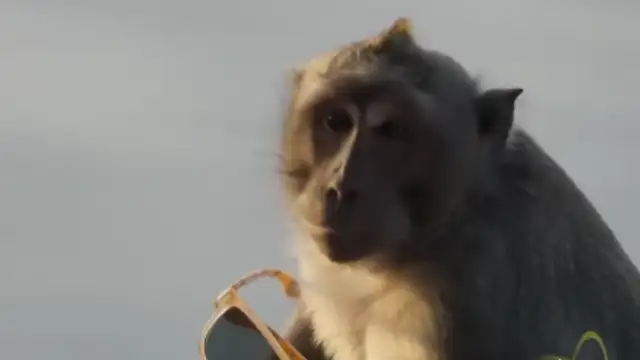
As one of the most popular tourist attractions around the globe, the naughty longtail monkeys of Bali, Indonesia, have for many years robbed tourists of valuable items such as mobile phones, wallets, and bought them for food such as human “forage” — mangos.
These furry animals can steal dozens of mobile phones and dozens of items from tourists every week in broad daylight in exchange for food. It has been reported that these acts of banditry have continued for decades without anyone being able to stop them.
The monkey drops his glasses for food.
According to the information received, the Uruvatu Temple is the venue for tourists to watch traditional fire dances, and the sun sets also allow them to enjoy the panorama of the Indian Ocean waves. The history of the Uruvatu Temple dates back at least to the eleventh century, where about 600 monkeys are found, and they are regarded by the local population as “guardians”.
A monkey from the Uruvatu Temple.
"The monkeys have taken the temple." Jonathan Jammeh, a tourist from London, said that his sunglasses had been stolen last year by a monkey.
Jammeh recalled that he and his wife had arrived at the temple and that the guide had handed him a stick which he said was used to drive away the monkeys. "I asked the guide, "What does that mean?" I thought he gave me the stick because I thought I was too old." However, the stick given by the guide is useless. When Hame was watching the scenery, a monkey jumped on his back, stole his favorite sunglasses and disappeared.
Later, Hammeh found it in a tree with sunglasses. When he showed signs of the monkeys waving cookies, the monkeys jumped down and grabbed the cookies and threw them out of the sunglasses.
Kadek Ali Astava, a monkey manager, said that when the site was initially open to visitors, tourists would feed the monkeys. Later, the temple managers began regularly feeding monkeys and prohibiting tourists from feeding them, and the monkeys began stealing from tourists.
Scientists studying primates have found that monkeys steal goods for money for food exchange with humans. According to several years of observation and analysis of hundreds of hours of video by the Leisbridge University team in Canada, some monkeys are able to distinguish between objects (smart phones, glasses, wallets) that are highly valued by humans and those that are less valued (hats, human tows, hair clips) and exchange them accordingly.
Last year, a 36-year-old woman from Kentucky, United States, Taylor Utley, visited the Urovatu Temple. As she walked along the cliff, a monkey took her mobile phone from her. She went through the bag to see if there was anything to attract monkeys. At that time, a veterinarian threw a bag of fruit to the monkey, who still grabbed the starter and seemed to feel that a bag of fruit was not enough to replace the cell phone. The trainer can only give it a bag and a bag of fruit until the monkey can't get the fruit in his hand and his cell phone is thrown away.
"I'm surprised," Utley said, "It's like a monkey-controlled criminal enterprise."