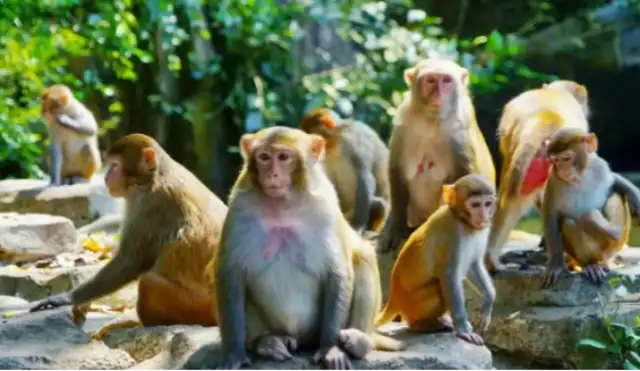
In recent days, on a tourist walkway in a certain area, a female tourist had just pulled out her bag of food and several monkeys had come down from a treetop, scratching her face. "The monkey is worse than the human." The tourist laughed and said.
In recent years, the number of wild monkey attacks on tourists in the landscape has not been small. Searching for the key word “monkey hurts” in social media shows a lot of relevant videos. The topic of “The wild monkey hurts”, which is now in the middle of the summer season, has once again been the subject of public debate, which has been interviewed by journalists of the Chinese Tourist Press.
Sea-South Bay Monkey Island Ecotourism Area
Why would a monkey attack?
"How can a monkey look cute and hurt himself?" In fact, journalists have searched social media to find that monkeys are often injured and looted in the scenery that many tourists share. Some of these clashes stem from the behaviour of tourists themselves — feeding and even flirting with monkeys and intimidating them.
Apart from practices such as feeding, even if tourists are cautious and avoid active contact, they are not absolutely safe. The reporter combing case found that many tourists claimed they had not provoked monkeys, but were still caught: some were just climbing through the mountain and the monkeys were bit; others were focused on taking pictures and the monkey jumped on his shoulder and scratched his cheek; others simply took food out of their bags and were immediately robbed and scratched by the monkeys. These experiences of “passive victimization” have left some tourists in a state of discomfort, stating that “no monkeys will ever be found” or that “monkeys will be seen walking around”.
On 16 February, a video from a friend of the Internet reported that several tourists had been watching wild monkeys in a view area in Shenzhen, and that a little girl had suddenly been bitten with her arm and had a very deep toothmark while standing in a monkey's front photo. According to media reports, in recent years, with the increase in the number of tourists travelling to the area, there have been incidents of injury to the monkeys, although the Park Service has repeatedly warned “not to feed”, but there have been many private feedings. According to park statistics, in the past two years, monkey injuries have occurred as the number of feedings has increased, mostly during weekends and holidays, with injured tourists being dominated by children and women, others being caught while feeding, and others being surrounded too close to being attacked.
In response, Dr. Sun Chien Fai, a scientist of the World Association for the Protection of Animals, argued that wild monkeys are usually not actively approached by humans. But primates are also good at learning and imitating, and if food is easily available from and to tourists, and without risk, their guard against human beings diminishes or disappears altogether. If some monkeys benefit from this, others in the herd will follow suit and even pass it on to the next generation. The monkeys are fast, their nails and their teeth are sharp, and there is a risk of accidental injury as soon as they approach the tourists.
What are the measures taken to manage the area?
In order to ensure the safety of tourists, many viewing areas have taken targeted measures to manage monkey injuries.
There are currently about 1,200 wild monkeys in Guizhou's Pering Hill Park, which are a herd of animals and are naturally proliferating and therefore more widely distributed. According to park staff, in order to reduce the incidence of injuries, the park has adopted a series of approaches to guide close contact between wild monkeys and humans through the establishment of signposts, audio broadcasts, and human counselling.
There are about 2,000 wild monkeys in the southern Gulf peninsula of the Sea-South Mahal, and over 600 of them are resident in the South Bay Monkey Island Park, attracting more than 1 million visitors each year. In order to reduce the number of injuries caused by the monkeys, there is a protection station for the monkeys at the scene of the scene, and every year experts are invited to study the healthy life of the monkeys at the park. The Deputy Director-General of the South Bay Monkey Island Ecotourism Area's Brand Operations, Shafu Sea, described the tourist zone as adhering to the “three-person” principle that the monkey is the owner, the tourist is the guest and the staff is the servant and the housekeeper. “Absolutely reducing the uncivil behaviour of tourists, such as flirting or disturbing monkeys, by means of pre-discussions, the creation of situational markers and real-time surveillance.”
Strong measures have also been taken for the monitoring and management of the monkeys in the Sichuan Zephyr landscape. The area is equipped with professional monkey managers in the area where the monkeys operate, to stop the monkeys and tourists from reaching out, to discourage tourists from feeding and provocative the dangerous behaviour of the monkeys, and to put on the top of the official web a “monkey watch” sign in the area where the monkeys operate, which guides tourists to look civilized. Every year, specialists in animal behaviour, such as the Sichuan Agricultural University, are invited to teach community managers about wild monkey habits, state-of-the-art management measures, etc., and constantly improve the protection and management of wild monkeys.
In Hunan's family scenery, a monkey management team was set up to patrol the area, repel the monkeys and discourage tourists from teasing or feeding them. According to the visitors to the area, the $277 ticket for the area included a $3 insurance fee, which would be covered by the insurance if, unfortunately, tourists were injured or bitten and could be treated and vaccinated at a local hospital. In the case of children without tickets, parents are also required to purchase $3 insurance at the ticket office before entering the school.
How can conflicts between monkeys be reduced?
How did the monkey conflict end? Specialists in animal protection, tourism management believe that the resolution of conflicts requires a combination of efforts, with respect for natural and scientific management at its core.
“The most effective means of mitigating the conflict is to stop feeding and keep safe from the monkey.” Sun Quanhui believes that the long-term feeding of monkeys is wildlife and can alter their autonomous feeding behaviour, allow them to become dependent on, and even to approach, human beings, and may reduce their ability to feed in the wild and lead to the degradation of the survival of wild populations. At the same time, the food that tourists feed does not necessarily correspond to the nutritional needs of the monkeys, and their health is affected by food additives and sugary salty foods. He suggested that, in day-to-day management, the landscape needed to strengthen the monitoring of monkeys and establish clear warning signs and quarantine facilities in areas where monkeys were frequented. Increased outreach to guide tourists to animal friendly forms of tourism and to enjoy the natural beauty of wildlife without disturbance.
Professor Zheng Zheng Ming, Vice-President of the University of Hunan, School of Tourism, suggested that science and technology and information technology could be used to improve early warning and control, building on existing management measures. “A zone in a position to do so may use intelligent means to monitor the monkeys' spatial movements and warn managers of the relevant excursions of the area in advance, and avoid danger by providing scientific guidance to tourists by managers.” For example, the use of electronic acoustic removal techniques for monkeys that may cause harm to tourists allows for safe observation and experience distance between humans and animals, with minimal impact on wildlife while at the same time ensuring safe tourist tours.
For the public itself, what should be the principle of living with wild animals like monkeys? “The basic principle of living in harmony with wild animals is to be safe from them.” Sun Quanhui said that animals were not responsible for their behaviour, but that humans could proactively adjust their attitudes and approaches to animals. This is both the protection of tourists ' own safety and respect for wildlife lifestyles and living space.