Designation: PET3091
English name: Brief description of the Banded krait ring snake species
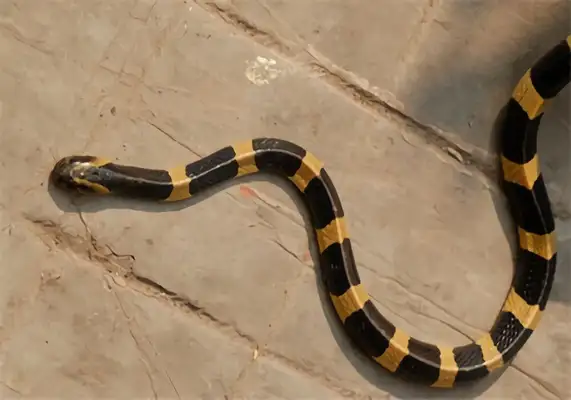
Banded krait, alias, gold bands, gold nails, etc. They are highly toxic snakes, but generally they do not attack humans. They are less toxic than their close relatives, but they are still highly toxic and in greater numbers than silver snakes.
The ring of gold is also a famous food snake species. The ring snakes are located around 25 degrees north latitude and south of it, including Fujian, Guangdong, south-west, Guangxi and south-south Yunnan, in the east towards the south-west of the Koda River, and abroad in South and South-East Asia. The Hunan mountains are also well distributed.
Chinese literary name: Golden Ring Snake
Chinese aliases: yellow velvet, gold belts, Buddha snakes, gold nails, gold karma, gold iron, hyena, gold snakes, etc.
English name: Banded krait
Two words: Bungarus fasciatus
Area: Animal
Gate: Spinal animal door
A reptilia.
FEEL: Squamata.
Section: Cobra Section Elapidae
For the Ring of Snakes: Bungarus
kind: Golden Ring Snake B. fasciatus
Distribution: Guangxi Province, Guangdong Province, Hainan Province, Fujian Province, Jiangxi Province, Yunnan Province, Hubei Province; outside Viet Nam, Thailand, India, Indonesia, Malaysia, Laos, Myanmar, etc. Golden Ring Snake Form Characteristics
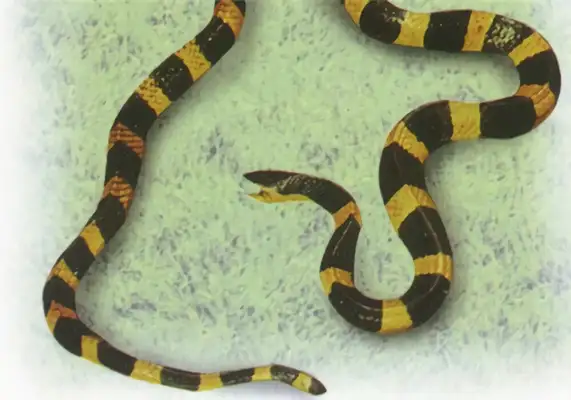
The golden ring snake is highly toxic, it is lethal, it is generally not offensive, it is warmer during the day and very alert at night. There have been reports of several cases of biting in Hong Kong.
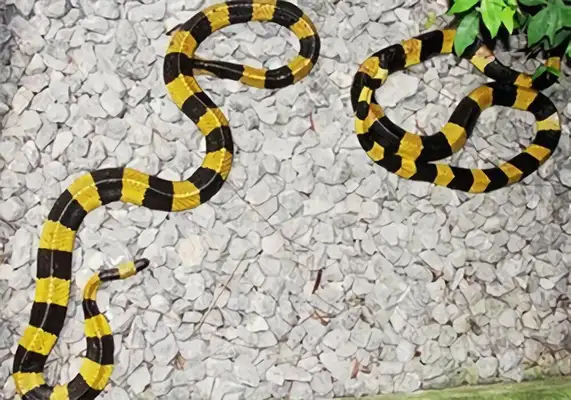
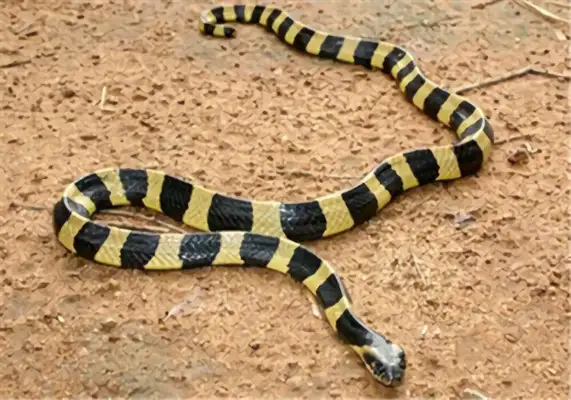
The head of the ring snake is elliptical, with a very short tail, with a trifling tail, a blunt round at the end of the tail, with a slight flatness, with a small and visible ellipse that runs between black and yellow, with a black ring and a yellow ring almost equal in width, with 23 to 28 rings in the body, with 3 to 5 rings in the tail, a smooth back in 15 rows, with a particularly large row in the centre of the back, complete anal phosphorus, a single line in the tail, gray in the abdomen and 100 to 180 cm in length. The head is black and brown, and the pillows have a light-coloured “V”. The back ridge rises on the ridge, so the torso cross-section is slightly triangleed and the tail ends are blunt. The head ellipse, less clearly distinguished from the neck, has a typical nine large scales on the back, a smooth back, a 15-line body, and a straight line of spines extending to a hexagon. The ring of gold.
Newly born golden ring larvae must be kept in a snake box no less than 15°C, so that they can be raised boldly in adulthood, after all. It is not recommended that newcomers raise golden ring snakes, although they are gentle and generally do not attack, after all, they are toxic, and there is a safety problem.
After November, temperatures fell below 10°C, leading to hibernation, and the Golden Ring snake also needed to accumulate large amounts of nutrients to meet the nutritional requirements of hibernation. In order to meet the nutritional needs of golden cyclic snakes during the two above-mentioned harvest peaks, rats such as mice or other fish such as larvae are dropped in the garden every evening before the Golden Circumcers go out of their nests or in the breeding pool. The amount is based on the number of people who have finished, so as to feed and feed as much as possible. The golden cycling snake is a thermogenic animal whose temperature has fallen since November, and the golden cycling snake is expected to be warmer than the winter, so that the sun tanned fine soil is filled into the snake's nest, so that the temperature in the snake's nest is around 11-13°C, and the relative humidity is around 10%, ensuring that the snake is safe for the winter. After winter, the first waking snakes of hibernation can be caught from their nests to the sun for about three hours, and the sun bath can be used to improve their body. During the summer, the rearing ponds and the feed ponds will be covered in a shade to avoid the tan of the pool, resulting in the death of snakes and live feed animals. In order to prevent snake disease, the sanitation of the snake park must be strictly maintained, the rest of the food and snake dung must be removed in a timely manner and the food and equipment must be regularly disinfected. Prevention of disease. In addition, the safe management of the snake park should be strengthened to prevent the flight of snakes and their natural enemies. Golden Ring Snakes.
They are typical meat-eating reptiles, and they are not only meat-eating but also live-eating. In the wild, they usually come out at night to hunt for food and find a safe place to rest during the day, so what food should be fed under artificial conditions?
In general, young snakes feed themselves on egg yolk for up to 10 days, without feeding and with clean drinking water. A small amount of food was not available until 10 days later. High-quality digestible foods, such as broken yellow, mud, etc., are generally dropped and some fluid foods can be fed to infirm snakes with syringes or earwashing tools. Young snakes are very resistant to hunger and do not eat for 20 days, and as long as they are guaranteed sufficient water, they will not starve; if they do not, they will die of thirst. However, artificial rearing must start as early as possible to facilitate its growth and reproduction. Young snakes shall be kept separately from adult snakes and other different species. They shall be raised separately by variety and size in order to prevent them from eating snakes and snakes and from eating each other ' s casualties. Viper breeders can heat up 200 watts of electric lamps in case of cold weather or put coarse masts in the snake room to prevent cold. Water from feed ponds and gaskets in snake nests should be regularly replaced during rearing, residual animal bodies and faeces should be removed in a timely manner and periodically disinfected and the environmental sanitation of snake gardens maintained. Attention should be paid to snake activities, feeding, drinking water and mental state and to the timely capture and treatment of the disease. In addition, care should be taken to prevent the harm of the natural enemies of snakes.
The venom of a ring snake can be used to raise frogs and lizards in snake gardens for their free feeding. Frogs can normally be caught and placed in snake gardens to compensate for the lack of feed. Early in March each year, the Golden Ring snake is weak and requires a large amount of nutrient supplementation.