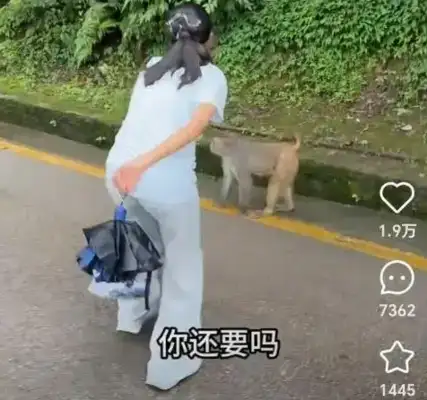
In recent days, some netizens have published videos stating that they and their sister went to Guizhou Qi Lingshan Park for a tour and that the sister had tried to feed the monkey with a watermelon, and instead of accepting the “good intentions”, the monkey jumped up and turned around and covered her clothes with her feet.
After the video was released, it was quickly triggered by online discussion, in which some said, “This monkey's hand is the contemporary Sun Goku?” and “Monkey: It's not sweet, it doesn't take!” and others said, “Prosperous monkeys, stay away, be civilized, don't feed.”
Video reporters tried to contact video publishers for details but did not respond. However, a search by journalists found that there had been a number of similar incidents in the recent past. Just a few days ago, another netizens said that they were standing in the park watching others feed the monkeys and were attacked by them.
In response to the recurrent “monkey” conflict, on 27 July, live video reporters contacted Shinsan Park, where staff stated that monkeys belonged to wild monkeys who were not domesticated and were therefore vulnerable to injuries, “which were wild and offensive”.
Staff stressed that the park had set up multiple security signs along the scenery to warn tourists not to approach monkeys. “This certainly cannot be fed, and there are security warnings along the way to remain above 3 metres.” At the same time, staff members have called on tourists to: “Do not bring food to feed as much as possible while playing for their own safety”.
The Director of the Institute of Animals of the Chinese Academy of Sciences, the National Museum of Animals, Zhang Jianhyu, stated that monkeys were wildlife and that people were too close to them to trigger attacks. “Since humans are too close to danger, they attack, do not feed, stay away”. He also pointed out that long-term feeding can lead to the development of food dependency in wildlife and that “the habit of demanding animals can hurt people once the feeding is stopped”. He therefore suggested that tourists should distance themselves from animals in the field and avoid feeding.