Data show that the number of Chinese pets exceeds 120 million. Millions of pets die each year, and the “back-to-back” of pets is receiving increasing attention.
A survey of Xinhua Vision journalists found that, in recent years, pet funeral services had emerged, but that there had been unlicensed operations, false propaganda, and poor fees.
More and more people perform rituals and say goodbye to pets.
More recently, Mr. Gao of Beijing held a ceremony and cremated a dead pet cat through a pet burial facility.
Over the years, more and more pet owners like Mr. Ko. In Beijing, Shanghai, Chongqing, etc., pet funeral services have emerged.
The pet burial refers to a series of post-mortem services extended by pet body treatment, including pet body cleaning, pet burial, pet ashes disposal and pet specimens, souvenirs, etc. Data from the survey show that, as of June 2025, there were more than 8,000 companies operating nationwide, most of them registered for nearly three years.
In the Guangqing Sanctuary for the life of pets in Chongqing, journalists saw about 300 square metres of rooms divided into multiple functional areas. The founder of the memorial said that it had opened in July last year and had served more than 500 pets, more than 80 per month alone.
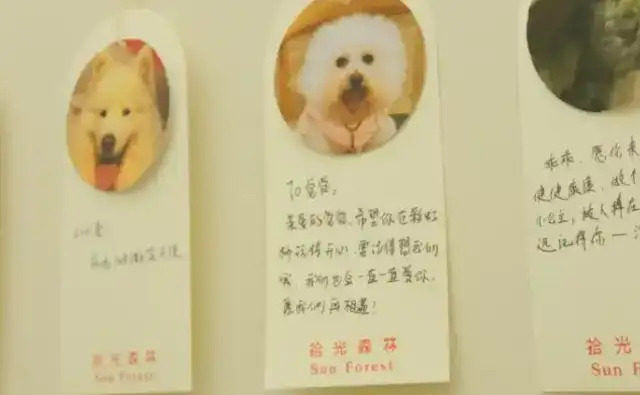
In Chongqing's new district, in the Golden Forest's memorial for the life of pets, the words of the owner of the pets are kept. (Pages for interviewees)
A farewell ceremony for pets, cremation ... Tamage said that the basic package was usually hundreds of dollars and could also be customized, such as flowers, customized urn cans, hair souvenirs, etc., at prices ranging from thousands to tens of thousands.
In addition to changes in the perception of pets and the increase in the number of pets, the regulatory policy has been updated and introduced over the years and has also contributed to the rapid development of the pet burial industry.
The newly amended Animal Vaccination Act of 2021 provides that sick and dead animals shall be treated in a non-hazardous manner and shall not be abandoned at will. The disposal of pet bodies is regulated in many places. For example, the Shanghai City canine regulations require that dogs and animal clinics should not bury or dump their bodies on their own and should be sent to designated harmless disposal sites.
In March of this year, Guangdong Province ' s first animal harmless treatment centre, which has been approved for animal quarantine conditions, was opened in Shenzhen to meet the needs of pet classification management, closed circulation transport, personalized end-of-care pet service, and professional harmless treatment of whole chain scenes.
According to the relevant studies, the market for pet burials in China reached 1.825 billion yuan in 2023; it is expected to reach 5 billion yuan in 2025 and surpass 10 billion yuan in 2030.
Unqualified, false propaganda, and random charges.
The journalists ' survey found that the pet burial industry is developing rapidly to meet the real needs of some pets and has played a positive role in the proper handling of pet bodies and the reduction of pollution; at the same time, issues such as unlicensed operations, false propaganda, and inducing consumption also arise from time to time.
— Unlicensed business, “Backbox cremation”. After the death of the puppet cat, Hu Chan chose a local pet burial facility to cremate. "There was a professional crematorium team on the list page on the Internet and it was also available for pick-up." Hu Chan said the site of the cremation was the trunk of a modified van outside the city.
It is understood that an animal harmless treatment facility should have a site of a certain size, be assessed through, inter alia, the environment, the risk of animal epidemiological conditions and be certified as such.
Industry sources have revealed that some businesses have not acquired formal qualifications for reasons such as site, equipment costs, etc., burning pet bodies through the purchase of second-hand medical incinerators in warehouses in the suburbs or in trunks of modified vehicles.
— Hypocrisy propaganda, “Wash as ashes”. The consumer indicated that the purchase of the pet cremation package page was explicitly referred to as “separate cremation”, but he arrived at the cremation site and found that his pets were burned with many pets and that an additional $500 was required for individual cremation.
On some social platforms, a number of netizens have posted allegations of false propaganda in pet funeral houses. Tam Xin Yuan revealed that the cost of treating pets is high, and that some bad traders even use grass ashes as ashes or distribute the ashes of a pet to multiple pet owners in order to get back to the cycle.
— Mischarging fees, suspected of inducing consumption. Journalists visited a number of pet funeral shops and found that the basic cremation prices of different shops in the same city ranged from $300 to $3,000 and that the price system was confusing.
Mr. Wang, who works in Shanghai, contacted a pet funeral home through the pet hospital. At first, he said that the $800 package would cover the whole process of autopsy, cremation, etc., but in cremation, he said, "Let love leave with dignity." He was advised to raise the standard and to purchase pet cemeteries, pets and funerals for a wide range of 2,000.
The industry has told journalists that some businesses are invisibly tying other projects in basic packages, such as basic cremation with high-priced urchin boxes, farewell ceremonies, etc., to induce consumption through the words “best of all” and “no regrets”.
Establishing clear responsibilities to strengthen norms
In April of this year, a pet owner of Liaoning, Chen Siu, died of six years of illness, making it difficult to deal with cat bodies. “On the Internet, it says that sick and dead animals are to be treated harmlessly, but in my county, where there is no professional pet crematorium, it feels too casual to bury in place.” As a result, Chen Si sent the cat to a pet burial facility more than 80 kilometres away.
In Chongqing's new district, the pet-showing room is located in the Guangqing Forest Memorial for the Life of Pets. (Pages for interviewees)
It is not a small number of people who do not know how to handle pets properly after they die. According to Liu Xiaoxia, the Secretary-General of the pet industry branch of the Chinese Livestock Association, the funeral of pets is currently concentrated mainly in second-line cities, with an uneven regional distribution that does not adequately meet related needs. “The harmless disposal of pet bodies is important for the safety of public health in cities and reflects human `respect' for animals and should actively promote the normative development of the pet burial industry.”
Industry experts have recommended, on the one hand, improving the standards of regulation and further clarifying the responsibility of pet care providers, pet breeding units and individuals for the sound handling of pets, and, on the other hand, improving the system for the sound handling of pets in conjunction with the actual improvement of the system for the sound handling of pets, strengthening the planning of the management of pets, optimizing the transfer and recycling services for pets and improving the capacity for harmless handling.
“Petal burial services, which cover a wide range of sectors, including civil administration, agroforestry, livestock, environmental protection and market regulation, should clarify the duties and content of the supervisory authorities, establish a coordinated regulatory mechanism, strengthen industry regulation and regulate operating procedures.” Xu Guangjian, Professor, School of Public Administration, People ' s University of China.
The Executive Director of the Luaoning Mount ' s Petty Chamber indicated that industry associations could work with the price sector to strengthen the guidelines, requiring vendors to mark prices and eliminate hidden fees, and through the "blacklist" mechanism to regularly expose businesses that had been subject to fraud, high prices and irregularities.
Xu Guang Jian et al. recommended increasing public awareness and responsiveness to harmless treatment and promoting a higher percentage of harmless handling of pet bodies. “If a consumer encounters false propaganda, forced consumption or fraud, the relevant evidence should be preserved, complaints should be made in a timely manner to the market regulator or consumer association to defend his rights and, if necessary, to seek legal means to protect his legitimate interests.”