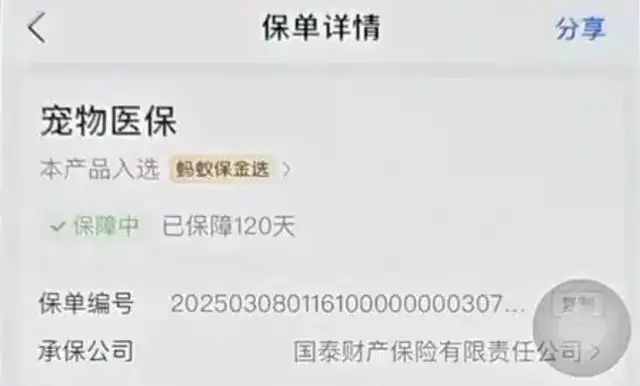
Ms. Consumers of the city of Guangzhou, Fujian Province, reported to the Ino-Gwang Network Woodpecker Consumers Platform that on 8 March this year she purchased a “Peter Health Insurance” for Pet Dog “Si” on a well-known web platform, under the cover of the State Thai Property Insurance Company Ltd. On 25 June, she found “the mental state of Junior” poor and went to an insurance-designated hospital to examine, identify the pets with tumours and undergo surgery the following day. However, when she approached the insurance company for compensation, she was refused.
Pats and dogs have long tumours.
The complainant's wife's son, Mr. Yoo, told journalists that on 8 March this year, on a well-known web platform, his mother had purchased a “Petal Health Insurance” insurance policy for his pet dog, “Stub II”, and that the policy issued by the underwriter, State Thai Property Insurance Ltd. contained the following sentence: “The whole product portfolio had an unexpected waiting period of 10 days, 60 days for tumours and oral diseases and 30 days for other diseases”.
After the insurance coverage, in mid-June Ms. Fong discovered swelling in the legs of the “second child”. On 25 June, a “minor” mental state was found, and he went to the hospital designated by the insurance company for a medical examination and found a tumour in the left leg of the “minus 2” with an area of 6 *5 cm. On the following day, “Sew II” operated, paying a total of $2133 for medical expenses.
After the surgery, Ms. Fong sought compensation from the State Thai Property Insurance Company Ltd., which refused on the grounds that “the waiting period ended with illness or symptoms, the waiting period ended and the insurance company did not assume insurance liability”.
According to Mr. Yoo, the “waiting period” for tumour insurance ended on 8 May, as indicated by the insurance company itself, while the “second” illness occurred in late June and the insurance company was liable for the full cost of his own medical expenses.
In a subsequent communication, the insurance company's client service responded to Mr. Yoo: “As judged by the time the swelling was formed, it was impossible to grow to such a size for a month, so it was judged that the illness and symptoms had arisen during the waiting period”.
But Mr. Lew believes that there is no basis for this assessment, “who can anticipate this disease”.
The insurance company gives the consumer a refund and compensation.
In the light of Mr. Yoo's reflection, the debate between consumers and insurance companies focused on the timing of the illness of “Stage Two”.
Mr. Yoo stated that on 11 July, following repeated interventions, the insurance company had indicated that it could refund in full the premiums paid for five months, totalling $365, and an additional $200 for “care money”.
On 12 July, journalists contacted the guest line of the State Thai Property Insurance Company Limited, and the person in charge responded to questions from journalists.
Why refuse to pay? According to the medical opinion given by the hospital doctor who operated “Step two” and in accordance with the principles of medical reasoning, the responsible official of the State Thai maternity insurance replied that it was reasonable to assume that the “Step two” had to have occurred before the end of the “waiting period” and therefore refused compensation. And then why are they paying refunds and compensation? The person in charge said that he wanted “a good communication with his client”.
Why didn't the insurance company confirm the pet's condition at the time of the purchase? The person in charge stated that prior to insurance coverage, the obligation to inform had been strictly fulfilled, and that in the “know-how-to-insured” form, the content that had a significant impact on the body of the pets had been added to the text, so that the client could make rational decisions on the basis of full understanding. “The product is low in premiums and profits, and the decision path for sales is short.” The incumbent also said: “It is also because it is cheap that many things need to be decided by consumers themselves.”
So, can the owner go to the regular pet hospital for a medical examination and issue a medical report to determine the health of the pet, at his own expense, before purchasing the pet insurance? The relevant head of the insurance company stated that the company accepted the true certificate issued by the non-scheduled medical institution, subject to the provision of proof of the medical institution ' s qualifications.
In addition, according to the Circular of the National Financial Supervisory Authority on matters relating to the strengthening and improvement of the regulation of Internet property insurance operations, “the property insurance company shall carry out Internet property insurance operations in a strict distinction between online and offline integration operations”. On the other hand, the insurance policy for the products purchased by Ms. Fang was not clearly marked as online sales. In this way, did the sale of KTIP Limited fail to comply? In response, the Officer-in-Charge stated that the Notice applied to personal risk operations and that Ms. Fong had purchased pet health insurance and therefore did not need to be specifically indicated.
There's no way to tell who's wrong.
After the insurance company offered to refund the premium and to compensate the “care money” for an additional $200, Ms. Fong accepted this solution, while Mr. Yoo said that he “can only accept it”.
And with regard to the journalist, “Does the insurance company intend to blur the insurance provisions and reduce the purchase threshold to the maximum extent possible?”, the above-mentioned head of the insurance company states that, in this case, for example, the present document is lost and that “will the loss be done?”
It is clear from the above that in this case both consumers and insurance companies find themselves “challenged”.
With regard to Ms. Fong and Mr. Yoo's experiences, Mr. Shi Jinji, Senior Partner of the Guangdong Rectangular Law Office, considered that the medical assessment of whether the neoplasm of “second child” was ill during the “waiting period”. In terms of the size of the tumour, however, it is unlikely that it will be possible to reach the point where surgical treatment is required in the short term. When faced with such incidents, consumers can defend their rights and interests legally. The people ' s courts have expedited courts to settle claims on behalf of the parties in cases within $50,000.
It's common to have disputes about pet insurance.
Although the dispute between the two parties has come to an end, the points behind it are worth exploring. For this reason, a series of visits by journalists from Ongwane have revealed that it is common for disputes to arise from the confusion in the pet insurance market behind this consumption.
After looking at the treatment of the second child and photographs of the tumors and growth areas removed, the director of a well-known old pet hospital in Fuzhou said: “In terms of the tumours' growth mechanisms, it is usually a gradual process; but in the case of inflammation, it may occur within days. There are many types of tumors, some growing fast and others growing slowly, such as acute tumours. It is difficult to draw conclusions without a medical assessment.”
“According to the above cases, it may have been long, but the owner never found out.” The President stated: “It is difficult to judge the difference between the parties to the dispute”.
Similar difficult-to-judge pet insurance disputes are not uncommon in practice. “A few years after the introduction of the pet insurance product, our hospital has experienced a number of cases involving pet insurance disputes. During the visit, the head of the pet hospital told the journalists accordingly. They all believe that the current market for pet insurance is chaotic.
The head of a pet hospital, who did not want to reveal his name, said to journalists that some of the pet owners had actually been insured in the health of the pets and had received compensation from the insurance company; others, who had found out that the pets were ill, had gone to buy insurance for the purpose of obtaining compensation; and others, who did not know about the pet ' s illness, had ended up suffering from a lack of understanding of the insurance provisions.
The director of the famous pet hospital mentioned above told journalists that this was a structural contradiction, the key to which was that insurance companies wanted a piece from the pet market, while the pet owner wanted to benefit from the pet insurance, which lacked effective regulation and led to frequent disputes.
“For human beings, the purchase of insurance types, such as medical care, is a safeguard, in the hope that it will never be introduced. But for the pet owner, insurance for the pet was paid at $1,000, and it would be better to pay $2,000.” The director said that “the insurance company is in fact aware of this and is intent on making the provisions ambiguous and lowering the purchase threshold, thereby maximizing the number of clients. There is also a high risk of disputes due to the small number of insured items and the fact that insurance companies rarely investigate the health of pets.”
Market disruption due to lack of regulation urgently requires standard provisions
With regard to the disruption of the pet insurance market, an in-house expert from a well-known firm in the insurance industry believes that this is highly relevant to insurance companies that have been insured, and that the ease of Internet platforms in recent years has further broadened their access to insurance companies. Because pet owners can buy their pets without under-marketing lectures or face-to-face counselling, and the cost of buying them is lower, some insurance companies feel that the area of pet insurance should be very market-rich, have room for profit, and even some platforms will advertise the pet owners and attract their owners to buy insurance for the pets. The number of users of pet insurance is increasing, but how this new area is regulated has not kept pace with the relevant national laws and regulations.
“At the same time, the insurance company suffers from defects in the determination of its own liability obligations.” The expert stated that, in principle, insurance companies should have recognized the physical health of the pets before the owner was insured, but that they had no incentive to fulfil that responsibility because of the low level of insurance coverage, the low cost of insurance and the high cost of pre-insurance recognition. If, before purchasing the pet insurance, the owner provides the pet with a medical examination at his/her own expense to confirm his/her health, this leads to an increase in the pet owner ' s input, which affects the company ' s clients. Both causes contribute to the risk of disputes in the settlement of pet insurance claims.
It was further noted that the source of the current turmoil in the pet insurance market was “the lack of regulation” and “the difficulty of maintaining normal order in the market simply by relying on market owners”.
The expert suggested that the financial regulator should thoroughly regulate the pet insurance market and could introduce standard clauses for pet insurance contracts. “In the case of human insurance, the standard life risk clause is very strict. Standard clauses allow enterprises to superimpose their services on this basis, but neither insurance nor insurance companies want to play `paint the edges', not only for consumers, but also for insurance companies `shelter the pits'.”