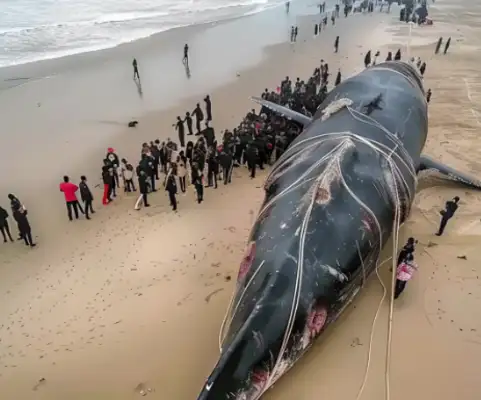
In recent days, a sad news has caused social concern. On the night of the day, a whale unfortunately ran aground on the beach of the town of Kwangpo, Hainan Shui County, and the crowd moved quickly to launch a caring relief operation lasting almost 30 hours. However, despite all the efforts, the whale eventually died at 4 a.m. on the 18th.
It is understood that this whale was found on the beach on the night of the 16th. When the crowd found out, the first call was made and the whale was rescued by spontaneous organization. They dig out deep ponds on the beach where the whales are stranded, using sunscreens to cover the air, to provide the whales with a relatively comfortable environment. A number of people are still standing around the whale and keep their skin wet by pouring sea water on its back. Subsequently, relevant departments, such as the MOWA, arrived quickly to coordinate the participation of various actors in the relief effort.
On 17 December, the rescue on the ground was still intense. Rescue personnel installed dive pumps to extract seawater and keep whales in the water. At the same time, provincial marine wildlife rescue specialists arrived at the site to test whale excreta. The results show that, although there are no visible injuries on the outside, the condition is more severe in the body. Experts have developed a series of treatment programmes to try to save the lives of whales. However, all efforts ultimately failed to save the life of the whale. At about 4:00 a.m. on the 18th, the whale stopped breathing and died. At present, whale bodies have been buried at the Hainan Aquatic Wildlife Rescue Centre.
In this incident, some people interpreted the grounding of whales as “collective suicide”. In response, the experts made it clear that this statement was clearly not scientific. Whales are not organisms with the same rich human feeling, and when stranded, they tend to appear horrified and make tragic calls for help. According to experts in the field of marine mammal research and protection at the Deep Sea Institute, the reasons for the run-off of whales and dolphins are complex, but mostly related to the damage to whales and dolphin echo positioning systems. For example, noises such as sound from military installations, underwater explosions and so forth may interfere with whale and dolphin echo-positioning systems and even cause direct physical harm. In addition, parasitic diseases, such as earring damage, can lead to an anomaly in the direction of a whale, a dolphin or a disruption of the balance, which in turn results in grounding.
Whaling grounding is not an example and has occurred in many parts of the globe in recent years. Not only did this mausoleum trap show us the effort made to protect wildlife, but it also triggered a deep reflection on the marine ecosystem and the survival of whales. How to better protect marine ecology and reduce the occurrence of tragedies such as whale grounding is an issue that deserves the attention and reflection of all of us.