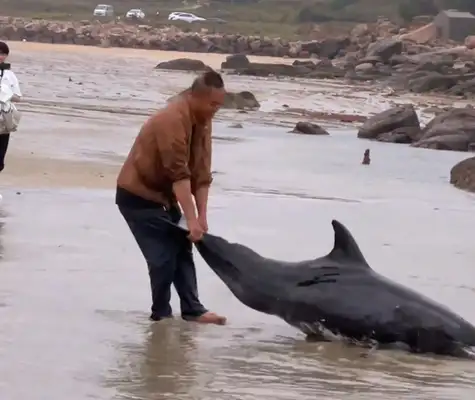
In recent days, a video of a dolphin crash on flat beach has generated widespread attention on social platforms. In the video, a man tried to drag stranded dolphins to the shallows, an act widely criticized by netizens. Shouldn't a dolphin be dragged back into the sea? In response, Dr. Chi Wai, an assistant researcher at the Third Institute of Oceanography of the Ministry of Natural Resources, provided professional explanations and advice that dolphins, as mammals, were required to surface regularly to breathe air, usually with illness or other health problems when dolphins were stranded. Forced return of weak or unbalanced dolphins to water could cause them to choke or even drown. It is therefore a wrong way to send stranded dolphins into the water.
Men drag dolphins to the shallows.
Dolphins on the beach. Emergency rescue station.
According to the video photographer, Ms. Zhou, at around 4 p.m. 12 p.m., she saw a dolphin standing on the beach in the former town of Paingwon, and then attempted to drag dolphins into the sea, but when dragged deep into the water, she discovered that dolphins were not far away and suspected of being injured. Subsequently, a local villager quickly dragged dolphins to the shallows and contacted a specialized aid station.
It is understood that at 1620 hours on the same day, upon receipt of a rescue call from the Alliance for the Protection of Aquatic Wild Animals of Fujian Province, the Oleburg Marine World Relief Station in Fukuya, a specialist was organized to carry first aid items and run into the flats with rain, during which the first aid measures were continuously coordinated with the fishermen on the ground. When they got there, they decided that the stranded dolphin was a rusty dolphin. His body suffered multiple traumas and he was anxious to breathe and had to be transported back to the Oleburg Sea World Hall in Fawzhou for treatment as a result of water strangulation due to the increased vulnerability of the beach waves. Dolphins are measured to be 2.23 metres long and weigh 106 kg.
Expert: Dolphins are found stranded and not suitable for re-entry into the sea Medium
Following the publication of a video on the rescue of dolphins on social platforms, a number of netizens criticized the men who dragged dolphins to the shallows, saying that it would directly result in dolphin deaths. Is that true? In this connection, the journalist interviewed Dr. Chi Hui, an assistant researcher at the Third Ocean Research Institute of the Ministry of Natural Resources. The man in the video dragged the dolphins to the shallows in order to wait for the rescue team. If the dolphins were not moved to the shallows in time, the water flooded their breathing holes after the tide. In fact, the best way to move was to use stretchers, which did not work well, but the limited conditions on the ground, together with hundreds of kilograms of carving dolphins, were understandable.
So, what's the right thing to do when you run into dolphins? In the past, Chi Hui said that if dolphins were found to be stranded, whether or not their vital signs were good, they should first be contacted by local fisheries authorities or fisheries law enforcement authorities (through 114 or 12345), who would then contact the nearest professional team and not directly return the dolphins to the water. While waiting for professionals to arrive at the scene, dolphins can first be raised (with their back fins up) to keep their head-top breathing holes completely exposed to air.
At the same time, shallow ditches can be dug where their chest fins are located, where they are collected to prevent fractures. Short-term departure from sea water does not dehydrate dolphins. It is only necessary to keep their skin wet, so that the skin of dolphins can be constantly watered with sea water (with care to avoid breathing holes) to prevent them from drying up. " It also needs to be noted that dolphins are not to be dragged at will and that the crowds are to be kept at a distance from the head and tail of dolphins in order not to be mistreated by struggling dolphins.”