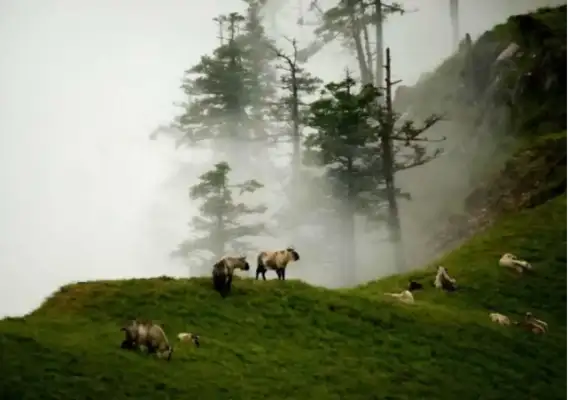
Sichuan Hiromoto, at the Kawagan junction, at the foot of the mountain, as an important area of the Grand Panda National Park, the Tang Jia River Area of the Grand Panda National Park (hereinafter referred to as Tang Jia River) is never short of stories. Not only are the wild pandas the first to meet Yukawa, but the wild animals in the low-altitude areas are also the first in the country.
Even with world-class ecological resources, the current business pattern in Tang Jia is still dominated by “visiting”, with tourists staying for less than six hours and consuming only 8 per cent twice. The question of how to bring economic “high value” to ecological “grace” is a question of the development of almost all protected areas.
“The keyword is `Protection + Man Brigade'.” On 18 July, Wang Loo, the party secretary and head of the Department of Natural Protected Areas at the Tang Jia River National level in Sichuan Province, stated in a cover press interview that efforts would be made to achieve a 20 per cent increase in the movement of large pandas in the Tang Jia region by 2028. At the same time, the short-term target for the revenues of the brigade is over $300 million, with an increase of $8,000 per person in the community.
The Tang Jia River is trying to “break the circle” in the construction of the “Symbiotic model of the Protection and Culture Brigade”.
Rehabilitation of ecology with the revenues of the Brigade
Achieving a virtuous circle of “protection-use-re-feeding”
“We are currently faced with the challenges of high protection costs, delayed community development and monopolistic landscapes.” In the case of Tang Jia River, Wang Lutan said that the implementation of the “Protection + Man Brigade” strategy to enhance the international impact of the Panda brand was not only a response to the spirit of the twelfth plenary session of the Provincial Council, but also a necessary way to promote ecological conservation and harmonious coexistence with economic development.
The Tang Jia River is a key habitat for rare species, such as large pandas, sprawling antelopes and chronology monkeys, which are both central to protection and central to the cultural brigade, in terms of the ecological requirements of protecting the base of the Great Panda National Park.
Wang Lu believes that “a virtuous cycle of `protection-use-resilient-resilient' can be achieved through scientific planning, zoning control and proper development, both by reducing human interference and by re-energizing ecological restoration with the proceeds of the Cultural Brigade”.
At the same time, this is a response to the aspirations of the community for a better life.
In response, she drew up a set of data that currently depended on traditional agriculture for the economy of the community at the entrance to the Tang Jia River, where the income of the population was only 72 per cent of the provincial average.
On this basis, the development of the cultural industry will not only create jobs in the fields of ecological stewardship, residential management, etc., but will also lead to the marketing of agricultural products, ecological conservation and rural revitalization, as well as coordinated development, so that the population can share in the ecological dividends and the mechanisms for achieving the value of ecological products.
On the other hand, it is also a realistic need to promote the transformation of the Tang Jia 4A area. Through the development of visitors' appointments, natural education and ecological experience projects, the transition from a “deep vacation” to a “door ticket economy” to an “industrial economy” can be facilitated.
Large panda National Park, Tang Jia River Area, wild pandas meet first in Kawakawa, and low-altitude wildlife meet first in the country.
Of course, there are also historical opportunities to take over the “Big 9” passenger flow. With the high-speed traffic in Guangping, the Tang Jia River is only an hour away from the Kowloon Trench. “In 2024, the number of tourists in the Kowloon Trench reached an all-time high. If we do not set up ahead, 90 per cent of the tourists will be `transit traffic'. "Lu Wang said.
5,200 people in the general control area.
It's a deep vacation.
At the moment, a building plan based on the Tang Jia River Area of the Grand Panda National Park has been launched.
Wang Lou revealed that, in general, the Tang Jia River Area of the Grand Panda National Park is targeted at a model area of the Grand Panda National Park, with a core indicator of 30 per cent improvement in the quality of large panda habitats by 2028. This will be based on the Tang Jia region of the Grand Panda National Park, which will be the centrepiece of the city of Qinghui, the village of Pinghu, and the village of Rui Jiu Gou, and will build a tourist resort at the Tang Jia State level, with a core target of over $500 million in annual ecotourism revenues.
Large panda National Park, Tang Jia River Area, wild pandas meet first in Kawakawa, and low-altitude wildlife meet first in the country.
In practical implementation, the principle of protection, bottom line control, has been repeatedly emphasized, i.e. development is strictly confined to general control areas to ensure that ecological functions are not reduced and areas are not reduced. In response, Wang Lu indicated that the Tang Jia River would improve the biodiversity monitoring network, establish an ecological carrying dynamic assessment system, limit daily circulation of 5,200 people in the General Control Area, and implement joint cross-regional patrols and joint law enforcement.
On a protective basis, Tang Jia will build a business model based on deep vacations and supported by mass tourism, with a per capita cost of not less than $800 per person/day, avoiding homogenous competition. Of these, deep vacations are broken down into natural education (research), ecological experience (rest), and the development of immersion courses and in-depth experience projects.
In this regard, Wang Lu mentioned tasks such as making a pretty panda IP, promoting quality upgrading, and enriching the vacation product system. In the case of quality upgrading, the Natural Museum, research base will be expanded in the Tang Jia River, the library of science and ecology will be upgraded, infrastructure will be improved, security management will be upgraded in view areas will be upgraded, a vacation bus will be opened, and new energy-based loops will be operated.
It is noteworthy that the principle of community-building and benefit-sharing is again emphasized. “We ensure that more than 30 per cent of the Civil Brigade projects are operated by neighbouring farmers, and that a revenue-backed ecological conservation mechanism is established.” Wang Lu added that the Tang Jia River would also launch a joint vote to create a “Big Nine Circles of Holidays”, develop a “Big Panda National Park Holiday Ring Line” and establish a Union for Natural Education to share science resources.
A business entity has a clear mandate.
Multiple social forces under a market-based operating model
Under the umbrella of the Protection + Brunei Brigade, the development objectives of Tang Jia River also cover different areas.
Wang Lu mentioned that, in terms of ecological conservation, there are plans to increase the trajectories of large pandas by 2028 by 20 per cent in the short term. In the long-term goal of 100 per cent expected habitat recovery by 2030. In terms of revenues, the short-term target is over $300 million. In the long term, it is expected that the share of income of the Bruneian brigade in GDP will exceed 20 per cent. In terms of community mobilization, the short-term goal is to achieve an increase of $8,000 per capita. In the context of long-term planning, there are also plans to develop 50 indigenous tourism enterprises to promote community economic development.
“The implementation of this strategy will require a multi-faceted effort of government, business, society, etc.” Wang Lu Thant said that, in its operations, Tang Jia River Tourism Development Ltd. is the main operator and is responsible for the operation of infrastructure, business practices and cooperative management to promote tourism in general. At the same time, social forces are involved under a market-based operating model.
“That is to say, the introduction of diverse social forces such as travel agencies, research institutes, natural education organizations, etc., under the management of the operators, and the joint development of tourism products, operational features, etc..” Wang Lu indicated that the diversification of the tourism industry was promoted through a market-based business model based on State ownership and social participation.
At the same time, the deepening of cross-regional collaboration mechanisms was highlighted.
“We are actively seeking support for the inclusion of Tang Jia River in the national list of tourist resorts.” Wang Lu indicated that the Tang Jia River has entered into a resource-sharing agreement with the State of Aboa to work on the construction of the Great Nine Zakami Holidays Alliance, which brings together the Gandam neighbourhood of Kawakawa to develop the joint Panda National Park holiday product.
For the Tang Jia River, green water and green mountains are fully unleashing developmental energy in the eternal value-added path.