In the early hours of 8 July 2025, an appalling abandonment was revealed on the streets of Gansulan State: a white puppy, forced twice by its master to be thrown into the green belt, struggled in despair to return to its master, but was brutally abandoned again. The video was quickly detonated on the Internet, and the reading of the topic “# Refusal to Abandon Pets#” jumped to 280 million times in just a few hours, “defaulted” by countless netizens. This is by no means an isolated case of the abandonment of pets. It is a mirror of demons that relentlessly reveal the tremendous progress that society is making in the perception of animal welfare and the alarming “policy gap” in our pet management system.
What the hell happened? In the video, two young people riding an electric car with another dog were so cruelly abandoned. The cries and struggles of the dog, in contrast to the indifference of the deserter, set off public anger. This anger is not a short-term emotional outburst, but rather a response to instincts of trampling on the dignity of life.
In the night streets, the dog interacts with people, and there are signs of “show your distance”.
Why is it so important? The reason for such a wide social resonance is that it touches on the core issues of modern civilization: how do we deal with those who cannot speak for themselves? It is not only an ethical trial of irresponsible behaviour, but also a vivid manifestation of public forces that promote social progress. When people collectively “break through” the fate of a puppy, we see a strong consensus and collective call that goes beyond individual compassion and respect for animal welfare and life.
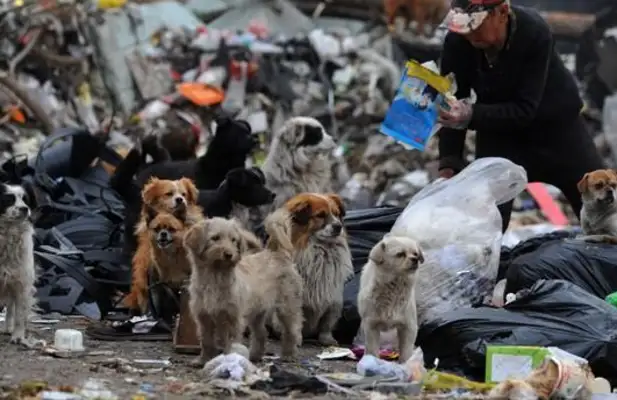
Those who rescue stray animals feed many stray dogs and cats in the dumps.
What will we say? This paper will provide an in-depth analysis of the social resonance between anger and warmth, reveal how existing laws and regulations are lagging behind, and demonstrate that they are a force that cannot be ignored, contributing to the accelerated improvement of Chinese animal welfare legislation and the construction of a more robust pet management system.
Anger and warmth: a spontaneous social relief operation
The cries of the dog, like the alarm of tearing the night sky, prompted public moral trials and warm relief. On the Internet, the condemnation of the deserters has been on the rise, and the pain in the eyes of the dog has gone beyond words. This sentiment spread rapidly from the line to the bottom, bringing together a powerful social force. The enthusiastic online friends fought for seconds to call surveillance and produce leaflets, only to find the helpless puppy as soon as possible. Volunteers organize their own night patrols without leaving any corner.
The Alliance responded quickly by setting up a special aid fund for dogs, which received a first-day contribution of 43,000 yuan, which will be used for the search, medical treatment and subsequent placement of dogs. Even more impressive, as of 10 July, 37 families had voluntarily applied for the adoption of the puppy, of whom there were many caring people from outside the country. This rapid shift from anger to action clearly demonstrates that the public's “detachment” is not an impulse, but a deep recognition of the dignity of life. It is evidence of the strong cohesion of the power of public emotion, rather than a short period of emotion. This spontaneous and sustained action is a vivid manifestation of the awakening and progress of the conscience of society, which in the most direct way has brought to the fore the harshest moral trials of those who ignore life.
However, this warmth has relentlessly ripped the “policy gap” of the existing pet management system. According to article 32 of the Lanzhou City Dog Regulation, the penalty for abandoning a dog is only a fine of $500 to $2,000. At the national level, however, article 30 of our Animal Disease Prevention Act provides only that “units and individuals shall not abandon any sick or dead animal at will”, and there is no clear legal sanction for the abandonment of healthy pets. Both the legal blogger “Justice Eye Watch” and the lawyer Yang Fan of the Gansheng District Attorney's Office stated that it would be difficult for the abandoned person to be held criminally responsible, even less guilty of endangering public safety by dangerous means, unless it could be proved that abandonment resulted in serious consequences, such as the wounding of a dog or the spread of the disease. This legal lag and ambiguity undoubtedly provides an “grey zone” for irresponsible pet owners to evade responsibility.
Professor Zhang, a psychologist, analyses the animal behavioral aspects of the dependency of dogs on their masters, and may cause post-traumatic stress disorder after abandonment, in the form of food denial, self-harm or attacks on human beings. More worryingly, psychological studies have shown that 68 per cent of the population of customary abandonment of pets have emotional apathy, and that this pattern of behaviour may extend to interpersonal relationships, causing wider social harm.
The data from the Small Animal Protection Centre in Lanzhou are even more alarming: In the first half of 2025, the Centre received a total of 1,273 abandoned pet dogs, an increase of 37 per cent over the same period last year, of which 62 per cent were dogs. Director Liu revealed that many owners chose to abandon them because of moving, pregnancy or economic pressure, but that the survival of domestic dogs in the field was less than 10 per cent. Of the stray dogs admitted in 2024, 43 per cent suffered from skin diseases, 28 per cent suffered from malnutrition and 15 per cent suffered from accidents or abuse. Abandonment not only puts innocent lives at risk, but also leads to an exponential increase in the number of stray dogs — a study by the University of Lanzhou Institute of the Environment shows that every stray can breed two to three cubs a year. At present, the Centre is overloaded and requires 12 tons of dog food per month, at a cost of up to $80,000. This shows that abandonment is by no means a simple individual act, and that it is putting enormous and unbearable pressure on urban public health and management resources.