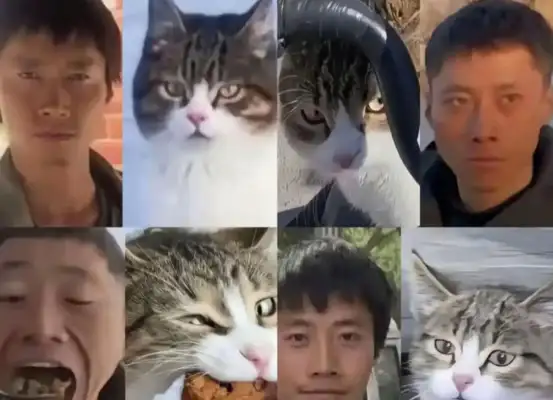
Zhao Soo's pet cat Goku died in Xinjiang. The death of the Red Cat, who had accompanied its owners across the sea of snow, with millions of fans, was far more than an ordinary pet event and became a prism in observing contemporary social value systems. From the initial story of a car accident, to the intoxication cloud, to what was ultimately characterized as a miseating, every turn of events was asking, "How can we protect the bottom line of civilization when the life and flow economy of a cat are intertwined, public opinion and the lack of law? "
I. From stray cats to the “healing top flow”: emotional alienation in the age of flow
In the cold winter of 2024, Zhao Zhao Zhao occasionally met a stray cat who had actively drilled into a tent to warm himself while riding in Xinjiang Canas. This fateful encounter has not only changed the fate of cats, but has also raised Zhao's number of riding videos from thousands to millions. In the lens, Goku will hold the rolling wrench, catch scorpions in the desert, guard tents at night, and these spiritual interactions are referred to by netizens as “the healing light of the highways”.
This phenomenon reflects the socio-psychological aspects of the post-epidemic era: when the pressure of reality increases, the desire for “unconditional company” is magnified in virtual space. The red essence of the Goku is an emotional reward — both as a partner on Zhao's ride and as an “electronic pet” for millions of netizens. Social media algorithms capture this demand with precision, packaging one cat's story into a “poetry and faraway” symbol, and sending it to the city's eager people.
However, gifts from flows are often accompanied by shackles. When the Goku becomes central to the competitiveness of accounts, its state of existence is no longer pure. The decision of Zhao Zhao to refuse the sterilization of cats was controversial, with supporters arguing that it was a respect for life choices, while opponents pointed to the risk of outdoor sterilization. This contradiction reveals the plight of the Internet red pets: They are “content products” of both the beloved family members and the flow economy. When commercial values conflict with animal welfare, trade-offs test the ethical bottom line of the master.
II. THE DEATH CURRENT AND PUBLIC SOCIETY CRACK: THE TRUTH TRULE TRULES
On 15 April 2025, the death of the Goku took place beyond everyone's expectations. The “car accident” initially reported in the media was denied by Zhao Sho, and the results of the examination published were that the cat had a good bone but his nose and mouth were bleeding, that unincorporated tubes were found in the stomach, and that the GPS locator was “immediately moved” for 20 minutes, and that the tractor button was removed. These unusual clues ignited the passion of the network members' detectives, some compared the nearby motorists' journey, others analyzed the source of the poison, and even a web-mobilization of the reward for truth.
Behind this popular event of reasoning is the mechanism for deconstructing the truth of the age of algorithms. The “information cocoon” effect of social media allows users to see only information that meets their own expectations, while algorithms, through interactive data such as praises, reviews, etc., push emotional content to more people. When the “polling conspiracy theory” was combined with the narrative of “good and malicious destruction”, rational discussion was quickly replaced by anger, and some netizens even resorted to cyber-violence against innocent bloggers.
Even more alarming is the “blow black production” shadow revealed during the incident. Netizen accounts suggest that there is a grey industrial chain of “rewards for net-killing red pets”, pointing directly to commercial competition as a possible motive for the death of the Goku. This deformed ecology reveals the dark side of the flow economy: When the commercial value of pets exceeds their own lives, they become tradable “commodities” or even victims of malicious competition.
III. Legal gaps and moral dilemmas: the governance of civil society
The most profound revelation of the Goku events is that it exposes the lag in our animal protection laws. At present, pets are still legally regarded as “property” and if it is proved that the Goku has been poisoned, the perpetrator may be sentenced only for the “intentional destruction of property” offence, usually for a term not exceeding three years. This legal orientation is deeply disconnected from public sentiment — when millions of netizens consider the Goku as family, the law equates it with ordinary property, and this fragmentation exacerbates public dissatisfaction with the justice system.
At the same time, drug sales on electric power platforms further sting social nerves. Not only is there an open sale of anti-coagulant rat drugs, but there is also a gift of a “guideline for poisoning”, a blatant violation that highlights regulatory gaps. Similar tragedies may be repeated without strengthening source governance.
The deeper dilemma lies in the ambiguity of moral judgement. When netizens are debating the “semi-destination” approach, the substance is looking at the boundaries of responsibility in modern society: does the owner have the right to expose the pet to outdoor risks? Should public concern for animal welfare go beyond species boundaries? There are no standard answers to these questions, but they reflect a clash of values in civil society.
IV. TRANSFER FROM TRANSFER TO RELIGIOUS RETURN: Public dialogue in the algorithmic era
On 9 May 2025, Zhao Soo suddenly declared the death of the Goku “basically determined to be the miseating of small rodents” and deleted parts of the video, which led to the incident in Lusenmen. This reverse reminds us once again that in the dissemination of algorithm-led information, truth often flows. Emotional public opinion is easily manipulated, and the voice of reason takes time to sink.
It is certain that events have contributed to progress on social issues. The voices of public figures, such as actor Zhu Yanmans, have brought events from the pet ring to the mainstream; the appeal by netizens for legislation to protect animals has led to increased attention to the improvement of the law; and the power of public opinion has been reflected in the management of drug sales on electric power platforms. This shows that when public discourse transcends individual emotions, it can be a driving force for social progress.
Conclusion: Protecting the dignity of life in the vortex of flow
The death of the Goku is a tragedy, but it is also a mirror reflecting the multiple dilemmas of our time: the alienation of life by the flow economy, the deconstruction of the truth by algorithms, the neglect of animal rights by the legal system, and the excessive involvement of public opinion in private life. The solution to these problems requires a wide range of efforts: legislators should speed up the legislative process of animal protection, the platform should optimize the mechanisms for recommending algorithms, the public should develop rational thinking, and content creators should be more ethical and avoid life-tooling.
In this time when everything can be “netred”, we need to rethink: When the death of a cat triggers the resonance of millions, is it the progress of civilization or the alienation of emotions? Perhaps the answer lies in how we treat life itself — whether it be a stray cat or a human being — every life deserves respect, not because of its flow value, but because its very existence is meaningful. As Zhao Soo said in the incident: “The Goku taught me the equality and dignity of life.” May this wave allow us to stop and listen to the voices of life on our way to the flow.