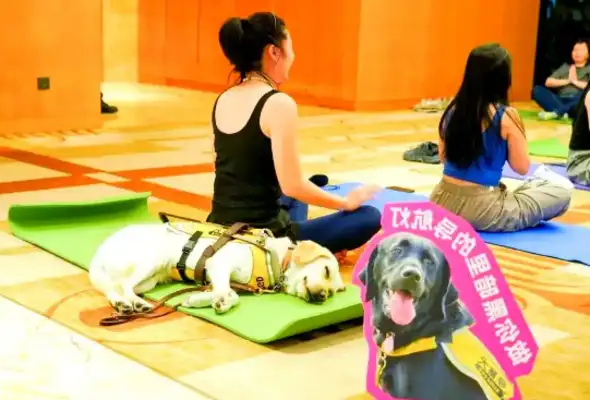
How can guide dogs gradually integrate into urban life? This topic has attracted widespread attention in the recent past. Zheng Ziyong, a member of the Guangzhou Municipal Council, presented a proposal at two meetings in the city of Guangzhou in 2025 “On improving the training system for guide dogs”, which has received positive responses from the relevant departments and groups, which support and encourage public places to provide practical training facilities for guide dogs in training periods. However, initiatives alone are not enough to address this problem. Before deciding whether to allow training blind dogs to enter public places, there is a need for consensus among all sectors of society on a range of issues, including why guided dogs need to be integrated into public scenes, how to ensure that they do not affect others, and how to identify specific access recognition mechanisms.
Some persons with visual impairment point out that the training of guide dogs not only addresses integration in service, but also the resistance of current societal attitudes. For example, the defecation of guide dogs in public places has given rise to much controversy. However, these are not really admission issues, but technical challenges that can be addressed through technical means such as training and the use of defecation bags.
It was further explained by a professional that one of the challenges for the guide dog industry is the problem of collage between the public and guide dog. Since guide dogs are sudden intrusions into public view and lack pre-eminence and understanding, there is a need for gradual adaptation and integration in the actual scene. This process is the key to addressing the problem of unadaptedness arising from ignorance.
In guide dog schools, while training can be simulated, these are no complete substitute for the real social scene. Especially in complex environments such as public transport, the need for guide dogs to learn how to integrate users into society undoubtedly increases the difficulty and importance of alignment. Therefore, a guide dog for the training period is a process for addressing these challenges and challenges.
> Cultivation process and standards for guide dogs
In addressing this issue, we have to focus on the development of guide dogs. The Headmaster of the Guangzhou School of Blind Dogs and the Headmaster of Blind Dogs, Li Xian, stated that the development of guided dogs has been linked to the breeding of selected species, the management of breeding, training assessment and back-to-back training, among other things, without disturbing the environment as an indispensable goal.
It is understood that national standards also specify strict criteria for guiding dogs in the selection of seeds, including the requirement that dogs have a full blood spectrum, clear three-generation sources, non-aggressive and genetic defects, and the screening of well-stable pups for family foster care for targeted training. In doing so, professional bodies regularly conduct assessments of larvae, covering training in their sensitivity to the outside world, enhancement of their ability to resist temptation and interference, as well as multiple assessments of stability, non-biting objects, excretion and outdoor behaviour norms.
> Training guide dog identification
When the stability of guide dogs is widely recognized, we further explore their identification. In the past, although the law allows guide dogs to enter public places, persons with visual impairments have found that in subways, for example, they often have to explain to others that “guide dogs are guide dogs” because of inconsistencies between guide dogs' documents and subway requirements. The frequency and difficulty of this interpretation often depend on the attitude of the staff, but the more critical problem is the lack of a unified guide dog identification mechanism.
To address this problem, in 2019, the guide dog base worked with various partners to share information on the guide dog for service in Guangzhou, thus improving the identification of the guide dog. In 2022, Guangzhou issued an opinion on how to verify access to public places with guide dogs, specifying the requirements for service guide dogs such as documentation, work clothes, blind saddles and towed ropes, thus effectively addressing the problem of identification.
Principal Li further stated that, even during training periods for professional development, guide dogs did not interfere with the environment.
> Adaptation and cooperation in public settings
Under the professional training chain, blind dogs entering the training cycle, even when accompanied by trainers, ensure that they do not interfere with the environment. However, they need time to become familiar with the environment. Therefore, after the period of foster care, guide dogs will enter the skills training and co-training phase, which will include learning skills such as transportation.
Headmaster Li has revealed that some of the regions that are leading in the development of guide dogs share information on guide dogs and receive hands-on training from trainers. Previously, a bus in Guangzhou had been working with the Guangzhou School for Guide Blind Dogs to facilitate public transport during training.
However, one of the major challenges now is: who will provide endorsements for blind dogs during training? Currently, more than 100 bus lines under the banner of a bus in Guangzhou continue to support the training of blind dogs during the training period. This model of cooperation has been validated in practice and demonstrated its viability.
01
A vision for future development and cooperation
In the future, local guidelines will be promoted based on successful experiences. Principal Li also indicated that the Guangzhou School of Blind Dogs has now established a complete and rigorous training system that responds to the recommendations of the Disabled Persons Union. She looked forward to closer cooperation with the Disabled Federation and the management of public sector operators in developing support guidelines and providing stronger endorsements for the practical training of blind dogs during training periods with professional advice.
“Currently, the suitability of trained blind dogs for practical training in public transport settings can be tested in practice.” An expert in industry has indicated. However, improving the stability of guide dogs and exploring the need for barrier-free construction through training in science alone are clearly insufficient to address the actual social inclusion.
In its response to the proposal, the Guangzhou Disability Federation also stated that current legislation and regulations lack clear policy guarantees for the activities of blind dogs during training in public places, which in part limits their access to practical training in public places. It is also hoped that the Guangzhou guide dog school will have clear access to the evaluation criteria for practical training in public places and related training systems to provide more targeted support.