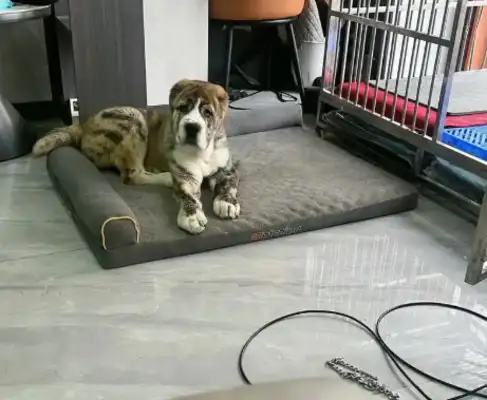
The owner of the pet, who had been introduced by a friend, asked the owner of the self-declared animal doctor to sterilize the noble pet dog who died unexpectedly and who was not actually qualified to practice medicine, to bring him to court. In recent days, journalists have been informed of the case by the Shunyi court, which ruled that the defendant was 70 per cent responsible and the dog owner 30 per cent responsible for his fault.
A couple of Lee raised a Central Asian wolfhound. Through a friend, a couple of Li had met with a doctor who claimed to be a doctor at an animal hospital and said that he could go to the house and perform sterilization for a pet dog. One couple paid a thousand dollars for surgery, and Tanya was sterilized at home for pet dogs. After the operation, the dog died as a result of a serious adverse reaction. One of Tan ' s admissions of medical negligence was that the improper operation led to the death of the dog and that the costs of the operation were refunded to Mr and Mrs Li.
Later, Mr. and Mrs. Li learned that Mr. Tani had no medical qualifications and that he was practising medicine illegally. A verbal promise from Tan would compensate for the price of the pet dog market and for the cremation of the pet dog at the request of a couple of Lee, and would then refuse to perform any liability. Mr. and Mrs. Lee brought the court to claim compensation for the damage to property caused by the death of the pet, loss of rearing expenses, and moral damage relief totalling $130,000. One argued that the pet dog died five hours after the operation, not on the spot, and that the operation was taking place at a time of high temperature differentials, and that the cause of death could be inclement or caused by other external forces and did not agree to compensation.
The Court found that, although it was probable that the death of the defendant ' s alleged pet dog had been caused by post-operative temperature or other external force, it did not submit sufficient evidence to that effect. The court found that the defendant, one of the defendants, had been held liable for the consequences of his death as a result of the operation.
However, the plaintiff, Mr. and Mrs. Li, as persons with full civil capacity and with relevant rearing experience, should have been aware of the risk of sterilisation of dogs, but it was equally wrong for them to perform the operation in their own homes without choosing a professional body or a professional, but by an accused who did not have the relevant qualifications. At its discretion, the court found that the defendant had a 70 per cent liability and that the plaintiff, Mr. and Mrs. Li, had a 30 per cent liability for the damages.
The court found that the evidence submitted by the plaintiffs was not sufficient to prove that the dog had been cremated and that the dog could not be valued, and that the court had taken all the factors into account and, at its discretion, set the market value of the dog at $50,000. In addition, the Court determined, at its discretion, that the cost of moral damage was $1,000. In the end, the defendant, Mr. and Mrs. Lee, were awarded a sum of $22,000 in compensation.
Judge Li Peng of the Lee Su court of the Shun Yi court reminded the owner of the pet that he should choose to operate from a compliance institution with the Animal Clinical Permit and a physician with a veterinary medical certificate, and avoid entrusting an operation to an unqualified person. There are medical risks such as anaesthesia, infection, etc., in the case of pet surgery such as sterilization, and the owner of the pet is required to inform the institution in writing about the risks and the post-operative care requirements. In addition, care is taken in the purchase of valuable pets to preserve proof of origin, trade certificates, payment records, etc., which is key to proving the market value of pets.