On 6 August, in an alternative pet store, the creamed iguana in the eco-cylinder was tanned on a mimic rock, and in a glass box on the other side, a fox was scouting. This is a scene that happens in pet stores today. From the palace guard to the corn snake, from the parrots to the piglets, these once small “other pets” are becoming new options for young people to take care of by virtue of their unique personality and low maintenance characteristics. The 2025 White Paper on the Chinese pet industry (Consumer's Report) shows that in 2024, the number of people raising “other pets” continued to rise; data show that some 1.770 million people are raising “other pets” and that the market is close to RMB 10 billion.
Young people tend to favour favour favouritism, both because of the need for low-burden company and personal socialization, and because of the hidden risk of abandonment in the context of new and different mentalities. In response, on 7 August, Dahai journalists interviewed Wang Yun Fei, Associate Professor at the Faculty of Social and Political Sciences of Anhui University, and the Director of Henan Zed Zhisai Law Office for the construction of a law firm, which reminds him of the need to maintain responsibility for life and avoid ecological damage to pet breeding, and pointed to the existence of multiple legal red lines between pet trade and breeding and the need to protect against risks.
Birds, reptiles, young consumers taking the lead
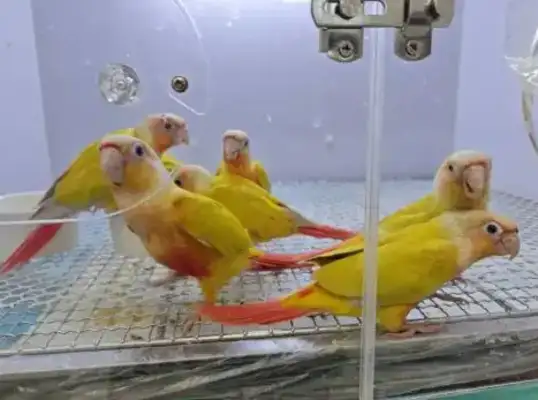
On August 6th, Da Ning journalists came to a pet shop in the Hoi-hai region of the city and saw that the owner of the shop, Mr. Mi, was busy introducing customers to the habits and characteristics of different kinds of parrots. “Young people are now more willing to pay for personalization, like these `net red properties', which can be sold several times a day during these days.” He told reporters that the most popular exotic birds in the store are parrots and pearl birds, “On the one hand, they can take a pearl bird at a more pro-people price, and on the other hand, birds are more interactive in petries”.
A parrot in a pet store.
In addition to birds, Mr. Mi described reptiles, such as lizards, frogs and snakes, as the main pets being sold. “... The price of such reptiles is concentrated in the range of $100-800, and the entrance palace is around $100, with corn snakes, high white snakes, etc. being slightly more expensive.” Mr. Mi told the journalists that “the audience for this kind of pet is relatively narrow, mainly by a group of exotic consumers, like a man who bought a lion iguana yesterday, saying that he wanted to find the feeling of a dragon tamer”.
The 2025 White Paper on the Chinese pet industry (Consumer's Report) shows that in 2024, the number of people raising “other pets” continued to rise; data show that some 1.770 million people are raising “other pets” and that the market is close to RMB 10 billion.
The heat of the exotic economy also poses new challenges for the pet health industry. A pet hospital worker told reporters that, in the past, only cats and dogs had to be treated, “The present pets are increasingly rare and strange, with birds, turtles and snakes, and the technical threshold for treating such pets is relatively high and presents many challenges for our work.”
Why would a young man like a pet? Low-burden company and personal social needs are key.
"When I'm in a hurry, I look at my frogs and calm down." “I'm a “stable” frog, which costs tens of dollars a month, and it's not annoying that he sits there most of the time, and you have to feed it.”
Frogs raised by Mr. Zhang.
Social identity is also an important reason why young people choose to be a pet. In a pet shop in the mountains of Hofer City, journalists saw two female college students who came to buy piglets: “We both like little animals, and now we rent houses outside, cats and dogs are not easy to raise, and little piglets and hamsters are our preferred pets.” Two students told journalists that raising pets would enrich their friends' circles and would have more topics with their peers. Journalists have noted that under the subject of #intribution # in the Little Red Book, young people have developed a unique sub-cultural layer by sharing their day-to-day rearing experiences.
Specialists read: The pandemic is marked by new attitudes and needs to be wary of the risk of abandonment after fresh feelings have faded
The heat of the exotic market has drawn the attention of the online community, which is seen as a new option for young people in the times to seek company, as well as as the idea that pet breeding is merely a temporary rise and simply a quest for freshness. In response, on 7 August, Wang Yun Fei, Associate Professor at the Faculty of Social and Political Sciences of Anhui University, argued that favouritism was favoured by young people and required a comprehensive analysis of the nature and social mentality of pet breeding.
In terms of core needs, the nature of pets is often associated with emotional needs - - Whether it is an emotional release driven by a sense of loneliness or the achievement of a symbolic emotional replacement through a pet, it requires a certain degree of interaction and “intelligence” to develop effective communication. However, the exotic epidemic is more marked by the emergence of young people.
“Spoken like lizards, snakes, with their own weak interaction, limited IQ, and even a somewhat gruesome image, may give people a sense of distance, but it is because of their `smuggling' that they become vehicles for young people to express their personality.” Wang Yun Fei mentioned that the preference for innovation is often of a phased nature and that “the lack of in-depth interaction and community of lovers, when fresh feelings fade, many people lose interest and even abandon them at will”.
Wang Yun Fei stressed in particular the importance of “responsibility”: “The heart of pets is responsibility for life. Off-farming appears to be `low-cost' and requires long-term inputs — for example, Angolan rabbits can accumulate up to tens of thousands of yuan over the years and have to deal with problems such as loss of hair and discharge. The ultimate abandonment of abdomen as a result of a sudden rise in the purchase of abdomen may not only be a disregard for life, but may also lead to the diversion to the natural environment, the disruption of ecological balance and even the risk of species invasion.”
Counsel suggests that there are multiple legal red lines for petling and trading, and that there are strict rules to protect against risks.
Major journalists have noted that consumer disputes about petation are common as the demand for it grows and that the consequences of consumer abandonment are sometimes dire. In response, on 7 August, the director of the law firm Henan Zedhiya warned the construction attorney that the transpophile and trade needed to be alert to multiple legal risks and that consumers and businesses needed to comply strictly with the laws and regulations.
In the case of consumers, the unauthorized purchase or raising of livestock may be linked to the “crimes against precious, endangered wildlife” in the Criminal Code of the People's Republic of China, if it is a national priority to protect wildlife or is included in an appendix to the Convention on International Trade in Endangered Species of Wild Fauna and Flora. It may also constitute a “crime of illegal introduction, release or abandonment of invasive alien species” if the object is introduced from abroad without quarantine or is abandoned at will after purchase. In addition, in the event of injury caused by the abandonment of a different pet, the original breeder or manager is liable for the infringement of rights under the Civil Code of the People ' s Republic of China.
For businesses, the sale of valuable, endangered wildlife and its products, which are primarily protected by the State, is strictly prohibited. At the transport stage, in accordance with the Postal Law of the People ' s Republic of China and its implementing regulations, the delivery of live animals is prohibited by ordinary express delivery and is subject to administrative penalties if they are transported by scientific packaging and legal means through professional pet shipping agencies. At the same time, businesses are required to disclose to consumers, in good faith, information about different varieties, health conditions, etc., without false publicity.
“Absorbing must not be fresh, but must first identify species properties, legal boundaries, and be prepared for long-term responsibility, avoiding contact with legal red lines or ecological hazards. "Study emphasis."