The pet economy's market has entered a period of 2.0, and while traditional pet food companies are still fighting for market shares, a group of “new players” who don't play the usual game have quietly reshaped the bottom logic of the industry — they re-engineered services with flow channels, redefined services with smart hardware, and created demand with data insight.
A silent revolution is taking place in the pet economy. While traditional pet food brands are still in the middle of the main food market, new “players” are pouring into the race lanes, and a group of cross-borderers from the Internet and technology are redefining the industry with a whole new business logic.
They are no longer limited to competition in the product itself, but rather build closer digital ties between people and love by building intelligent ecology, reshaping consumption landscapes and innovative service models.
Internet giants such as Ali Baba, Kyoto, and the United States are using their powerful platforms and logistics capabilities to re-construct the “human field” of pet consumption; and companies like rice, beauty, and electricity come across the border with the logic of “fall-down” with smart hardware, generating a billion-scale smart-care market.
It's the most sensitive smell of capital, from the rapid rise of new brands of red dogs and sanctuaries to the development and supply chain of head firms.
We will look at how Internet giants and cross-border players can change industrial ecology. What new opportunities have the DTC model and digital marketing brought? In the end, who will win this multi-angle game? Where is the next growth point in the industry?
Internet giants' “de-dimensional strikes”: re-constructing man's stores
At a time when competition in the traditional pet food industry is getting hotter, outsiders — the Internet giants and domestic electric companies — are using capital and technology as their weapons, opening new battlefields and reshaping the business model and competitive boundaries of the industry.
On the one hand, the Internet giant enters the pet track, re-energizing the industry with increased stock competition; on the other hand, its “fall-down” is reshaping the patterns of people, goods and fields consuming pets.
The most typical of these are Internet platforms and access to local life giants. Al-Baba and the United States Corps, among others, successively set up a web-based pet service that extends the tentacles to areas such as pet medicine, electricians and new retail sales. The entry of Internet giants is not simply to move pet products online, but to overhaul traditional pet consumption chains using their powerful platform ecology, logistics capabilities and data advantages.
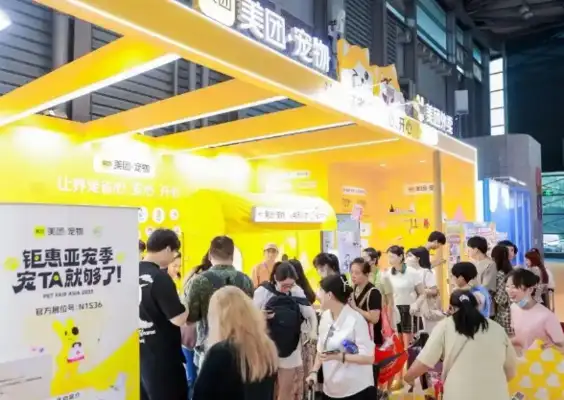
For example, according to the United States Web of Mission Officials, starting with the exploration of the pet industry in 2018, the United States has been taking root for more than seven years in its pet service, exploring digital transformation paths with tens of thousands of physical pet stores to accelerate supply and demand matching efficiency. At present, the arrival point for the Mission is “local life”, with more than 25,000 new-line pet stores and service providers on the Mission platform in 2023, and more than 60 per cent increase in the number of company purchase orders for pet stores nationwide.
The Mission also took advantage of its immediate distribution by introducing a combination of “pets + take-out” services, which allow consumers to purchase pets food, supplies, etc. at the time of ordering, to meet the “one stop” demand for pets. This led to an explosive increase in the number of related orders. According to 36 krypton reports, after 95, young pets have become the main consumers of online pets.
Ali Baba, too, had set up a flagship channel for pets, while a newer station explored the storage of pets for distribution. As the largest online trading platform, Alibaba plays the role of an ecological builder. In 2021, Skycat upgraded the pet sector to an independent business, demonstrating its strategic importance. Not only did Alibaba provide the broadest distribution channel for branders (28.6 billion yuan by 2024), but C2M models, using consumption data to guide product innovation and precision marketing in upstream brands, greatly improved the efficiency of matching supply and demand.
The core advantage of Kyoto is “self-employment + logistics”, which enters the service experience track. It not only opened up pet life in 2017, but also made use of its cold chain and instant distribution network, which cover the entire country, to solve the problem of distribution of highly time-bound food for pets and prescription drugs.
Kyodong also relies on the Kyoto Health and Kyoto Supermarket dual platform to power pet electrician. According to the White Paper on the Health Consumption of Chinese Pets, released by the King's Health, online sales of sub-groups such as pet medical devices and prescription foods have increased dramatically, with the average annual medical expenditure of the pet owner reaching more than $1,200. The cooperation between the Kyoto Health and Petty Institute extends its services beyond the sale of goods to professional medical counselling.
During the period of Kyoto 618 in 2023, the number of transactions of Kyoto pets had increased by 45 per cent each year, and the number of online pet requests exceeded 58,000, demonstrating the enormous potential of the “Internet + pet care” model.
In April 2025, the Kyoto Group ' s flagship insurance broker platform, Kyoto Dongbao, joined forces to develop a new New Kyoto-owned pet health insurance model covering the three main areas of pet medicine, medicine and health care. Through the Kyoto APP, users search for “Peat risk”, which can be purchased by choosing “Kyoto Pao Petty Medical Insurance (Darling)”. The product came online on 23 April and as at 27 April, the Shanghai area had exceeded 1,000 units per unit.
It is foreseen that the penetration of Internet giants into pets through online traffic, logistics networks and digital capabilities will continue to generate new business patterns in the industry.