Today, in addition to traditional pets such as cats and dogs, a growing number of pet lovers are playing with “other pets”, which usually refer to non-traditional, non-domestic animals that we are raising as pets, such as snakes, lizards, spiders, etc., which cover insects, fish, amphibians, reptiles, birds and animals, and have reaped a great deal of conundrums in the form of “cool” “others”. According to China's White Paper on the Petty Industry 2025 (Consumer Report), more than 17 million people are raising pets, and is it free to do so? Is there anything you like to keep? What are the security risks?
On a social platform in the country, there are a wide range of bloggers who sell “offsides”, share pet planning and “playing” secrets.
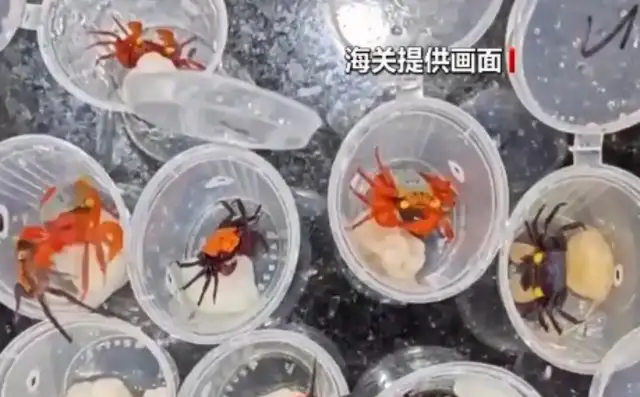
In addition to the purchase of “divorce” through a web platform, some lovers ventured to bring foreign organisms into the country as “divorce” violations. Just last month, a passenger at the northern port of Pearl Sea intentionally circumvented baggage checks. As a result, customs staff found 170 different, colourful, small live crabs from their backpacks. The live crabs were identified as vampire crabs and alien species. Vampire crabs, also known as demon crabs, are known for their bright yellow eyes and unique colours, and are small crabs originating in India, South-East Asia and elsewhere, with a length of no more than 3 cm.
In March of this year, a passenger at the Fukuda port hid 15 living reptiles and illegally brought them into the country.
Liu Qianhua, the Imperial Customs Officer attached to Shenzhen Customs: The passenger was dressed in swollen clothes, stiff body and nervous, and we stopped and checked him. As a result, transparent plastic bags were found on both sides of his waist and back, containing 10 endangered chameleons, 4 alien umbrella iguanas and 1 egg iguana species.
At present, the case has been referred to the Department for further processing. In accordance with the relevant provisions of our country, in addition to the legal possession of import and export certificates for wild flora and fauna, it is prohibited to carry endangered species and their products out of the country, and criminal liability is established in accordance with the law for serious offences.
As the heat of domestic “otherty” continues to rise, some illegal traders seek to buy and sell from abroad animals such as reptiles, insects and other animals for profit, including species of endangered species, which could cause considerable damage not only to the primary population and habitat of the species, but also to the natural ecology of the country. In addition to animals, some alien plants may pose a potential threat to domestic ecological security.
In recent days, at Chongqingjiang North Airport, some fresh citrus blades were packed in the luggage of an incoming passenger. They said they were going to bring it home for cooking. However, the “first killer of the citrus industry” — citrus yolksis — was detected on these tiny pieces of citrus leaf.
The Southwestern University Institute of Oranges, Director of the University of the South-West: citrus yogurt is one of the most difficult, dangerous and threatening diseases in citrus production, causing hundreds of billions of dollars in economic losses to the global citrus industry every year, and, in the name of citrus cancer, the citrus fruit tree loses its economic value within three to five years.
In addition to this, the fruits, cactus and so on, which are common to us, may be at risk if they are alien species. In recent days, customs officers have discovered five cactus balls in an incoming mail parcel at the Fort Guiyang. These are the three types of cactus, the planet, Black Pyramid, and Raeyun.
Zhang Zhang Zhang Zhen, Chief of the Sanctuary and Food Inspection and Quarantine Department of Guiyang Customs These three cactus are not naturally distributed in our country and belong to alien species. Such plants tend to have greater environmental adaptability and proliferation capacity. At present, cactus, pear cactus and single cactus are included in our secondary invasive alien species.
In addition, recently at ports of entry, such as Hangzhou and Aoshima, staff members have also found fruit such as pickles, cherries, bamboo and pineapple brought home from abroad from passengers' luggage. On these imported fruits, quarantine harmful organisms such as platinum, shields and flies are identified.
These harmful organisms, which are easily parasitic in fresh fruits and brought in, pose a potential safety risk to our agricultural production and ecological security.
Qingdao Airport Customs Officer Lee Soojie: The entry of fresh fruits requires authorization from the relevant administrative authorities of the country and a quarantine certificate issued by the official authorities of the exporting country or region before entry is certified by a quarantine. We remind a large number of passengers entering the country not to bring in any form of quarantine, such as fresh fruit, vegetables and seeds, and to ensure the safety and security of the common protectorate.