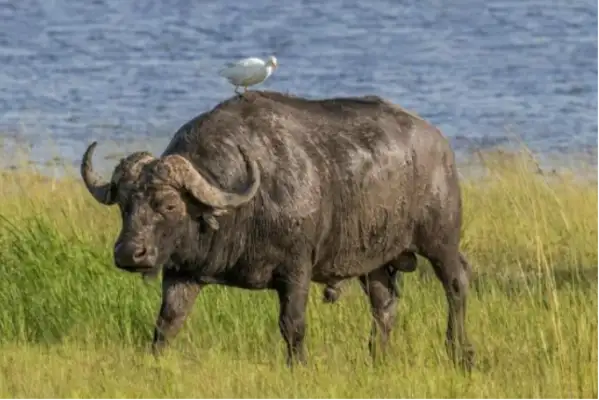
About a week ago, a wealthy American businessman hunted large wildlife in South Africa and was ambushed and attacked by African buffalo while tracking a buffalo. The 52-year-old hunter was seriously injured in the stomach and torso after he was capped by a buffalo and eventually died of his injuries.
Despite the misfortunes of this rich businessman, many netizens have chosen to stand by African buffaloes as self-defence.
The wealthy hunter was a regular customer of the hunting tourism company, who killed an antelope on the first day of his arrival at the large hunting grounds. This large hunting area he went to was called the "Hunter's Paradise" because it was so well suited to the pursuit of African buffaloes.
The African buffalo that the rich hunter would have hunted was the Cape Buffalo (English: Capebuffalo, academic name: Synceruscaffercaffer), the largest sub-species of African buffalo, with a male weight usually much heavier than that of a female, with a large male shoulder of about 1.5 metres tall, with a weight of close to 900 kg, close to that of a small car.
This African buffalo is also the deepest colour, almost black, and, because of its ferocity and its tendency to retaliate when threatened, to come back and then follow, attack or kill hunters, they are also known as the “Jungle Mafia”.
As one of the most dangerous animals in Africa and in the world, African buffaloes cause injury or even death to many hunters every year. In 2018, just in the same region where the rich in the United States died, while a hunter was about to load the newly hunted African buffalo in a truck, another buffalo suddenly washed out and killed the hunter with his horn.
The massive size, ferocity and rapid attacks have allowed African buffalo and African lions, elephants, leopards and black rhinoceros to be called the BigFivegame. They are the five most valuable large African prey in trophies.
Hunting Travel also warns its clients that even when shooting is accurate, when African buffalo rushes in, they can absorb large quantities of lead bombs, with the worst intentions in hunting. In 2022, when another hunter was hunting, an African buffalo ran over him despite the hunter ' s shooting, and the hunter was eventually stabbed by his horn and died instantly.
In fact, even lions are careful when hunting African buffalo. In a one-on-one confrontation, African buffaloes risk killing lions with horns on their heads. Usually, when hunting African buffalo, the lions work together in a team that separates them from the herd and joins forces in hunting.
The head of an African buffalo is characterized by two horns on its forehead, forming a strong bump, like a natural helmet or shield. Their two large horns are curved, their tails are sharp and their most powerful self-defence/attack weapon. Both females and males have horns on their heads, and usually males are bigger and bigger. However, the female horn did not form a bone shield at the base link.
African buffalo are herds of animals, often in groups. When threatened, they surround young, ageing or sick members, the strongest of the group at the outer circle, thus resisting potential predators such as lions and hyenas. Sometimes they even pursue predators themselves, thus successfully stopping predator attacks.
On the African buffalo hunting trip, hunters need to travel a long way to observe different bulls and to look around at traces and footprints to determine the location and behaviour of cattle or single buffalo. The price of hunting an African buffalo is about $10,000, and if it were a large bull in size, the price could exceed $50,000.
The hunting of large prey as food is an old habit and has evolved into a sporting and recreational activity in human society. This activity is common in some African countries, where the cost of large-scale hunting varies from several thousand dollars to hundreds of millions of dollars, depending on hunting sites, animals, etc.
At present, participants in this campaign are mainly rich white males. With expensive permits, the hunters would drive convertible hunting trucks to search for prey in the hunting areas. Once the target animal is found, the hunters follow it on foot, then shoot and finally show off their spoils.
Large hunters think they are doing “good deeds” because they hunt only a small proportion of the population and kill mostly older male animals or individuals suitable for elimination, helping to maintain the health of wildlife populations.
Moreover, they claim to have paid a great deal of money to provide local income and employment opportunities, and that local hunting revenues could be used for wildlife conservation.
However, the balance between hunting and protecting wildlife is also a problem. For these people, who enjoy hunting and share pictures of trophies, experts say that they are actually showing off the luxury they can sustain, thereby promoting personal wealth and social status.
Moreover, as a result of corruption and lack of regulation, much of the proceeds from many hunting activities are still in the pockets of small-income groups, such as private hunting tourism companies, rather than wild animals that really need protection.
Even more alarming is the fact that legal recreational hunting demeans the lives of preyed animals, which invisibly undermines wildlife protection.