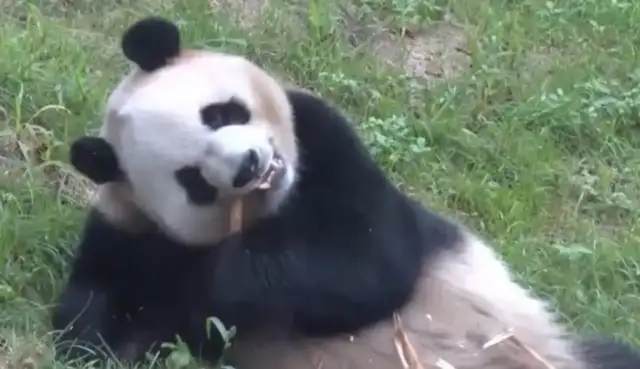
Recently, the Great Panda Palace of Harbin Island, Heilong River, was opened to the outside world, following an official meeting with citizens and tourists of the large panda "cheese" who had arrived from Chengdu.
A panda up north up in Ice City.
Official meeting with tourists
Cheese and Sesame are twin brothers, eight years old, at the age of the big panda. His brother's "cheese" is well-sized, has thick hair and has a moustache on his chin. The brother “sesame” is known for his “black sesame pellets” next to his nose, which are strong, smooth, full-headed, black-eyed, and makes it look very spiritual.
Chengdu's panda breeding research base, the Centre for Research and Reproduction in Tuejino, is very bright: because they are twins, this means that they both have a certain similar appearance, lifestyle and character. For example, they're both more lively, they like to climb trees, they like to bathe in water, they like to be clean.
In response to local problems in Harbin, the Sun Island Landscape has established a stable supply chain of bamboo by air and increased other food on a daily basis, in line with the formulation of the Chengdu base. At the same time, a team of professionals, including full-time breeders and veterinarians, has been set up at the Grand Panda Museum in Sun Island to take full responsibility for the day-to-day raising and health care of the panda.
Deputy Minister for the Operation of the Great Island Panda: We are closely associated with the veterinary team at the panda base to monitor the health of the panda in real time. If the panda is in an abnormal situation, we'll ask the base for support and assistance first.
Simulation of habitat environments
To keep the big panda up north comfortable.
In order to meet the needs of the large pandas, the large pandas of Sun Island were carefully designed locally.
Harbin is a temperate continental monsoon climate, and the Solar Island Panda Palace, in conjunction with the Harbin climate features, has developed the concept of “habitation recapturing” to simulate native habitat environments from a wide range of sources, such as temperature, humidity, wind, light, etc., thereby guaranteeing the health and comfort of the panda.
Zhao Tsao, a staff member of the Big Panda Museum of Sun Island: The most appropriate temperature is 7-20°C. It's natural for a panda to be cold, hot and wet, to be warm in winter, and to be warm in winter, we have made a whole system to keep it warm outside the outer wall. In the summer, if the temperature is high outside, it will return to the indoors, which are also areas at 20, 22 and 25 degrees.
Air circulation and ventilation are essential for large pandas, with the Solar Island Panda Palace setting up a full-air system for large pandas that fully guarantees ventilation and fresh wind cleanliness. On the light side, internal displays and cage areas simulate solar spectra, light intensity and moon light, based on the environmental characteristics of the large panda habitat, with the use of smart controllers to achieve a gradual loss of light, to avoid sharp and dark changes leading to panda stress and to ensure the suitability of winter light. Through these initiatives, a complete system of environmental regulation has been developed to create a comfortable living environment close to the original habitat in the cold climate of Harbin, which has been accepted by a team of experts from the State Forest and Grass Office.