On 21 August, Shanghai had a high temperature of 38°C and the heat in the twenty-seventh Asian pet exhibit (hereinafter referred to as the "Apploit" exhibit) remained undiminished. More than 310,000 square metres of exhibition space was added, and over 2,600 industry-wide exhibitors and businesses brought together in Shanghai with more than 20,000 brands, and some viewers came to the site with their beloved “black children”.
After 95 years of running a pet trading company in Beijing, Jilin Jr. Chen Long brought in a number of company-grown short-haired British cats, several of which were rare in cinnamon, cinnamon with white, and black kittens. "The choice of a cat is mainly about its hair, shape, face, ear distance and the degree of family..." Chen, while interacting with cats with cats, talks about the cat's secret. Two days after the opening, he had sold three cats for thousands of dollars.
Chen Long joined the pet industry a few years ago because he likes small animals and he owns cats and dogs. His company had a breeding base in Liaoning Mount, bringing in the cat species found abroad to breed for generations before achieving the desired results. In addition to the pet cat that brought the show, his shop sells the higher-priced game cat, “The price of the game cat is typically between $30,000 and $50,000; the top-class cat that can be ranked in the competition can be sold to more than $80,000”.
While raising cats, Chen Long’s company is developing and selling cat food. “Because we grow cats, we can’t keep buying other cats’ food, and unless the ingredients inside are clear, we can’t keep cats safe. We've developed our own cat food for the fungus, which promotes digestive absorption, and our cats have been eating this cat food since they were kids." In the past, Chen Lung opened up the market mainly by spoiling the circle of friends, fairs and, more recently, started to sell live, hoping that the business would go further.
One of the features of the APA is to make pet and pet providers temporary “sets” that not only facilitate the display of goods but also help businesses to reach new partners. In the last two days, Chen Long's “Technologies” is a pet supplies company from Zhejiang Heining, whose general manager, Qin, introduced the company's owner, who plays “Technology-enabled pet life” and specializes in developing and selling smart pets.
According to Qin, the company ' s founder was a designer, who used to do renovations to focus on high- and middle-end client groups, such as large layers and villas. A few years ago, he found that the number of foster families was increasing, and that traditional cages were unable to meet the needs of the pet owners, especially those of wood, which were prone to tide and stench during the rainy season. As pet lovers, the founders led the team to start new business.
"Eats like cats, dogs, birds, etc., have their own familiar ambient temperatures, so our pet cabins design the thermostats, and new wind systems that filter the smell and remove the hair from the pets. The pet cabin is equipped with a camera, and the owner of the pet can operate remotely through his mobile phone.” Qin told the press that the company was selling well and that it was showing up in the industry.
When it comes to market expectations, Qin is very optimistic: “In the pet industry, pet supplies are the third main track after pet food and pet medicine. I think the pet industry is an industry that can penetrate the economic cycle." He cited Japan as an example where the pet market had been growing for 30 years, despite 30 years of economic stagnation.
The confidence of practitioners stems from the fact that our pet market is growing rapidly.
According to China's White Paper on the pet industry 2025 (hereinafter referred to as the “Report”), which read the products of the big data platform for the pet industry, China's urban (dog and cat) consumer market grew by 7.5 per cent in 2024 to reach $30.2 billion. The report indicates that some pet owners are willing to invest more in food, medicine, supplies, services, etc. for pets.
The report also shows that the food market remained the main consumer market in 2024, with a market share of 52.8 per cent; followed by the health market, with a market share of 28.0 per cent. Among them, vaccines, medical examinations are relatively stable, and medicines, diagnostics and treatments have decreased slightly; the market share of supplies and services is low at 12.4 per cent and 6.8 per cent, respectively, but there is room for higher growth.
In addition to cats and dogs, Angolan rabbits, parrots, honey bags, leopards, crocodile turtles, etc. can also be seen at the Yappa exhibition, along with their respective pets. A shopkeeper who sells cheetahs, African bullfrogs, and non-putched guinea pigs, among others, tells reporters that the main “seller points” for such pets are scarce, highly appreciated and easy to raise, “while they are not as close to people as cats and dogs, the advantage is to feed well, and some of the pets do not matter even if the owner does not feed for a week”.
Reports indicate that in 2024, the number of people raising pets continued to rise. Of the pet species, turtles, snakes and ceremonials are the main breeders among the reptile species, accounting for 54.9 per cent, 51.6 per cent and 48.8 per cent, respectively. hamsters, Kinsy Bears and flower mice are the main breeders among rodent species, accounting for 42.1 per cent, 36.5 per cent and 21.1 per cent, respectively; parrots and pigeons are the main breeders among birds, accounting for 53.6 per cent and 32.7 per cent, respectively; seawater and cold water freshwater are the main breeders, accounting for 45.2 per cent and 43.7 per cent, respectively.
The main problems encountered during pet breeding are the low number of ambulatory hospitals, the uneven quality of pet commodities, the purchase of unhealthy pets, and the high cost of pets, which is more than 30 per cent. The second is the lack of awareness of how to address the problem of feeding, which is more than 20 per cent.
A small pet rabbit shop from Shanghai has brought beautiful, gentle rabbits, such as truffled rabbits, and Angolan rabbits, to this Asian pet show, and they suck. The shopkeeper told the press that the price of these rabbits ranged from $1,000 to $10,000, and that, as an emerging pet, many consumers were on-line “grass” and off-line payments, which could be bought to comb the rabbits, dress them up, and “walking” in small carts to form a small crowd. However, the follow-up costs for rabbits are high, with pets mainly preparing rabbit cages, beds, pots and various maintenance costs.
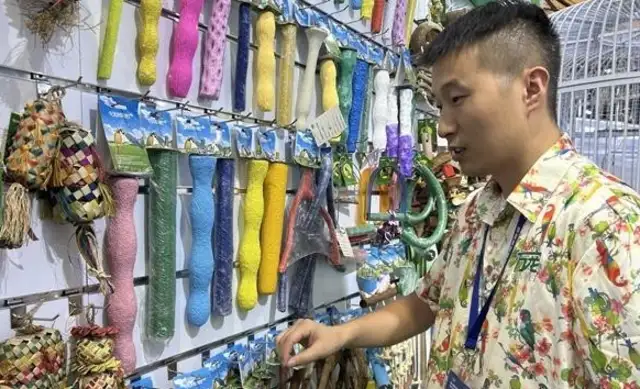
Ma Yoon, a salesman for a pet supply company in Henan, told journalists that in recent years the State policy on artificially growing parrots has gradually been liberalized, that sales of company bird supplies and pet parrots have been increasing, and that as salesmen he earns very well. He said, “We sell tens of millions of dollars a year, mainly from bird supplies, at lower unit prices, such as cages, bamboo toys, etc., and export 80 per cent.”
After 95, Chen Zheng, a young man, runs a pet company in Henanzhou, which sells a slidy small pet bag of honey at a price of 500 to 1800 on the basis of hair and product. In general, Chen Zhi is often shown live on the platform about such “pull children” as many do not know: “Honey bags are free of rabies, rabies, plagues, small and delicate, can be cared for like cats and dogs, and can live for more than 12 years in the case of a human rearing”.
Because of the love for pets and the interest in pet commerce, Chen Zhen changed from a senior pet “player” to a “full-time breeder” and moved completely into the pet industry two years ago to specialize in the breeding, marketing and after-sales services of honey bags. He observed that it was mainly young people who liked honey bags and that after 90, the main consumer was Bo and Bo.
In the pet market, Chen Zhen discovered that there was a phenomenon in the industry of making money in second place and in the short term. “A weekly cat, like a weekly dog, is a bad product for the merchants, who can only live for a few days after they get it. If you really do long-term business, you have to do a series of productive, sanitary, healthy, after-sale jobs, which are relatively not profitable.”
In Chen’s view, the pet industry will “expulsion bad money” in the future: “The old saying, ‘Tale bad farmers’, I think it would be appropriate in the pet market. If a pet is cheap, it means that it has a series of low costs and no after-sales service, which may lead to higher costs for the pet owner. Businesses need to provide better products and services to survive rather than attract customers at low prices.”